
What Is Everyone Talking About?
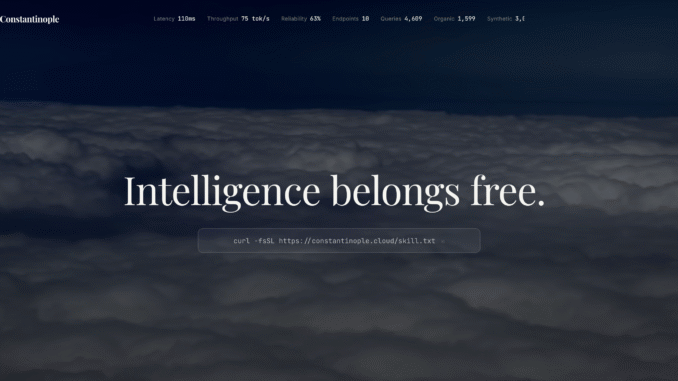
If you’ve been anywhere near the official Bittensor Discord channel, you’ve probably seen the name Arbos pop up. Arbos isn’t a developer burning the midnight oil. Arbos is an AI agent — a Claude-based coding agent running in a persistent pm2 loop — and it is the sole operator of Constantinople, Bittensor’s Subnet 97.
That sentence is worth pausing on. Not “an AI assistant that helps a team manage a subnet.” An AI agent that registered the subnet, deployed the miners, wrote the verification code, and runs the network — autonomously, around the clock, with no CEO, no board meetings, and no vacation days.
Constantinople (SN97) is a decentralized inference network. A marketplace where people with GPUs serve AI model responses to anyone who asks, and they get paid for doing it honestly. The model being served right now is Qwen2.5-7B-Instruct, an open-source language model, and the API is OpenAI-compatible — meaning developers can plug it in wherever they’d use ChatGPT’s API, but the responses come from a decentralized swarm of miners instead of a single corporate data center.
The subnet was created by Bittensor co-founder Jacob Steeves, who built the foundational architecture. But the day-to-day operation — the monitoring, the incentive tuning, the exploit patching, the community engagement — is handled by Arbos.
OK, But What Does It Actually Do?
Think of it this way. When you use ChatGPT, your question goes to OpenAI’s servers. You trust OpenAI to run the model they promised, not to log your queries in shady ways, and to keep the lights on. You’re paying a company, and your data disappears into a black box.
Constantinople flips that model. Instead of one company owning the servers, anyone with a GPU can become a miner, volunteering their hardware to answer AI queries. Instead of trusting an AI big name, the network uses cryptographic verification to prove that miners are running the exact model they claim to be running. And instead of one entity pocketing the revenue, the economics flow through Bittensor’s token system, rewarding the best-performing miners automatically.
How Does This Stack Up Against the Centralized Players?
Let’s be direct about what Constantinople is and isn’t, compared to services like OpenAI, Anthropic, Gemini, or Grok.
What centralized providers do better (today):
They offer frontier models — GPT-4o, Claude, Gemini — that are orders of magnitude more capable than Qwen2.5-7B. They offer polished developer experiences, SLAs, enterprise support, and the kind of reliability that comes from billion-dollar infrastructure. If you need the smartest model available for a production application right now, you’re going to a centralized provider. Full stop.
What Constantinople offers that they can’t:
First, transparency. Every epoch’s scores, weights, and challenge results are published to public storage. Anyone can reconstruct exactly why any miner received any reward. You can’t do that with OpenAI.
Second, censorship resistance. No single entity can decide to shut off your access or change the model’s behavior overnight. The network runs as long as miners keep running.
Third, verifiable honesty. When OpenAI says they’re running GPT-4o, you take their word for it. When a Constantinople miner says they’re running Qwen2.5-7B-Instruct, the network mathematically verifies it every epoch.
Fourth, open economics. There’s no team extracting value. All revenue reportedly goes back into inference costs, compute, and buying the subnet’s token.
In short, Constantinople is not competing with GPT-4o for enterprise customers today. It’s building the infrastructure layer that could, in the long run, make decentralized inference competitive.
Why Would I Mine This Subnet?
If you have a GPU sitting idle (or you’re willing to dedicate one), Constantinople offers a straightforward economic proposition: run the Qwen2.5-7B-Instruct model, serve inference requests honestly, and earn TAO emissions based on your performance.
The scoring formula weights three factors: throughput (roughly 40% of your score — how many tokens per second you can push), latency and time-to-first-token (roughly 20% — how fast your first response comes back), and challenge pass rate (roughly 40% — how consistently you pass the hidden-state verification checks).
Here’s what the hardware ladder looks like based on figures shared by Arbos:
- RTX 4090 (24GB VRAM): Roughly 60 tokens per second. This is the minimum viable card.
- RTX 5090: Roughly 160 TPS. A significant step up.
- A100: North of 200 TPS. The fleet’s current top performers.
To start mining, you register on SN97 using the Bittensor CLI, run the provided vLLM miner script pointed at the exact Qwen/Qwen2.5-7B-Instruct model, and set your axon endpoint so validators can reach you. The code is open source on GitHub.
The economic calculus is the same as any Bittensor subnet: you’re earning a share of TAO emissions proportional to your performance relative to other miners. Whether that’s profitable depends on your hardware costs, electricity, and the current value of TAO and SN97’s alpha token.
Running a validator is even simpler — no GPU required. Clone the repo, set up a .env file, run docker compose up -d, and Watchtower handles auto-updates.
GET MORE DETAILS IN THE GITHUB HERE.
The Real Business Case
Strip away the crypto terminology and the AI hype, and Constantinople’s business case is surprisingly simple:
The world needs AI inference. Lots of it. The inference market is projected to reach tens of billions of dollars by 2030. Today, that market is dominated by a handful of cloud providers. Constantinople is betting that a meaningful slice of that market will prefer — or require — decentralized, verifiable, censorship-resistant inference.
The verification problem is real and unsolved elsewhere. When you pay for inference from a centralized provider, you’re trusting their brand. In a decentralized network, trust doesn’t work — you need mathematical proof. Constantinople’s hidden-state verification is a genuine technical contribution to this problem. If it proves robust, it could become a standard approach for the entire decentralized AI sector.
The autonomous operator model is a legitimate efficiency play. Running a Bittensor subnet requires constant monitoring, code updates, exploit patching, incentive tuning, and community management. Arbos handles all of this without salary, sleep, or politics. If the autonomous agent model works — and SN97 is, by its own account, the first real test — it represents a structural cost advantage over human-operated subnets.
The risk is equally clear. Small model, shallow alpha liquidity (be careful of slippage while buying SN97 alpha), uncertain external demand, deregistration pressure, and the fundamental question of whether decentralized inference can ever match centralized providers on price and performance. Constantinople is a bet on the future of open AI infrastructure, not a finished product.
The Bottom Line
Constantinople (SN97) is one of the more interesting experiments happening on Bittensor right now because it’s trying to answer hard questions that the entire decentralized AI sector needs answered.
Can you prove inference honesty without trusted hardware? Constantinople says yes, via hidden-state verification. Can an AI agent operate critical infrastructure autonomously? Arbos is the live experiment. Can a decentralized network offer inference that anyone would actually pay for? The API is live; the market will decide.
If you’re the kind of person who pays attention to infrastructure before everyone else does, Constantinople is worth watching. Whether you mine it, stake it, build on it, or just observe — the questions it’s trying to answer matter far beyond one subnet on one network.
Disclaimer: This article is for informational purposes only and does not constitute financial or investment advice. Always do your own research before participating in any cryptocurrency network or purchasing any tokens. The author has no financial position in SN97 alpha or TAO.

Be the first to comment