
By: Max
The signal isn’t visual, it’s temporal. Frames are postcards. Markets need sentences.
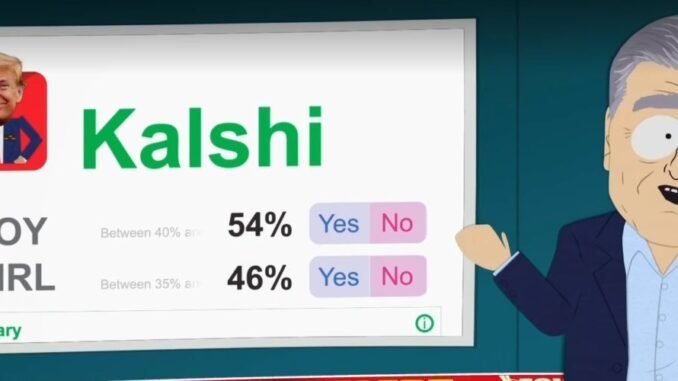
When Kalshi popped up in a South Park episode, it was a wink that prediction markets have gone mainstream. Now imagine brands and traders speaking a shared, machine-readable language about what happens inside the episode itself. Not vibes. Not recaps. A precise way to state and settle what viewers actually did, second by second.
Here’s the shift. Treat video as a time series and you get two clean “words” to talk with: flow and break. Flow is the state that persists: attention above baseline, laughter holding across a bit, a character on screen for a full thirty seconds. Break is the hinge that flips truth values: the moment a catchphrase drops, the instant a cutaway lands, the switch from teaser to act one.
With that language, a network, a brand or a trader can mint markets that are both fun and defensible. “Viewers keep attention above 70 percent for thirty seconds after the joke lands” is a flow claim. “First laugh spike arrives before the title card” is a break claim. “Sponsor logo appears within five seconds of the hinge and attention does not drop for twenty seconds” is flow tied to break tied to a rule. Each contract resolves on a replay with receipts: a smooth attention trace, the marked hinge, and the exact window. No arguments. Just time.
This scales beyond one gag. A season becomes a ledger of state spans and hinge times you can search, price and compare. If a brand wants to test a placement strategy, it can list a small set of scene-level markets during the premiere: hold attention for a full scene, recover within ten seconds after the joke, deliver a second hinge before the break. Traders can express views on timing and persistence rather than guessing at ratings the next day. Creators can experiment with narrative rhythm and see in minutes which beats hold and which beats slip.
The same language travels to live events and streams. A game show can publish a timetable of expected hinges and let the audience trade persistence around them. A music video drop can carry markets on whether the chorus hinge outruns the intro flow in the first hour. A sports shoulder piece can anchor attention contracts to interview beats, settling on traces instead of polls.
Under the hood, it is simple. Compress each frame into a small state. Run a smoothing path to carry the story, and a difference path to catch the hinge. Tie both to the specific question before you answer it. The output is not just a label; it is a claim with evidence: “Flow held here,” “Break happened there,” “Window satisfied,” all with confidence bands and a pinned model version. Brands get transparent proof of lift, not a black box. Traders get clarity on what the contract really means, not a phrased-to-argue description.
Why is this game-changing? Because it turns content into tradable primitives that are native to how people experience video. We remember sequences and moments, not single frames. A market that speaks flow and break can price those sequences and moments cleanly. It invites creative experiments (“what if the logo lands exactly at the laugh?”) and gives immediate, auditable answers. It nudges media away from after-the-fact metrics and toward live, scene-aware truth.
South Park name-checking Kalshi was the first step. The punchline for the industry is deeper. Once video speaks flow and break, brands, platforms and traders finally share a language. You do not argue about what people saw; you settle what time says they did.
NOTE: This article has been inspired by the vision AI research we’re conducting at @webuildscore and by “Video Flow as Time Series: Discovering Temporal Consistency and Variability for VideoQA” by Zijie Song, Zhenzhen Hu, Yixiao Ma, Jia Li and Richang Hong (Hefei University of Technology and USTC, ICME 2025), that leans into this idea: Instead of treating a clip like a stack of pictures, it treats it like a time series. The model they build carries two thoughts at once. First, flow: the smooth story that connects one moment to the next. Second, break: the sharp change that flips the answer.
Enjoyed this article? Join our newsletter
Get the latest Bittensor & TAO ecosystem news straight to your inbox.
We respect your privacy. Unsubscribe anytime.

Be the first to comment