
By: Dr Reed
Welcome to Level 2 of the r3tard guide to Bittensor, where things get a little more complicated, but also a lot more interesting.
If you missed Level 1, click here to read it..
Today we’re diving into two things:
- What a subnet actually is
- How subnet tokens compare to tokens on other networks
By the end, you’ll understand why Bittensor operates more like a perpetual accelerator (think: infinite Y Combinator) and why that makes $TAO fundamentally different from any other crypto ecosystem.
WHAT EXACTLY IS A SUBNET?
Despite their variety, all subnets within Bittensor share the same structural template. Every single one is built on three layers:
A) Base Layer – The Emission Rail
This is where the protocol distributes tokens (emissions) to miners and validators. Every subnet uses the same fair-launch tokenomics and distribution rules.
B) Incentive Mechanism (IM) Layer
This is the “game design” layer — where the team decides:
- What they want miners to produce
- How that output should be competed for
- How validators will score and rank miners
It’s the incentive engine that shapes the behavior of the entire subnet.
C) Product Layer
This is where the subnet’s output becomes a real, monetizable product.
- Deliver value → receive more emissions
- Fail to deliver → funding dries up
Simple. Brutal. Meritocratic.
SUBNET OUTPUTS: THEY CAN BE ANYTHING
One of Bittensor’s superpowers is how flexible these outputs can be.
Here are just a few examples:
1) Compute Provision
- Chutes
- Lium
2) Predicting Bitcoin’s Future Price
- SynthData
3) Improving or Auditing Agent Code
- Ridges
- Bitsec
Each category has clear scoring benchmarks:
- Was the compute delivered?
- Was the prediction correct?
- Which miner improved the code the most?
This flexibility makes Bittensor not just an AI network, but an incentive engine that can capital-fund any idea that is measurable and potentially profitable.
SUBNET TOKENS: HOW THEY DIFFER FROM NORMAL CRYPTO TOKENS
Let’s get something straight:
Buying a subnet token is similar to buying a meme coin or startup token on Solana or Ethereum, but the underlying economics are totally different.
On Solana/Eth:
- Teams design their own tokenomics
- Anyone can mint anything
- Whether the token drives value back to SOL/ETH is mostly irrelevant
- Value flows away from the L1, not toward it
On Bittensor:
- All launches follow the same fair-launch tokenomics
- Every subnet competes for emissions
- Funding is tied to performance
- Value must be driven back into $TAO to survive
- Teams must buy their own subnet token with TAO to maintain emissions
This creates a radically different competitive environment.
THE META: Bittensor Is a Perpetual Y Combinator
Think of the protocol as hosting 128 live startups.
Every subnet is constantly judged on:
- How much value it produces
- How much TAO it drives into its liquidity pool
- How well it maintains capital efficiency
- How strong its miner outputs are
- How compelling its product vision is
The ones who excel get more runway. The ones who fail lose funding. The worst ones get repurposed.
This alignment, every project fighting to pump TAO into its pool, is the special sauce.
- Solana projects aren’t aligned with SOL.
- Ethereum projects aren’t aligned with ETH.
- Bittensor projects are structurally aligned with TAO.
That’s the key difference.
NETWORK OF NETWORKS: WHY BITTENSOR COULD BE ENORMOUS
Most crypto networks (like Bitcoin, Solana, Ethereum) grow according to Metcalfe’s Law: Value ∝ number of users squared.
It’s how social networks and blockchains traditionally scale.
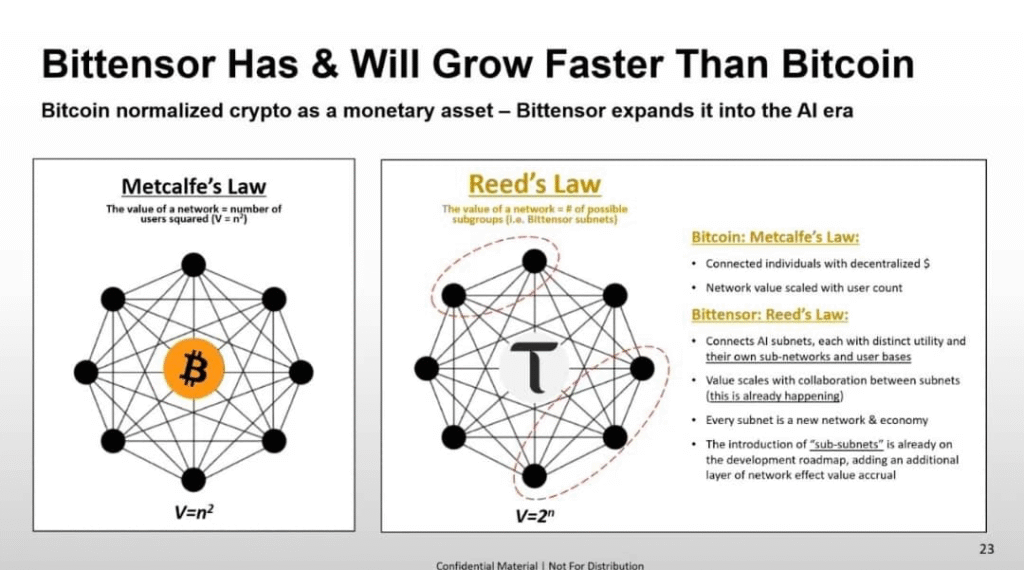
But Bittensor is not a single network. It’s a network of networks.
Each subnet is its own economic micro-universe:
- Its own users
- Its own miners
- Its own token
- Its own AI/compute output
- Its own revenue model
And all of them interconnect through TAO.
This places Bittensor in the category of Reed’s Law systems — networks of interconnected groups — which grow exponentially faster than Metcalfe’s Law systems.
If Metcalfe’s Law built the internet…
Reed’s Law built Facebook groups, Discord servers, and online ecosystems that scale at breakneck speed.
That’s why, structurally, Bittensor has the potential to grow far more explosively than any L1 before it.
FINAL THOUGHTS: WHY BITTENSOR MATTERS
To recap:
- Subnets are structured like startups.
- Incentives are based on real performance.
- Tokenomics are standardized and fair.
- Teams are forced to align their incentives with $TAO.
- The network grows according to Reed’s Law, not Metcalfe’s Law.
It’s an economy where:
- technology
- incentives
- capital
- and competition
all collide in real time.
Bittensor isn’t just another blockchain.
It’s a self-funding, self-incentivizing, self-optimizing AI super-network.
And this — the subnet model — is the engine behind it.
Enjoyed this article? Join our newsletter
Get the latest Bittensor & TAO ecosystem news straight to your inbox.
We respect your privacy. Unsubscribe anytime.



Be the first to comment