
Late on the evening of April 9, 2026, Sam Dare, the founder of Covenant AI, posted a 1,200-word statement to X that detonated one of the most consequential disputes in the short history of decentralized artificial intelligence. Within hours, roughly $300 million in value had been wiped from the Bittensor subnet ecosystem. TAO, the network’s native token, plunged from roughly $337 to a low of $262, an 18% collapse that erased the gains of a rally Dare himself had helped ignite just weeks earlier.
Dare accused Jacob Steeves (Const) of running what he called “decentralization theatre”: a network that advertises distributed governance but in practice concentrates power in one man’s hands. He cited suspended emissions to his subnets, revoked moderation rights over his own community channels, unilateral deprecation of infrastructure, and strategic token sales designed as economic coercion. He said Covenant AI could no longer build on a foundation where the core promise made to investors, that no single entity controls the network, was a lie.
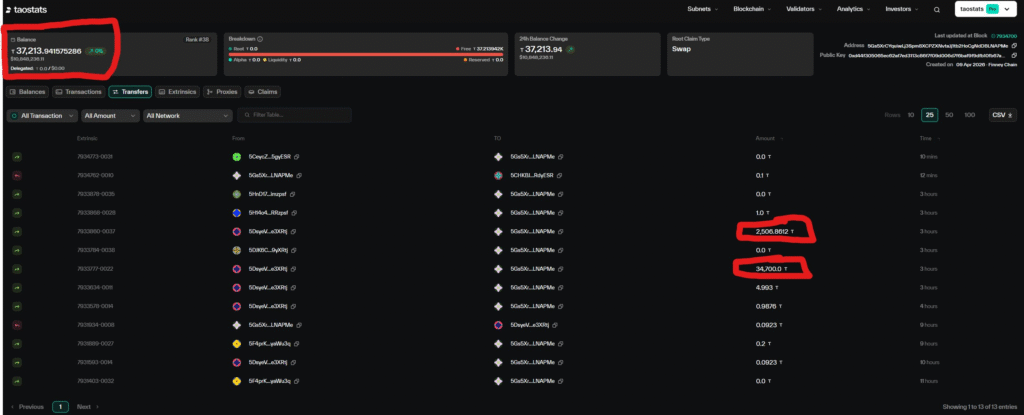
Then he sold approximately 37,000 TAO worth of subnet alpha tokens from his wallets, a sum valued at roughly $10 million at the time of the transactions. On-chain records show two principal transfers: one for 34,700 TAO and another for 2,506 TAO, both executed within hours of the announcement.
It was either the most principled departure in crypto or the most eloquently justified exit liquidity event. The Bittensor community has not reached consensus on which.
What Covenant Built, and Why It Mattered
To understand why this departure hit so hard, you have to understand what Covenant AI represented for the Bittensor ecosystem.
Covenant AI operated three subnets on Bittensor: Subnet 3 (Templar), focused on decentralized pre-training; Subnet 39 (Basilica), handling compute; and Subnet 81 (Grail), devoted to fine-tuning and reinforcement learning. Together, these subnets formed a vertically integrated decentralized AI lab — a prototype of what an open-source, permissionless alternative to OpenAI or Anthropic might look like.
The flagship achievement was Covenant-72B: a 72-billion-parameter large language model trained entirely across the Bittensor network by more than 70 independent contributors using commodity GPUs and ordinary home internet connections. No centralized data center and no corporate whitelist. The model processed approximately 1.1 trillion tokens and scored 67.1 on the MMLU benchmark, placing it in competitive range with Meta’s LLaMA-2-70B, a model built by one of the most well-resourced AI labs on the planet, on substantially more data.
The technical innovation that made it possible was the SparseLoCo optimizer, which compressed communication overhead by roughly 146 times through sparsification, two-bit quantization, and error feedback. This allowed nodes connected by regular broadband to coordinate training that previously required data-center-grade interconnects.
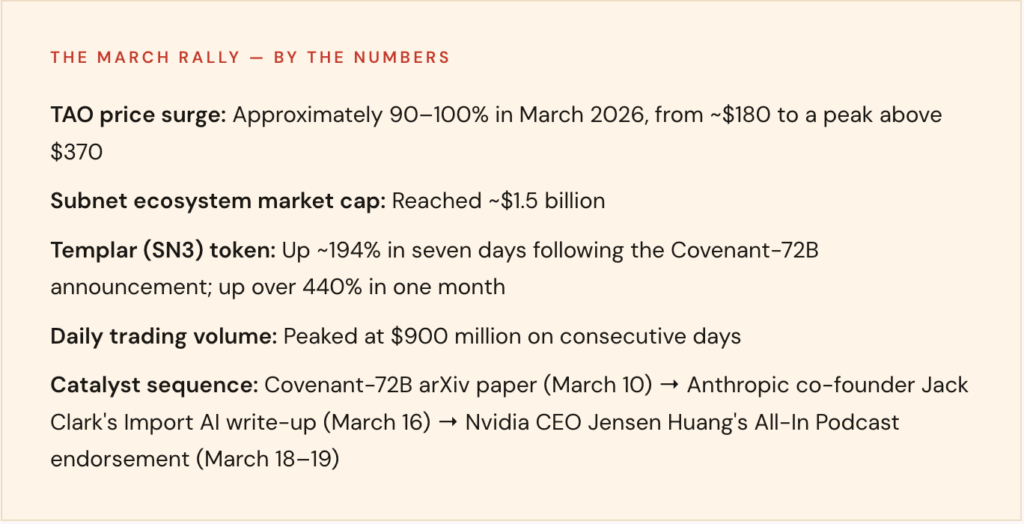
The attention was not just from crypto-native audiences. On March 16, Anthropic co-founder Jack Clark devoted a section of his widely-read Import AI newsletter to the Covenant-72B result, titling it a discussion of how distributed training could challenge the political economy of AI. He acknowledged the model as a meaningful milestone while noting that frontier models in 2026 still far exceed its capabilities. Days later, Nvidia CEO Jensen Huang compared Bittensor’s approach to “a modern version of folding@home” on the All-In Podcast during a conversation with Chamath Palihapitiya. The AI token sector jumped more than 40% in a single day.
For Bittensor, Covenant-72B was not just a technical achievement. It was the proof point. The demonstration that permissionless AI training could produce something real. And Sam Dare was its architect.
The Accusations
Dare’s exit statement is built around a single structural claim: that Bittensor’s governance is centralized in practice, regardless of its decentralized branding. He points to the network’s triumvirate structure (three individuals who manage the multisig for network upgrades) and asserts that Jacob Steeves maintains effective control over it, deploys changes unilaterally, and uses the other members as legal insulation.
The specific grievances are more immediate. Dare alleges that Steeves suspended emissions to Covenant’s subnets, removed moderation capabilities over Covenant’s community channels, publicly deprecated Covenant’s infrastructure without due process, and conducted large, visible token sales timed to moments of operational conflict as a form of punitive economic pressure.
“When a single actor can suspend a subnet’s emissions, override an owner’s authority over their own community spaces, publicly deprecate projects without process, and use token sales as a coercive mechanism to compel compliance — that is not decentralization. It is centralized control with decentralized branding.”— Sam Dare, Covenant AI exit statement
Dare frames this as an irreconcilable breach. He states that Covenant can no longer raise capital, attract talent, or ask its community to commit resources on top of infrastructure that one person can undermine at will. The team, models, and research will continue elsewhere, with announcements forthcoming.
Steeves Responds — Point by Point
Jacob Steeves did not stay silent. In a series of posts on X and a message in the Bittensor Discord, he disputed each of Dare’s claims and offered a markedly different version of events.
| Dare’s Claim | Steeves’ Rebuttal |
|---|---|
| Emissions to Covenant’s subnets were suspended | Steeves says he has no special ability to suspend emissions. He sold some of his alpha holdings on the three subnets because they were not running and had near-100% burn code active. This affected emissions the same way any buy or sell does under the dTAO mechanism — no privileged access involved. |
| Moderation rights were revoked over Covenant’s channels | Steeves says he temporarily stopped Dare from deleting posts by community members who were raising genuine criticism. The moderator role was not removed; only the ability to suppress dissent was briefly restricted, then reinstated. |
| Covenant’s channels were deprecated | Steeves says Dare deprecated his own channels via a pinned comment and a post on X. The channels in question is one Discord channel. |
| Large, visible token sales were used as economic coercion | Steeves characterizes the sales as small, less than 1% of his total investment in Dare’s subnets. He notes that visibility is impossible to avoid in his position and asserts his right to buy and sell tokens, which he describes as the foundation of the dTAO system. |
In his Discord statement, Steeves addressed the Bittensor community directly, tagging the Grail, Templar, and Basilica subnets. He recalled that when dTAO launched a year earlier, the plan had been to introduce community-owned vote-based subnet ownership, where alpha holders could elect the team managing a subnet’s hyperparameters. That feature was delayed to give subnet owners more control in the early stages. He proposed reviving it now.
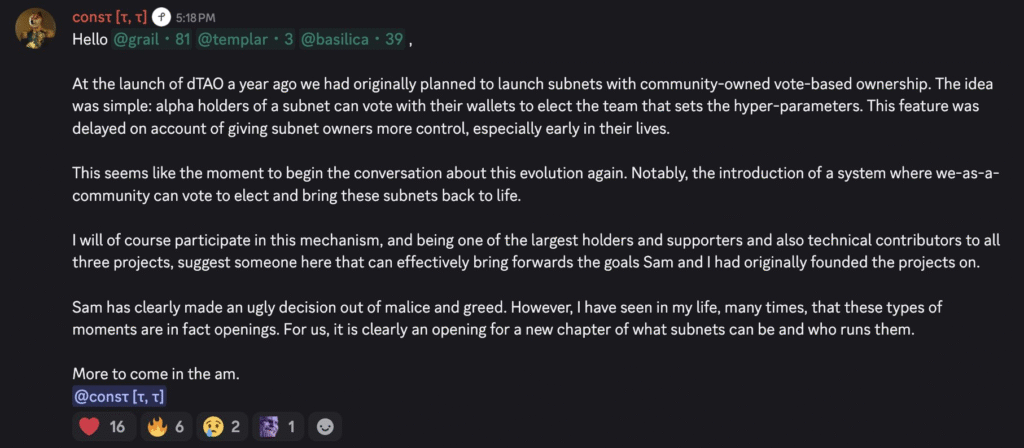
His characterization of Dare was unsparing. He wrote that Dare had “clearly made an ugly decision out of malice and greed,” but framed the crisis as an opportunity, an opening for a new model of subnet governance.
The Counter-Narrative: Was This a Rug Pull?
Within hours of the statement, community sleuths had located the wallet and the on-chain evidence. A Taostats page showed a wallet holding approximately 37,213 TAO, worth roughly $10.8 million. Two circled transactions showed the bulk transfers. The wallet had been effectively emptied of its subnet holdings.
For much of the Bittensor community, the timing was damning. A midnight announcement, simultaneous token liquidation across all three subnets, and a polished ideological statement that read more like a prepared exit than a spontaneous act of principle.
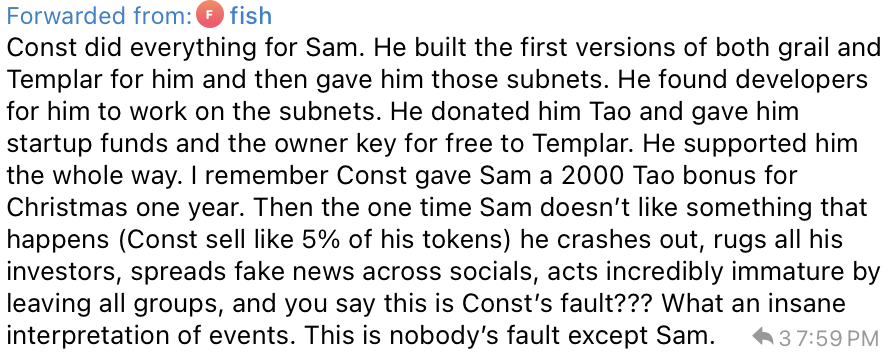
Fish, a long-standing Bittensor community member and the owner of Subnet 51 (Lium), offered a pointed counterpoint. He claimed that Steeves had built the first versions of both the Grail and Templar subnets and handed them to Dare, found developers for him to work with, donated TAO and startup funds, gave Dare the Templar owner key at no cost, and supported him throughout — including a 2,000-TAO Christmas bonus one year. In Fish’s telling, Dare’s reaction to Steeves selling roughly 5% of his token holdings was wildly disproportionate: a crash-out that led to rugged investors, fabricated narratives, and an immature public exit.
The rug-pull interpretation gained momentum quickly. Crypto influencer DreadBong0 described the exit as a “rug for max extraction” that destroyed investor trust. The dominant sentiment across X, Discord, and crypto media skewed heavily negative toward Covenant — not necessarily because people believed the governance critique was invalid, but because the method of departure inflicted severe collateral damage on the miners, validators, and retail investors who had backed Dare’s subnets.
The Market Damage
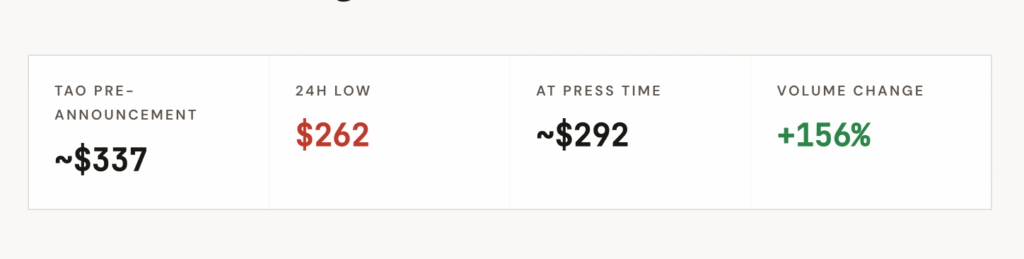
The sell-off was swift and broad. TAO dropped over 15% within hours, with CoinGecko data showing a slide from approximately $337 to $284 before stabilizing around $292. Some reports tracked the decline as steep as 18%, with the 24-hour low touching $262. Trading volume surged 156%, as investors rushed to either exit positions or buy what they perceived as a dip. Bittensor futures open interest fell on exchanges like OKX, Gate, Bitget, Hyperliquid, and LBank, though Binance and Bybit held steady.
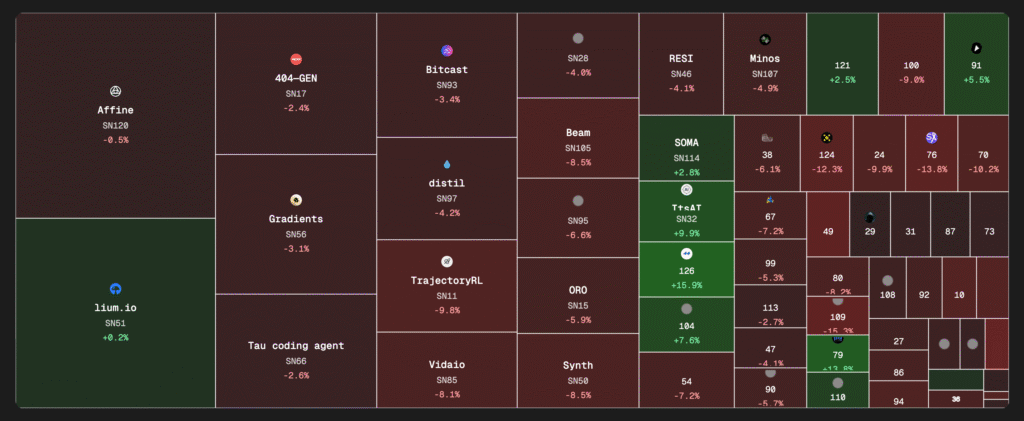
The subnet ecosystem absorbed even deeper losses. Estimates suggested over $300 million in value was wiped across the subnet token market, which was mechanically linked to TAO through staking-backed automated market makers. The very structure that had amplified the March rally — subnet tokens acting as leveraged bets on TAO — now amplified the crash.
The Governance Question That Won’t Go Away
Strip away the personal drama, and there is a structural question at the center of this dispute that the Bittensor ecosystem cannot easily dismiss: how decentralized is it, actually?
Dare’s critique of the triumvirate is not new. The idea that a small number of individuals hold disproportionate influence over a network that bills itself as permissionless has been whispered about for months. Even those who are harshly critical of Dare’s exit acknowledge that the governance concerns carry some validity. The difference is that most believed these issues warranted internal reform, not public detonation.
Steeves appears to agree that governance needs to evolve. In his forward-looking posts, he announced that Bittensor would develop “lock-based subnet ownership” — a system where a team’s ownership of a subnet would be determined by their long-term economic commitment to the project. Under this model, investors would see in advance if an owner unlocked their tokens, could reprice the subnet before the owner sells, and could redirect their conviction to another team or agent to manage the system.
He framed the entire Covenant episode as a productive exploit, a stress test that teaches the system its weak spots. “The quicker you find them, the faster you learn,” he wrote, before thanking Dare by his handle for “helping further Bittensor’s decentralization.”
What Comes Next
The immediate aftermath has settled into an uneasy calm. TAO has partially recovered but remains volatile. Covenant AI has indicated it will continue its work in decentralized AI training outside of Bittensor, with announcements forthcoming. The subnets (Templar, Basilica, and Grail) now face an uncertain transition. Steeves has signaled that community-owned governance mechanisms will be introduced to allow alpha holders to elect new management for those subnets.
Enjoyed this article? Join our newsletter
Get the latest Bittensor & TAO ecosystem news straight to your inbox.
We respect your privacy. Unsubscribe anytime.

![[Tao Pod] Quantum Biology Meets Bittensor: Engineering Life & AI Compute](https://taodaily.io/wp-content/uploads/2026/02/maxresdefault-49-326x245.jpg)
Be the first to comment