

Digital advertising is one of the biggest recurring expenses in the modern economy. Global companies are spending over a trillion dollars annually to be seen on every major platform, with the unsurprising result that traffic spikes temporarily but then fully resets when spend stops.
The model produces reach but nothing compounding, nothing retained, and no transferable asset created through the spend.
BitAds (Subnet 16) introduces a framework in which marketing expenditure becomes an owned, on-chain resource, not a repeated rental fee.
By tying performance incentives to verified commerce rather than impressions or traffic, BitAds shifts the economics from sunk cost to measurable output.
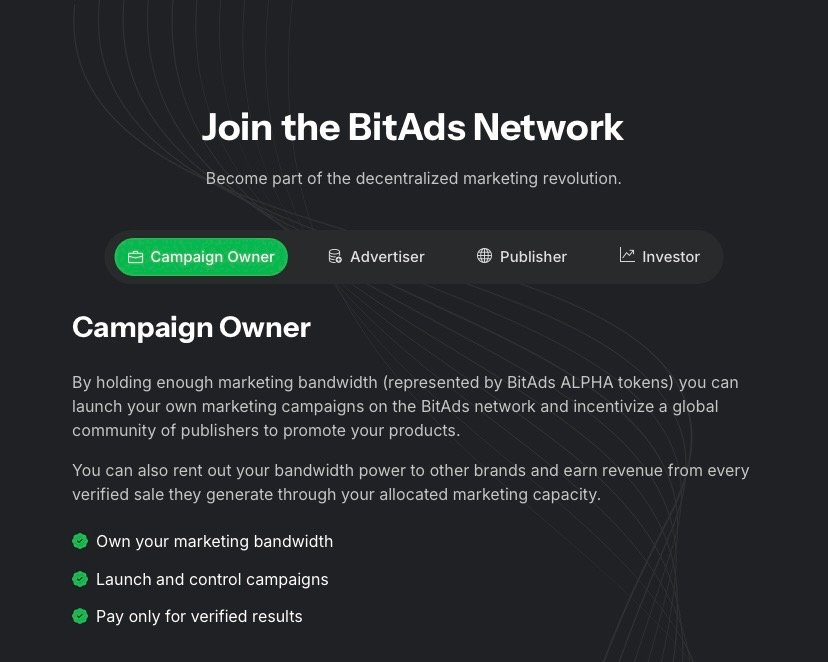
Marketing Bandwidth as a Network Asset
Subnet 16 was Bittensor’s first major non-AI subnet and remains one of the clearest demonstrations of how the $TAO network can support industries well beyond model training.
The system replaces this conventional model, in which companies pay centralized platforms for ephemeral impressions. Instead, advertisers accumulate and stake the native SN16 Alpha token. The staked amount translates into campaign weight, giving priority access to miners promoting the offer.
The contrast is direct:
- Traditional Model (Google/Meta)
- Attention is rented.
- Spend turns into real engagement.
- Value disappears when the campaign is over.
BitAds Model (SN16)
- Bandwidth is owned.
- Payment is proportional with measurable results.
- The staked asset remains liquid and can appreciate.
Subnet 16 positions this bandwidth as a reusable, compounding component rather than as a one-time expense.

Economic Design: The Three-Phase Rollout
Subnet 16 has a defined expansion plan that demonstrates utility, extends reach, and develops continued demand for SN16 Alpha.
- Phase 1: Internal Campaigns
BitAds runs campaigns within controlled sub-slots of Subnet 16. Revenue generated from these internal efforts is partially allocated towards Alpha buybacks. The phase establishes the revenue → buyback loop.
- Phase 2: Ecosystem Integration
A second sub-slot supports campaigns from other Bittensor subnets. Subnet 16 earns commissions from the sales it helps drive, and those commissions feed additional Alpha buybacks. This phase connects BitAds to the wider network.
- Phase 3: Marketplace Expansion:
External merchants participate without requiring $TAO. They rent campaign bandwidth, paying commissions on verified results. Alpha holders receive increased governance significance and demand with volume of campaigns.
Strengthening the Broader $TAO Network
Subnet 16 improves the Bittensor ecosystem by demonstrating that the $TAO incentivization mechanism can support entire industries well outside generative AI. Advertising is one of the world’s largest recurring expenditures. Integrating even a small percentage of this volume into $TAO introduces a steady, non-crypto economic stream to the network.
The subnet demonstrates that Bittensor’s architecture is capable of coordinating distributed agents around economically meaningful, verified outcomes and not simply model output.
It establishes a precedent that $TAO protocol can serve as the groundwork for any industry in which there is a need for incentives to track measured performance. Subnet 16 becomes proof that the network can extend into real-world commerce at scale.
This is furthered by the buyback mechanism that every verified sale, commission, and revenue cycle feeds back into Alpha Scarcity. As campaigns grow, the subnet exerts a compounding effect on the asset that controls access to bandwidth.
Conclusion
Subnet 16 aligns marketing incentives with verifiable outcomes and positions the Bittensor ecosystem as an infrastructure layer for real-world commerce.
Enjoyed this article? Join our newsletter
Get the latest Bittensor & TAO ecosystem news straight to your inbox.
We respect your privacy. Unsubscribe anytime.
Be the first to comment