

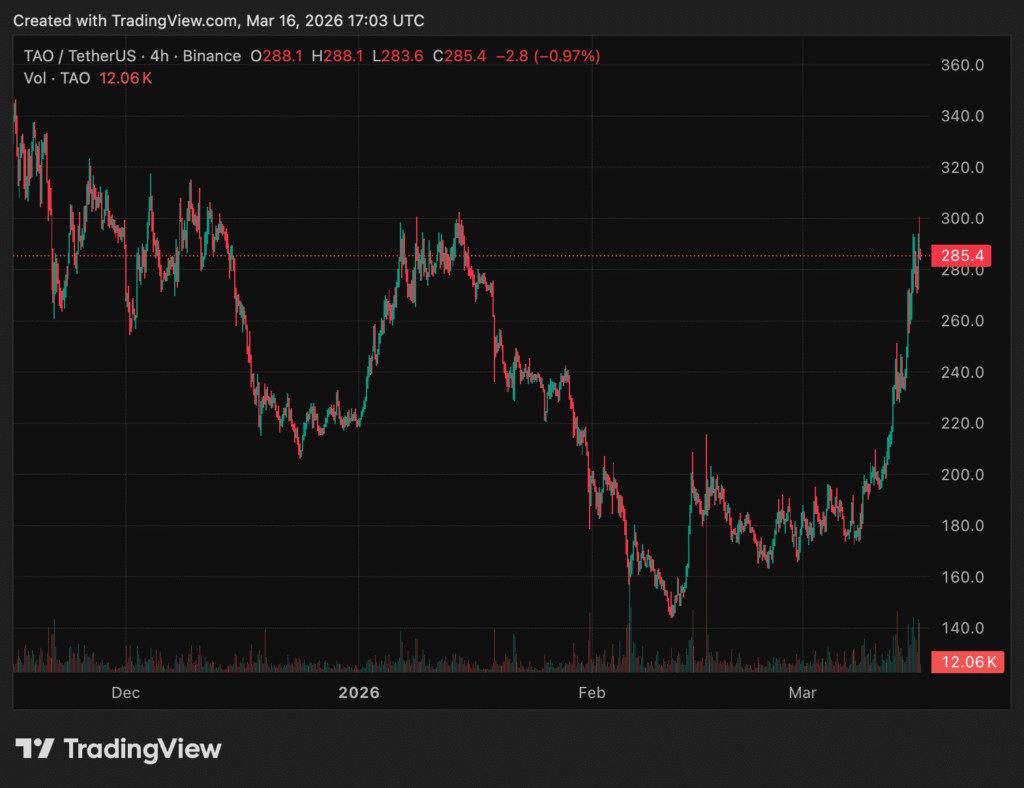
Something unusual is happening with Bittensor. Over the past several weeks, TAO has roughly doubled in price from the low $140s to +$290, making it one of the strongest performers in crypto during a period when most assets have been grinding sideways. That kind of move demands an explanation. Not a single explanation, really, but a stack of them, because no 100% rally in a mature protocol happens for just one reason.
Below is an attempt to lay out the ten most important factors behind the surge. Some are structural. Some are narrative-driven. All of them, taken together, paint a picture of a protocol that is starting to be taken very seriously. Not just by crypto-native speculators, but by institutions, builders, and a growing chorus of mainstream tech voices.
Disclaimer: This is an opinion piece, not financial advice. Do your own research before making any investment decisions.
1. The Post-Halving Supply Squeeze
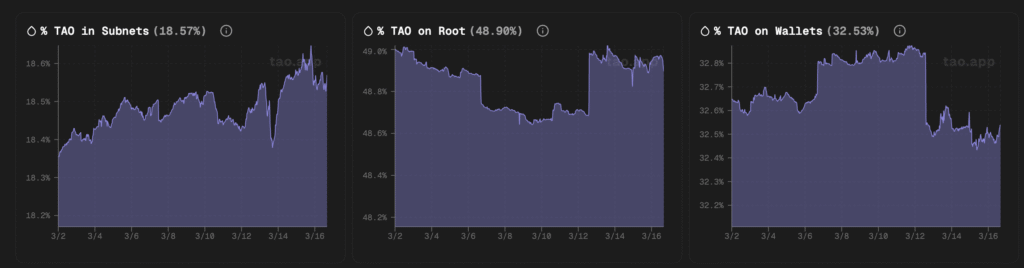
Bittensor’s first-ever halving landed on December 15, 2025. Daily TAO emissions dropped from 7,200 to 3,600, a 50% supply cut, modeled directly on Bitcoin’s scarcity playbook. With north of 67% of circulating supply staked in root and locked into subnet pools, the supply on exchanges is increasingly trending downwards. Basic economics takes over from there: shrink the supply while demand is rising, and prices move. Fast.
2. Templar’s Covenant-72B Goes Viral
On March 10, Templar (Subnet 3) announced the completion of Covenant-72B: a 72-billion-parameter large language model pre-trained on 1.1 trillion tokens across more than 70 globally distributed nodes. No centralized data center. No single point of control. Just a swarm of machines coordinating through Bittensor’s incentive layer.
The announcement ripped through social media, racking up over 1.6 million views on X and sending Templar’s alpha token up 194% in a week.
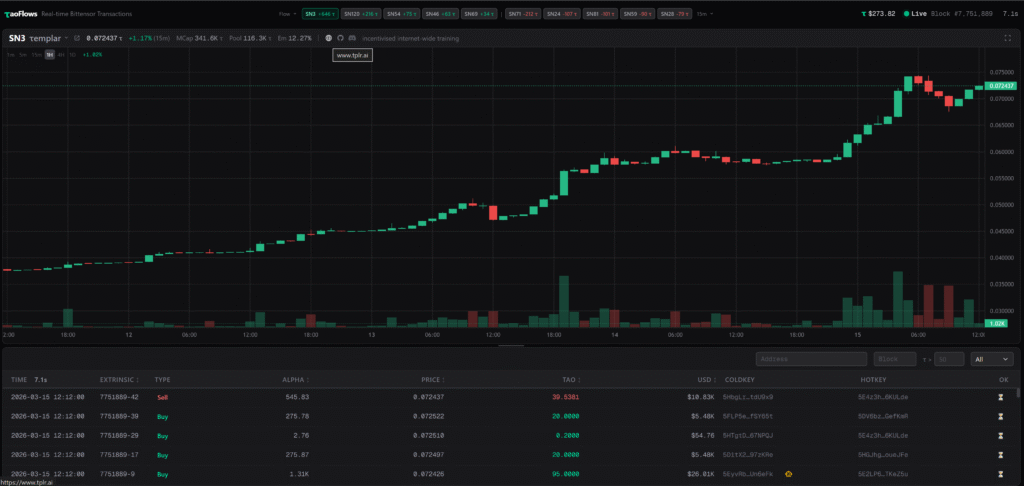
Three other Bittensor subnet tokens—Templar (SN3), Targon (SN4), and Basilica (SN39)—ranked among the top eight daily gainers on CoinGecko.
But the downstream effect on TAO itself was arguably more important: buying subnet tokens requires holding TAO first, so every spike in subnet demand funnels directly into base-layer buying pressure.
As a technical milestone, Covenant-72B is the largest decentralized LLM training run ever completed. As a narrative catalyst for TAO, it was gasoline on a fire.
3. Ridges AI Ships Its First Product
Ridges AI (Subnet 62) moved from “roadmap” status to “live” with the launch of Ridgeline, a tool designed to deploy autonomous AI engineers on GitHub issues.
This was pretty bullish for the Bittensor ecosystem. The protocol’s most anticipated subnet eventually releases a product that people want to use. Bittensor stops being an experimental playground and starts functioning as a marketplace. Every functional subnet’s product that goes live adds another reason to hold TAO—and another demand sink for the base token.
4. Nvidia’s GTC Conference Lifts the Entire AI Sector
Nvidia’s GTC 2026 conference, kicking off in San Jose on March 15–19, brought a wave of AI-sector enthusiasm. Ahead of Jensen Huang’s keynote on March 16, reports surfaced about NemoClaw, Nvidia’s open-source enterprise AI agent platform.
In reaction to this news, the broader AI token sector rallied hard, and TAO was among the biggest beneficiaries. When the world’s most important chipmaker is talking about the future of AI agents and decentralized compute, a protocol literally built for that purpose tends to attract attention.
5. Grayscale’s Bittensor Trust Reaches a Regulatory Milestone
Grayscale’s Bittensor Trust became an SEC reporting company, and 90 days after that designation, the private placement holding period shortened from one year to six months. That’s a significant change for accredited investors who previously had to wait a full year before any liquidity.
The move makes TAO exposure more accessible and more attractive to institutional capital. Grayscale also filed an S-1 in late December 2025 to convert the trust into a NYSE-listed ETF (ticker: GTAO)—a clear signal that the firm sees enough demand to pursue a public listing. The combination of shorter lockups and ETF aspirations is exactly the kind of institutional plumbing that turns speculative interest into durable capital flows.
6. Jason Calacanis Brings Mainstream Credibility
Jason Calacanis—angel investor behind Uber and Robinhood, co-host of the All-In Podcast, and host of This Week in Startups—has become one of Bittensor’s most prominent advocates. He co-founded Stillcore Capital, a fund focused exclusively on TAO and Bittensor subnet alpha tokens, alongside Mark Jeffrey and Rob Greer.
On a February 2026 episode of This Week in Startups titled “Wisdom of the $TAO,” Calacanis walked through the Bittensor thesis in detail, framing the protocol as a potential foundational layer for decentralized AI. For a retail audience that follows mainstream tech personalities, this kind of endorsement carries weight, and Calacanis has never been shy about amplifying his bets.
The Chamath Palihapitiya connection doesn’t hurt either; Palihapitiya has discussed Bittensor at All-In summit events, in earshot of David Sacks, the Trump administration’s crypto and AI policy lead.
7. General Tensor Closes $5M in Funding
General Tensor, a Toronto-based infrastructure company that mines, validates, and operates subnets on Bittensor, closed $5 million across oversubscribed pre-seed and seed rounds. The seed was anchored by Good Morning Holdings, a venture firm backed by Goldman Sachs. The pre-seed, closed in December 2024, was led by Lvna Capital with participation from Digital Currency Group (DCG), X Ventures, Proof of Talk, and Outliers Fund.
General Tensor brings something unique to Bittensor: rather than simply buying and holding TAO, the company accumulates it through integrated infrastructure operations, achieving roughly 40x cost efficiency compared to open-market accumulation. When Goldman Sachs–affiliated capital is flowing into the operational backbone of a decentralized AI network, big money starts paying attention.
8. The Subnet Ecosystem Is Exploding
Beyond the headline-grabbing milestones, the broader subnet ecosystem has been quietly gaining mass. Activity is diversifying: It’s AI (for AI detection – SN32) claims 98% accuracy with real business-to-business revenue; Voidai (SN85) is bridging TAO to DeFi chains like Ethereum and Solana; and Bitcast’s (SN93) revenue successfully offsets miner emissions.
The relationship between TAO and subnet alpha tokens creates a unique value flywheel. More subnet activity means more demand for TAO (since it’s the gateway token), which raises the cost of entry, which raises the stakes and quality of participation. Yuma’s “State of Bittensor” report has tracked this compounding effect through subnets like Score (SN44) and Targon (SN4), both hitting real-world performance benchmarks.
9. The Broader Crypto and AI Markets Are Running
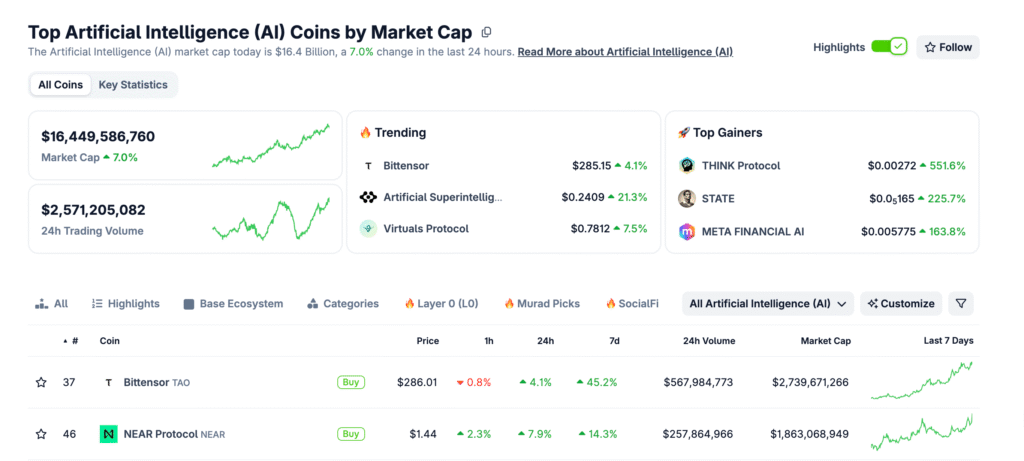
No token exists in a vacuum. Bitcoin has been clawing back from a brutal five-month losing streak that dragged it from its October 2025 all-time high near $109,000 down into the low $60,000s. March has brought a relief rally—BTC is back above $73,000—and that shift in sentiment has opened the floodgates for altcoin rotation, including into AI-themed tokens. The total AI crypto sector market cap has climbed from around $14 billion in early March to the $16–18 billion range by mid-month, according to CoinGecko data.
TAO benefits disproportionately from this dynamic. As the largest AI crypto asset by market cap, Bittensor saw a significant gain in its token value too. Daily trading volumes have regularly topped $300–500 million during this period.
10. The Decentralized AI Narrative Is Finding Its Moment
Underneath the price action, something philosophical is happening. The concentration of AI power in the hands of a few companies—OpenAI, Google, Anthropic—is becoming a mainstream concern. Bittensor offers a fundamentally different architecture: permissionless, open, and designed so that no single entity can meter access to intelligence.
Constantinople (Subnet 97) crystallizes this idea. It’s a subnet run entirely by an AI agent—no CEO, no board, no human governance layer. Just code, GPUs, and cryptographic proofs. Whether that’s the future of organizations or an interesting experiment is debatable, but as a demonstration of what’s possible at the intersection of crypto and AI, it’s hard to ignore.
The Bigger Picture
A 100% rally rarely has a single explanation, and TAO’s surge is no exception. What makes this particular move interesting is the layering: a structural supply shock from the halving, genuine technical milestones from subnets like Templar and Ridges, institutional capital flowing in through vehicles like Grayscale and General Tensor, and a macro environment where AI and crypto are both running hot.
Whether the current price reflects fair value, a discount, or exuberance will only be clear in retrospect. But the days of dismissing Bittensor as a niche crypto experiment seem to be over.
Enjoyed this article? Join our newsletter
Get the latest Bittensor & TAO ecosystem news straight to your inbox.
We respect your privacy. Unsubscribe anytime.


Be the first to comment