
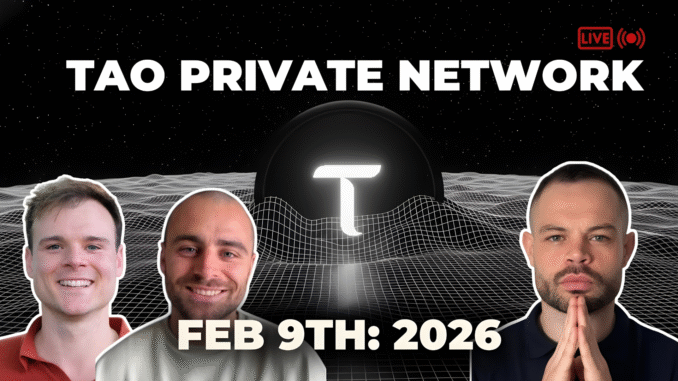
In this episode, Gordon Frayne hosted the team from TAO Private Network (TPN) to break down the critical role of Subnet 65 (SN65) in building a decentralized internet access layer for Artificial Intelligence. The episode’s overall takeaway was that while humans need VPNs for privacy, AI agents need them for survival, specifically to bypass the firewalls and CAPTCHAs that block data center traffic.
Watch the full episode here:
The AI Data Crisis: Why Datacenter IPs Are Dead
Gordon and the team confirmed that the biggest bottleneck for modern AI isn’t just compute. It’s data access.
Standard AI agents running on cloud infrastructure (like AWS or Google Cloud) face the serious issue of being easily identified and blocked..
Firewalls, CAPTCHAs, and anti-bot systems instantly flag traffic coming from known data center IP ranges.
This creates a “blindness” for AI models trying to perform real-time tasks like:
- Market analysis and price scraping
- Competitor research
- Global news aggregation
- Social sentiment tracking
The Solution: Turning Home WiFi Into AI Infrastructure
To address this, the team explained how Subnet 65 is building a decentralized architecture based on Residential IPs.
Unlike traditional VPNs that route traffic through centralized server farms, TPN aggregates bandwidth from thousands of everyday users (“Workers”).
The discussion highlighted why this distinction is vital:
- Workers: Regular people running a lightweight node on their home internet.
- The Result: AI traffic looks indistinguishable from a normal human user browsing from London, Tokyo, or New York.
- The Utility: This allows AI agents to “blend in,” bypassing the IP bans that cripple centralized scraping bots.
The Architecture: A Trustless “Zero Log” Standard
One of the more interesting technical updates was around the network’s approach to privacy.
They framed “Zero Logs” not as a company policy (like NordVPN), but as a cryptographic guarantee.
In a centralized VPN, you have to trust the provider not to sell your data.
In TPN, the architecture is designed to be trustless:
- Validators constantly challenge miners to verify performance.
- Traffic is routed through independent nodes incentivized only to pass packets, not inspect them.
- Dynamic Rotation ensures that tracking a user or agent across sessions is nearly impossible.
The Economy: Tokenizing Bandwidth with dTAO
Frayne and the developers also dug into the financial model behind the network, specifically the role of the dTAO (Alpha) token.
TPN is effectively creating a marketplace for bandwidth.
- Miners compete to organize the best pools of residential IPs.
- Workers earn rewards for contributing their idle upload speed.
- AI Agents pay to consume this bandwidth for scraping and retrieval tasks.
The team framed this as a self-sustaining economy where censorship resistance is the product, and high-quality residential bandwidth is the scarce resource.
The Bigger Vision: An Unstoppable Retrieval Layer
The episode closed by reinforcing the broader thesis: the internet is splitting into a “human web” and a “machine web,” and TPN is building the bridge between them.
By decentralizing the access layer, they are ensuring that AI agents cannot be cut off from the information they need to learn and operate.
Their argument is that as AI integrates deeper into the economy, the demand for unblockable, residential-grade internet access will only grow, positioning Subnet 65 as a critical utility for the autonomous future.
By: Gordon Frayne
Enjoyed this article? Join our newsletter
Get the latest Bittensor & TAO ecosystem news straight to your inbox.
We respect your privacy. Unsubscribe anytime.
Be the first to comment