
Full article and cover image credit: Tao.bot
On November 4, Bittensor activated Tao Flow, its new emissions model. And in just one month, the shift has already reshaped incentives across the entire network.
Under the old system, emissions were tied heavily to historical alpha token prices, which meant subnets that had been pumped months earlier could continue receiving outsized rewards even after usage dried up. It was a model that rewarded past momentum, not present value.
Tao Flow ended that.
What Tao Flow Actually Rewards
Instead of old price charts, emissions now follow real-time net $TAO inflows—the amount of stake entering a subnet minus the amount leaving it, smoothed using an EMA.
- Positive inflow = emissions
- Negative inflow = zero emissions until inflows flip positive again
This means the network now rewards where $TAO is actually moving today, not where it moved long ago.
What We’ve Seen in the First 30 Days
In just a month, Tao Flow has already changed behavior across the ecosystem:
High-flow subnets are burning supply to stay competitive
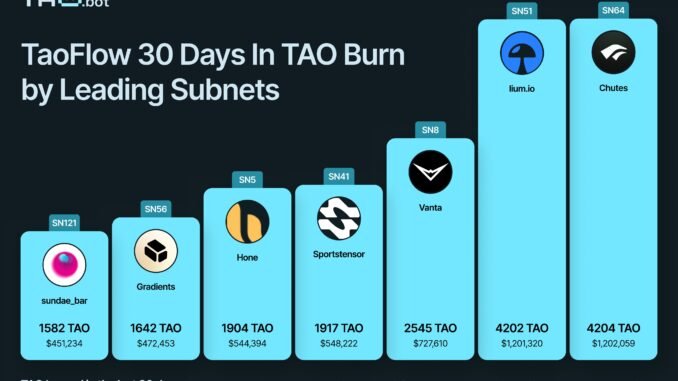
Subnets with strong inflow have been aggressively burning their own tokens, removing supply to strengthen scarcity and attract more stake.
- Chutes (SN64): 4,204 TAO burned
- Lium (SN51): 4,202 TAO burned
- Vanta (SN8): 2,545 TAO burned
These burns directly boost competitiveness under Tao Flow.
“Ghost town” subnets are trending toward zero emissions
Subnets with consistent outflows have naturally slid towards zero rewards, exactly as designed. Tao Flow simply stops subsidizing idle capital or abandoned projects.
Stake rotation is accelerating toward real utility
Capital is flowing toward subnets with:
- Real usage
- Active products
- Transparent updates
- Clear demand
Narratives alone no longer sustain emissions, value creation does.
The Net Effect of Tao Flow
1) A true meritocracy
TAO now flows to subnets that can attract and retain stake, not to the ones with the loudest narratives or past price spikes.
2) Healthier emissions distribution
Idle or speculative subnets naturally lose emissions, while productive subnets get reinforced.
3) Deflationary pressure increases
As high-performing subnets burn tokens to stay competitive, circulating supply shrinks, strengthening the overall economic model.
Perfect Timing: The Halving Is Next
With Bittensor’s first halving less than two weeks away, Tao Flow is arriving at a crucial moment.
It sets the stage for a network where:
- utility matters
- revenue matters
- sustained demand matters
- long-term builders get rewarded
TaoFlow didn’t just adjust emissions, it changed the culture of Bittensor. It shifted the incentives from hype to value, from momentum to performance, and from speculation to sustained demand.
And it’s only been one month.
Enjoyed this article? Join our newsletter
Get the latest Bittensor & TAO ecosystem news straight to your inbox.
We respect your privacy. Unsubscribe anytime.


Be the first to comment