
There is a growing gap between how markets are typically explained and what is actually unfolding beneath the surface. Most narratives remain anchored to liquidity cycles, rotations, and short-term positioning. Yet, underneath that layer, a more structural transformation is already in motion, one that is redefining how value is created, measured, and ultimately captured.
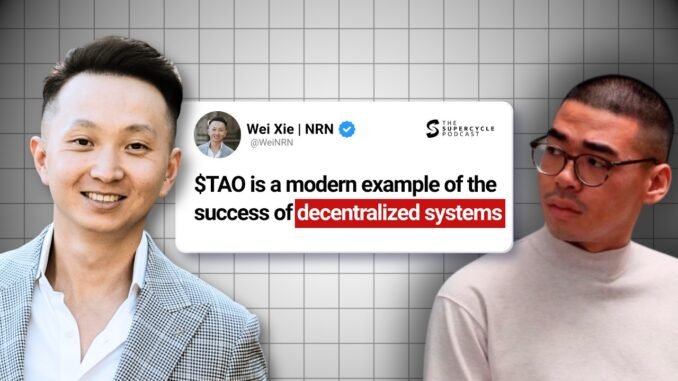
In The Supercycle Podcast’s conversation between Wei Xie (Co-founder, NRN Agents) and Jack Ai-Leung, that transformation is not treated as a distant possibility, it is examined as an emerging reality! What unfolds is a precise and layered dialogue where capital allocation meets technological acceleration, and where both speakers, from distinct vantage points, converge on a single thesis: intelligence is becoming the primary economic resource, and new coordination systems are forming around it.
Wei approaches the discussion through the lens of markets, incentives, and capital flows, while Jack extends it into systems, infrastructure, and societal consequences. The strength of the conversation lies in this interaction. Each idea is introduced, challenged, and refined until it becomes structurally clear.
From Cycles to Systems: Reframing the Current Moment
Wei begins by dismantling the default reliance on cyclical thinking. In his view, interpreting the present through expansion and contraction cycles is increasingly insufficient, because it fails to capture the systemic impact of artificial intelligence.
Jack builds on this by grounding the shift in real-world implications:
a. Automation is expanding into high-value cognitive domains,
b. Service-driven economies face structural compression in margins, and
c. Highly skilled labor is being forced to redefine its role in value creation.
Wei reframes this as a coordination problem. He noted that if intelligence becomes abundant and inexpensive to produce, then the central challenge is no longer production, but allocation.
Jack agrees, emphasizing that this transition is already unfolding across industries and geographies. It is not theoretical, and it is not gradual; it is active!
Together, they move the conversation away from timing markets and toward understanding systems.
Capital Has Not Left. It Has Repriced and Moved
A critical insight introduced by Wei is that speculative demand has not disappeared, it has been redirected. Where crypto previously absorbed capital through layered infrastructure narratives, financial experimentation within DeFi, and attention-driven token cycles
That same demand is now flowing into AI through public market leaders tied to compute and model deployment, frontier laboratories operating at the edge of capability, and infrastructure providers supporting large-scale training.
Jack adds an important dimension by noting that AI is not only attracting capital because of returns, but because it is perceived as foundational. It is becoming unavoidable.
Wei synthesizes this into a clear allocation structure:
a. Centralized AI captures immediate, measurable value, and
b. Decentralized systems represent long-term, asymmetric exposure.
This reframes crypto as evolving into a coordination layer within a larger intelligence economy (not just for attention!)
The Bridge: From Mechanism Design to Intelligence Markets
Wei connects the present moment back to crypto’s institutional evolution, where mechanism design and incentive alignment became core primitives for coordinating decentralized systems.
Jack extends this framework into AI by asking a more fundamental question: If intelligence can be produced collaboratively, how should it be organized?
Both converge on the same answer, that:
a. Intelligence must be evaluated in open, competitive environments,
b. Contributions must be rewarded based on measurable utility, and
c. Coordination must occur without centralized control
Wei sharpens this into a definitive framing by adding that what is emerging is not simply decentralized AI, but markets for intelligence, where:
a. Compute becomes a priced input,
b. Model performance becomes a ranked output, and
c. Incentives continuously drive optimization.
This is where Bittensor becomes structurally important.
Bittensor ($TAO): A Live Market for Intelligence
Wei frames Bittensor as a direct extension of decentralized coordination into intelligence production. The question it attempts to answer is both simple and profound: can intelligence be produced, evaluated, and monetized in an open market?
Jack focuses on how the system operates in practice by explaining that:
a. Distributed participants contribute compute and models,
b. Continuous evaluation mechanisms rank output quality, and
c. Incentive structures reward performance in real time
Wei translates this into economic terms, he opined that Bittensor is not infrastructure in isolation, it is a marketplace where intelligence is:
a. Produced through competition,
b. Validated through decentralized consensus, and
c. Monetized through token incentives.
At the same time, both acknowledge the system’s complexity. Jack highlighted that:
a. Subnets function as independent economies with unique rules,
b. $TAO serves both as a reward mechanism and coordination layer, and
c. Participation requires a deeper level of conceptual engagement.
Wei reframes this complexity as necessary as a system capable of coordinating intelligence at scale cannot be trivial.
Subnets: Where Theory Meets Real Markets
The discussion reaches its strongest point when both speakers ground theory in execution. Wei emphasizes that subnets are not conceptual, they are competing directly in real markets. Jack reinforces this by pointing to specific implementations that illustrate the breadth of the system:
a. In the field of healthcare and scientific discovery, Metanova (Subnet 68) is expanding the search space for drug discovery by decentralizing molecular exploration, enabling faster and more cost-efficient identification of viable compounds.
b. For language and real-time communication, Babelbit (Subnet 59) is redefining translation through predictive modeling, reducing latency by anticipating speech rather than reacting to it.
c. Yanez (Subnet 54) focuses on financial security and identity systems by building adaptive KYC and AML systems through adversarial environments, where defenses evolve continuously against synthetic attack vectors.
d. Finally, Beam (Subnet 105) is advancing infrastructure and resource coordination by transforming idle global bandwidth into a monetizable resource, enabling a decentralized alternative to traditional infrastructure models.
Wei connects these examples back to capital efficiency and execution:
a. Rapid iteration cycles replace prolonged development timelines,
b. Performance is measured continuously rather than periodically, and
c. Incentives align contributors toward measurable outcomes.
Jack emphasizes the compounding nature of open competition, where each improvement strengthens the system as a whole.
A New Builder Archetype
Both speakers identify a shift in how companies are being built. While Wei observes that founders in this ecosystem prioritize speed over extended fundraising cycles, independence over venture capital constraints, and immediate market interaction over closed development, Jack expands on the implications.
He added that products are built within live, competitive environments, performance is transparent and continuously evaluated, and feedback loops are immediate and unforgiving
Wei frames this as a filtering mechanism where capital no longer guarantees survival (only execution does!)
The Strategic Necessity of Decentralized AI
Jack articulates the central risk shaping the current trajectory:
a. AI capabilities are increasingly concentrated
b. Access is constrained by infrastructure requirements
c. Economic value is captured within closed systems
Wei responds by positioning decentralized AI as a structural counterbalance. Together, they define its role as:
a. Expanding access to intelligence production,
b. Distributing economic upside across participants, and
c. Introducing competitive pressure on centralized incumbents.
Both are aligned on one point.
Risk, Timing, and the Nature of Asymmetry
Despite the strength of the thesis, both speakers remain disciplined. Wei highlighted that:
a. Most subnets are still early and pre-revenue,
b. Product-market fit is actively being discovered, and
c. Token dynamics introduce volatility.
Jack added:
a. The ecosystem remains experimental,
b. Adoption timelines are uncertain, and
c. Competitive outcomes are not guaranteed.
Yet, both converge on a defining insight, the point where asymmetry is created. Although early systems carry uncertainty by design, they also offer exposure to entirely new categories of value creation.
Final Perspective: Intelligence as the Next Economic Primitive
What gives this conversation its lasting weight is not a single claim, but the alignment of two independent perspectives. Wei approached from capital, incentives, and market structure, and Jack approached from systems, technology, and long-term trajectory.
Importantly, both arrived at the same conclusion: that intelligence is becoming the defining economic primitive of the next era, and that the systems used to coordinate it will determine how value is distributed.
In that context, Bittensor is not simply another protocol to analyze, it is an early, functional expression of a much larger shift toward open intelligence markets.
As the shift continues to unfold, the question would move from whether these systems matter to whether they were understood early enough to act on.
Enjoyed this article? Join our newsletter
Get the latest Bittensor & TAO ecosystem news straight to your inbox.
We respect your privacy. Unsubscribe anytime.



Be the first to comment