
In the age of centralized AI, the idea that anyone, anywhere, can plug into a network and contribute to real-world intelligence still feels radical. But that’s exactly what Subnet 72 on Bittensor is proving.
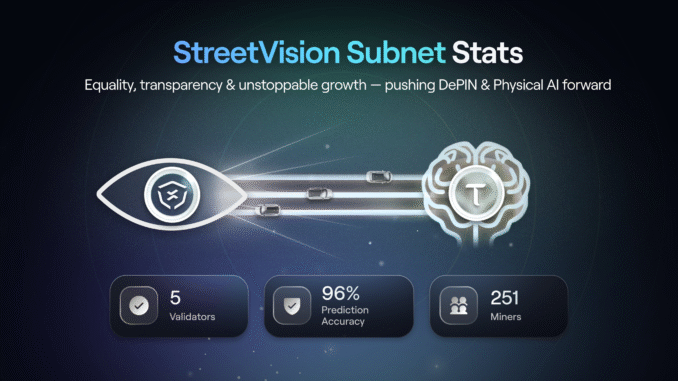
Three months after launch, StreetVision powered by NATIX has shown that decentralized, crowd-powered AI isn’t just a fairer model—it’s a highly effective one. With miners achieving a 96% accuracy rate in detecting roadwork from 360° imagery, the subnet is making the case that physical AI, powered by incentives and distributed consensus, can outperform traditional siloed systems.
How StreetVision Works
StreetVision operates as a Bittensor subnet. In this case, the focus is on road infrastructure: detecting and mapping roadworks from 360° street-level imagery.
The subnet today is composed of 256 participants, 251 miners detecting/mapping and 5 validators ensuring accuracy.
Together, this decentralized cohort has already processed over 133,000 detection tasks in just three months.
Miners: The Frontline of Intelligence
Miners in StreetVision are the backbone of the subnet. They process 360° imagery, flagging instances of roadwork with remarkable precision.
What makes the system unique is the way incentives are designed:
a. Rewards are performance-based: miners are paid not just for participation, but for accuracy.
b. Distribution is equitable: the top five miners are in close competition, but the average miner isn’t far behind.
c. Fairness is measurable: with a Gini coefficient of just 0.068, the network demonstrates near-equal distribution of rewards across contributors.
This ensures no single miner dominates—proof that decentralized incentive alignment can foster a genuinely collaborative system.
Validators: The Backbone of Trust
While miners generate predictions, validators safeguard the integrity of the subnet.
a. Only five validators currently operate, but they carry significant weight in the ecosystem.
b. Validators scale their rewards directly with stake and trust, ensuring incentives are fully aligned with the health of the network.
c. Key community actors like Yuma and RoundTable21 are already establishing themselves as critical nodes in the subnet.
Why This Matters
StreetVision isn’t just a subnet—it’s part of a broader movement that blends DePIN (Decentralized Physical Infrastructure Networks) with Physical AI.
a. For cities, it represents a future where infrastructure intelligence is not controlled by a single vendor but crowdsourced and community-governed.
b. For contributors, it shows that everyday participants can earn crypto by providing real-world intelligence, not just computational cycles.
c. For Bittensor, it underscores the strength of its marketplace model: aligning incentives so that every participant wins when the network improves.
The Bigger Picture
StreetVision (Subnet 72, powered by NATIX) illustrates how decentralized AI on Bittensor can support the development of infrastructure that would be more connected, efficient, and accessible.
The approach to achieve this is straightforward: collaborate, continuously refine, and drive new breakthroughs.
Useful Links
StreetVision: https://subnetalpha.ai/subnet/streetvision
NATIX: https://www.natix.network
Enjoyed this article? Join our newsletter
Get the latest Bittensor & TAO ecosystem news straight to your inbox.
We respect your privacy. Unsubscribe anytime.


Be the first to comment