
Some years are about ideas, others are about proof.
For Score (Subnet 44), 2025 was the year decentralised vision AI left the whiteboard and entered the real world. What began as a focused experiment in sports analytics matured into something much larger: a general purpose vision layer designed for production environments where accuracy, uptime, and reliability matter.
Over twelve months, Score moved from testing concepts on the football pitch to deploying live systems across industry, agriculture, energy, and service infrastructure. The shift was not incremental, it was structural.
This is the story of how theory became infrastructure.
From Sports Thesis to Strategic Pivot
At the start of 2025, the computer vision market faced a paradox. Cameras were everywhere, but understanding what they captured remained expensive, centralised, and inaccessible to most organisations.
Score initially set out to challenge this imbalance through sport. Football, in particular, offered an extreme proving ground. Fast motion, constant occlusion, and unstructured play make it one of the most demanding environments for vision systems.
The insight was that if decentralised models could reliably interpret a live football match, they could likely handle more structured environments beyond sport.
Football was never the destination, it was the stress test.
Solving the Labeling Constraint
The first major barrier to scale appeared quickly: Traditional computer vision pipelines rely heavily on human annotation. That approach does not scale across industries, geographies, or data volumes.
The answer came through a fundamental architectural shift.
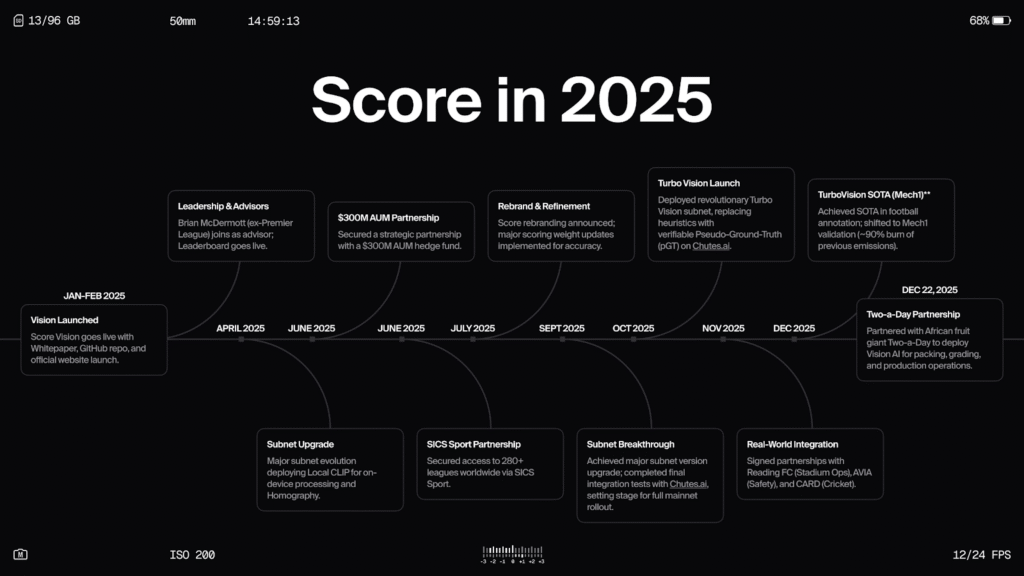
In mid-2025, Score introduced Turbo Vision, a new approach built around visual language models and pseudo-ground truth generation. Instead of relying on manual labels, the system allowed models that already understand the visual world to label data autonomously.
The impact was immediate.
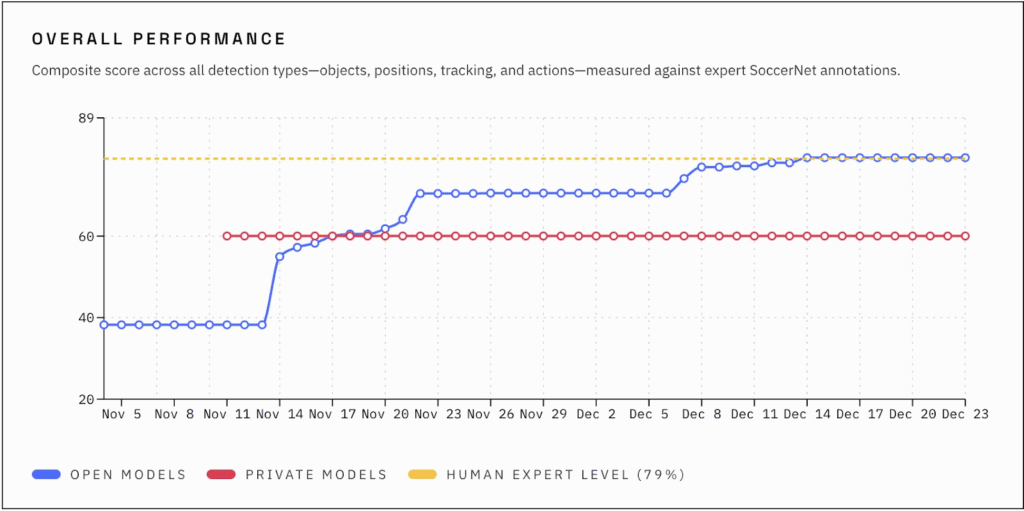
By December, Turbo Vision achieved state-of-the-art (SOTA) performance in football annotation, surpassing expert human-level benchmarks. This was not a marginal improvement, it was a decisive leap that rendered legacy approaches obsolete.
Score responded accordingly by retiring most legacy emissions and consolidating around the new standard.
Decentralised research had crossed into production grade reality.
From Engine to Product: The Emergence of Manako
Turbo Vision unlocked something larger than better sports analytics, it revealed a universal capability. If models could understand complex, unstructured scenes without human guidance, the same system could be applied to factories, farms, stations, and cities.
This insight led to the creation of Manako.
Manako is not a research tool, it is a managed vision platform designed for operators and developers who need deterministic, reliable outcomes. Instead of conversational outputs, Manako delivers stable, versioned vision pipelines exposed through simple APIs (Application Programming Interfaces).
Plain language requests are translated into composable systems built from specialised elements where performance is predictable, upgrades are continuous, and vision becomes infrastructure.
Football validated the approach, Turbo Vision powered the engine, and Manako became the product.
Proving Value Outside the Crypto Bubble
Technology alone is not validation, deployment is. In 2025, Score crossed into the real economy through a series of live partnerships that tested its systems under continuous, high stakes conditions.
a. Sports and Performance Analysis
Score partnered with Reading FC to deploy the Reading Model, automating scouting from lower league footage and reducing human bias. The system demonstrated how decentralised intelligence could outperform legacy analytics in both cost and coverage.
In cricket, Score partnered with CARD under the leadership of Nathan Leamon to democratise elite ball tracking. Using standard broadcast footage, the goal is to match gold standard accuracy while unlocking access for emerging teams and leagues.
The effort also enables the creation of a fully-owned historical cricket database at global scale.
b. Industrial and Energy Infrastructure
The partnership with AVIA marked Score’s expansion into general vision. Deployed across thousands of petrol stations, the system monitors equipment health, safety conditions, and operational anomalies around the clock. This validated Score’s ability to handle continuous workloads in mission critical environments.
c. Agriculture and Supply Chains
With Two-a-Day, one of Africa’s leading fruit exporters, Score entered agricultural production. The models were tested against variable lighting, organic shapes, and high-speed conveyor systems. From defect detection to flow optimisation, the deployment confirmed that the same vision engine could handle both mechanical precision and natural variability.
d. Service Infrastructure
The year closed with a partnership with Lavance, France’s leader in vehicle wash infrastructure. Across thousands of stations, Score’s vision systems are being used to detect mechanical anomalies, safety risks, and performance degradation in real-time. The shift from reactive maintenance to predictive operations reflects the practical value of an always-on intelligence layer.
Strengthening the Foundation
Alongside visible deployments, 2025 was also about building quietly but deliberately. Score expanded its leadership across engineering, sport, and business.
It secured access to large-scale training data through partnerships spanning hundreds of leagues. It launched internal systems that demonstrated measurable financial performance, connecting vision intelligence directly to capital allocation.
These steps transformed Score from a promising protocol into a functioning organisation capable of sustained delivery.
2026: Distribution at Scale
If 2025 was about proving the engine works, 2026 is about putting it to work everywhere. Three priorities define the year ahead:
a. Launching Manako as a Public Platform
Manako will move from internal infrastructure to a public utility. Developers and businesses will gain direct access to the element economy through a simple SDK (Software Development Kit), without the need for specialised machine learning teams.
Because the underlying elements continuously improve through network competition, deployed systems become more accurate over time without retraining.
b. From Perception to Prediction
Score has achieved reliable perception which is the next frontier is understanding and foresight.
In 2026, semantic reasoning and predictive modelling will move to the foreground, enabling systems to interpret events, detect intent, and forecast outcomes with confidence across industries.
c. Deeper Integration Across Sectors
Expansion will focus on embedding vision intelligence directly into partner stacks across logistics, retail, security, healthcare, and infrastructure. The goal is to become the invisible intelligence powering critical systems.
‘Powered by Manako’ becomes a mark of operational maturity.
Closing Reflections
The infrastructure is built and the engine is verified. What began as a sports experiment has become a decentralised vision layer for the physical world.
Score enters 2026 not as a concept, but as a system already operating where accuracy and reliability matter most.
Every camera, thanks to Score, is becoming intelligent and this is only the beginning.
Enjoyed this article? Join our newsletter
Get the latest Bittensor & TAO ecosystem news straight to your inbox.
We respect your privacy. Unsubscribe anytime.


Be the first to comment