
Genomic medicine has already changed oncology, what it has not changed is access.
Today, sequencing a patient’s DNA and identifying clinically meaningful mutations is technically possible, scientifically validated, and commercially available.
Yet it remains slow, expensive, and centralized. Turnaround times can stretch for weeks, costs can run into the thousands (if not millions), and the infrastructure behind it is concentrated in a handful of advanced labs serving a fraction of the global population.
What if genomic analysis were not a service sold by a few institutions, but a performance market open to anyone capable of delivering accuracy?
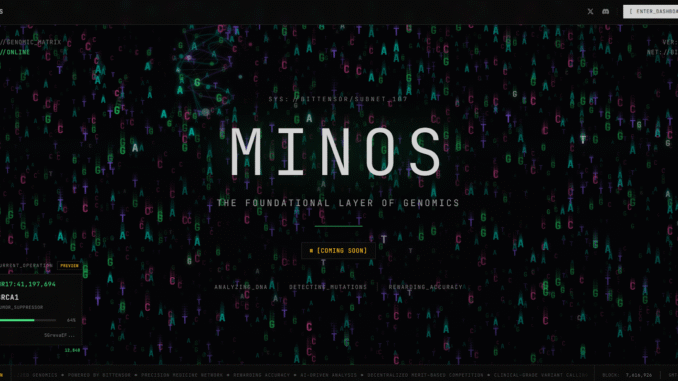
That is the premise behind Minos, a genomics-focused subnet built on Bittensor, designed to be the economic layer for genomic intelligence.
From Centralized Labs to Competitive Intelligence
Modern precision medicine depends on one critical step: identifying meaningful variants in a person’s DNA.
The process, known as variant calling, involves scanning billions of genetic “letters” to detect mutations that may be linked to cancer or other diseases.
When done correctly, it enables:
a. Targeted therapies,
b. Early intervention strategies, and
c. Risk stratification for families.
Today, dominant players such as Illumina, Foundation Medicine, and Tempus operate within a traditional model:
a. Collect samples,
b. Run proprietary pipelines,
c. Deliver results, and
d. Bill accordingly.
While this model works, it is capital intensive, geographically limited, and structurally exclusive.
Minos approaches the same problem from a different angle by decentralizing performance instead of centralizing pipelines.
What Subnet 107 Actually Incentivizes
Minos turns genomic analysis into a competitive marketplace. On Subnet 107:
a. Miners process genomic datasets,
b. Validators score outputs against reference benchmarks, and
c. Rewards are distributed in $TAO based on measurable accuracy and efficiency.
To measure success, two key questions on important variables need to be asked:
a. PRECISION: How accurately does a miner detect clinically relevant mutations compared to established benchmarks?
b. EFFICIENCY: How much compute is required to achieve that level of accuracy?
This dual incentive matters as it discourages brute force solutions that consume excessive resources while maintaining high-scientific standards.
Performance is not self-reported, it is scored, and the scoring directly impacts economic reward.
What Makes This Different From a Traditional Genomics Startup?
A conventional startup would raise capital, build proprietary pipelines, and sell services to hospitals or researchers. Minos approaches this quite differently, it inverts this same structure.
Instead of owning the compute and charging clients, it creates a network where compute is distributed, methods compete transparently, and accuracy is continuously benchmarked.
The result is an open performance market for genomic intelligence. If the network improves variant detection, the gains are embedded in the system’s competitive dynamics rather than captured behind corporate walls.
The Long-Term Implications
Genomics scales with data and compute. Thus, Subnet 107 can, in theory:
a. Aggregate global compute resources,
b. Continuously refine pipelines through competition, and
c. Lower marginal cost per genome.
Over time, this could alter three constraints that define today’s system:
a. Cost,
b. Turnaround time, and
c. Access.
If genomic pipelines become cheaper and faster without sacrificing accuracy, downstream applications expand:
a. Oncology treatment selection,
b. Rare disease diagnostics,
c. Large-scale research cohorts, and
d. Preventive health modeling.
This is a structural possibility created by incentive design.
Why Timing Matters
Minos is still very early: Whitepapers, formal roadmaps, and expanded integrations are still developing. Validators are joining, and benchmarks are being refined.
Early stage decentralized networks are fragile, incentive misalignment can undermine quality, and poor benchmarking can distort rewards.
But if Subnet 107 successfully maintains rigorous validation, transparent scoring, and scientifically-grounded evaluation metrics, it becomes more than a niche experiment.
It becomes a test case for whether decentralized AI can operate in domains where precision is non-negotiable.
A Shift in Philosophy
Minos is not arguing that blockchain replaces biology, it is proposing that economic competition can enhance scientific output.
Instead of billing for access to genomic insight, the system rewards those who produce it most accurately and efficiently. While this distinction might be subtle, it is so significant.
In one model, knowledge is sold, and in the other? Knowledge is competitively earned and continuously refined.
Conclusion: Infrastructure Before Impact
Cancer genomics is not solved by a subnet, it’s an infrastructure that determines what becomes possible.
If Minos proves that decentralized competition can produce clinically reliable variant detection at scale, it will have done something meaningful.
This can be achieved neither because it would use a token, nor because it would sit on a blockchain. But because it would redesign the incentive layer beneath genomic intelligence.
Precision medicine today is constrained by cost and centralization, and Subnet 107 is an attempt to remove those constraints by turning accuracy itself into the reward.
Whether it succeeds will depend not on narrative, but on numbers.
Be the first to comment