
Quasar, a decentralized AI project, is now live on the Bittensor network as Subnet 24. Kind of like opening a gym where independent people compete to make AI better at remembering and reasoning over huge amounts of information.
The problem Quasar solves is simple but huge: regular AI forgets stuff when you give it too much information at once. If you ask ChatGPT to analyze an entire book or a massive codebase, it’ll likely start losing details or just give up. Quasar built an AI that can handle millions of tokens with near-perfect recall.
What Quasar Is Actually Trying to Build
Quasar isn’t trying to be “another chatbot.”
Quasar is trying to build an AI that can read your entire codebase, every line, and actually remember all of it when answering questions. Or read a whole book series and recall tiny details from book one when you’re asking about book five.
A simple way to picture it:
Regular AI: “I can handle about 100 pages before I start forgetting stuff from the beginning.”
Quasar AI: “Give me 10,000 pages. I’ll remember all of it with 99.9% accuracy.”
That matters a lot when you need AI to actually work with large amounts of information, like legal documents, financial reports, entire software projects, and medical records.
The Memory Wall Problem
Here’s the technical thing that Quasar fixed, explained simply.
Regular AI (like ChatGPT) uses something called “quadratic attention.” Without getting into math, this basically means: the more information you give it, the exponentially harder it works and the more it costs to run.
It’s like asking someone to remember everyone’s name at a party. Works fine with 10 people. Gets hard with 100 people. Nearly impossible with 1,000 people. The brain just hits a wall.
AI hits the same wall around 100,000 to 200,000 words. After that, it either forgets earlier stuff, gets too expensive to run, or just breaks.
Quasar uses ”linear attention” instead. This means if you give it 10 times more information, it only works 10 times harder, not 100 times harder.
So the party analogy becomes: this person can remember 10 names, 100 names, or 10,000 names with the same level of effort per name.
That’s why Quasar can handle millions of tokens (tokens are basically word chunks) without breaking a sweat.
Who’s Behind Quasar
Quasar was built by SILX Inc., a small AI research company from the Middle East and North Africa region.
- Youssef Farahat is the CEO with 4+ years of blockchain expertise. He is a part-time researcher and has been exploring advanced technologies and decentralized systems.
- Eyad Gomaa is the CTO and lead researcher. He’s been working on breaking past traditional AI limitations, specifically this memory problem. He published research on new attention mechanisms and basically said, “We can do this way better and way cheaper.”
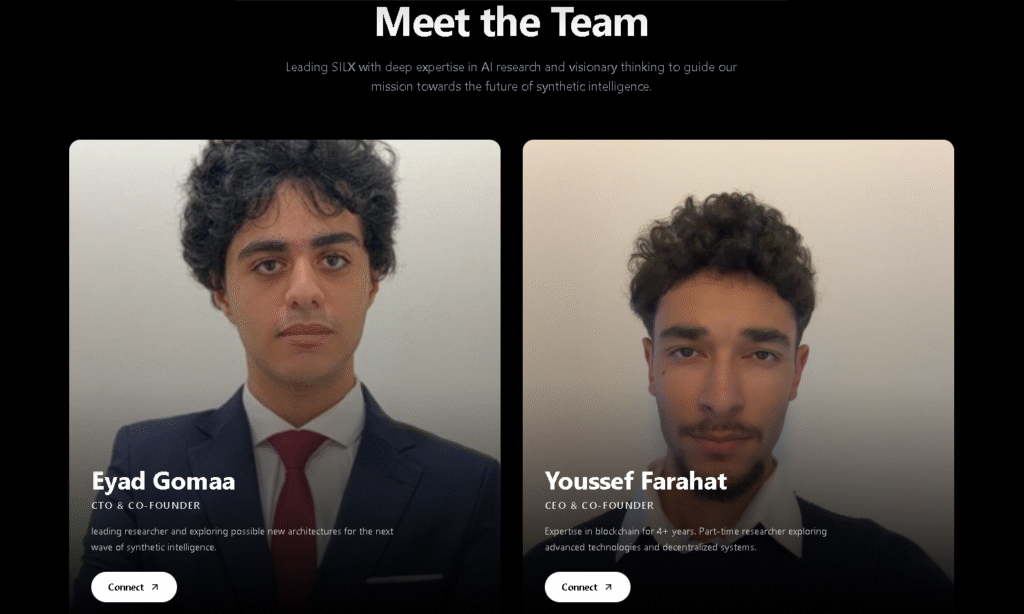
They’re backed by advisors from the Bittensor ecosystem, including people who run investment funds focused on decentralized AI projects.
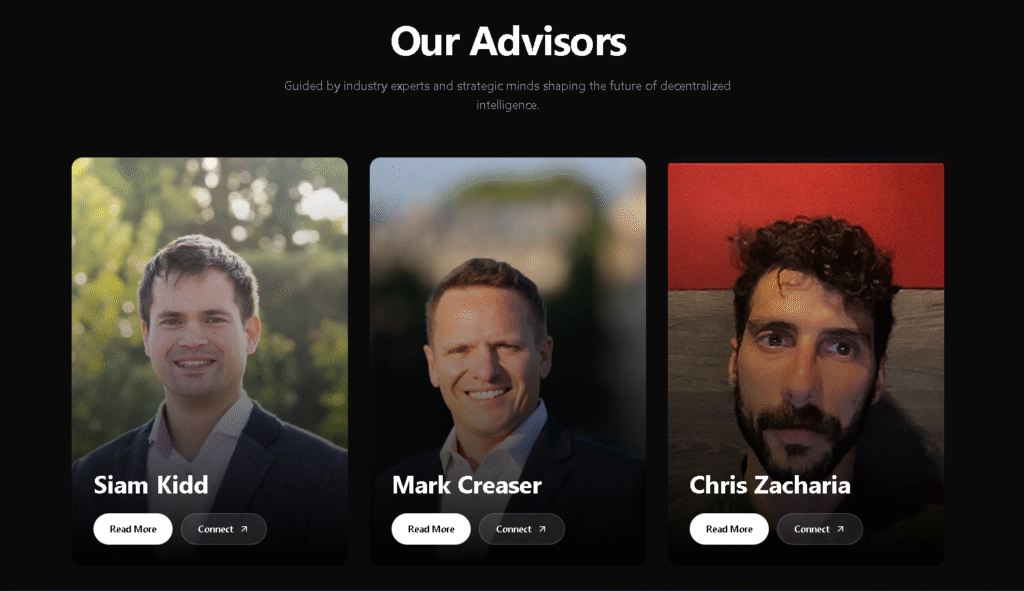
- Siam Kidd is an Ex-RAF pilot turned macro trader with 20+ years in markets, including £422K profit during the 2015 crash. He built and exited a crypto PE firm for £10.75M. And now, he drives thesis, allocation, and narrative for DSV Fund, spotting early signals and acting before consensus.
- Mark Creaser is an operator-investor with 20+ years of scaling growth, capital systems, and execution ops. He bridges signal with strategy at DSV Fund.
- Chris Zacharia is another advisor who is currently building distributed intelligence on Bittensor at Macrocosmos. He is also the creator of Bitstarter, Bittensor’s first crowdfunding platform, where you can discover new teams, pledge TAO, and get liftoff. All on-chain, built for Bittensor, open for all.
The Cost Breakthrough
Here’s a number that matters: Quasar trained their AI model for under $50,000.
Compare that to traditional AI companies like OpenAI, which spend $10 million or more training similar-sized models.
That’s 99.5% cheaper.
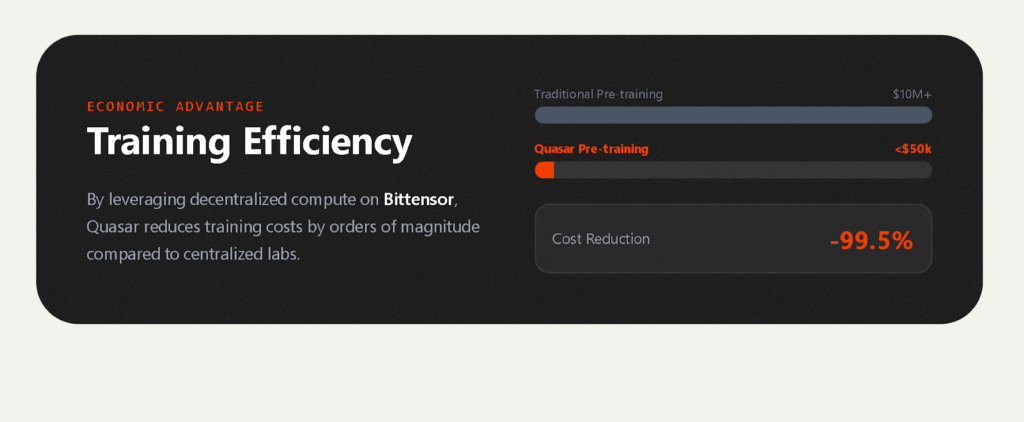
How? By using Bittensor’s decentralized network. Instead of renting expensive GPU clusters from big cloud companies, Quasar taps into thousands of regular people running consumer hardware worldwide. Competition keeps prices down. Decentralization spreads the work.
This isn’t just about saving money. It means small teams can compete with billion-dollar AI labs. It means AI development doesn’t require massive venture capital. It means more people can build advanced AI.
How Regular People Can Use Quasar
You don’t need to mine or validate to benefit from Quasar. There are simple ways to use it right now.
Quasar Copilot is their main product for normal users. It starts at $7 per month for the Standard plan. Think of it like ChatGPT, except it can actually handle your entire codebase or massive documents without forgetting.
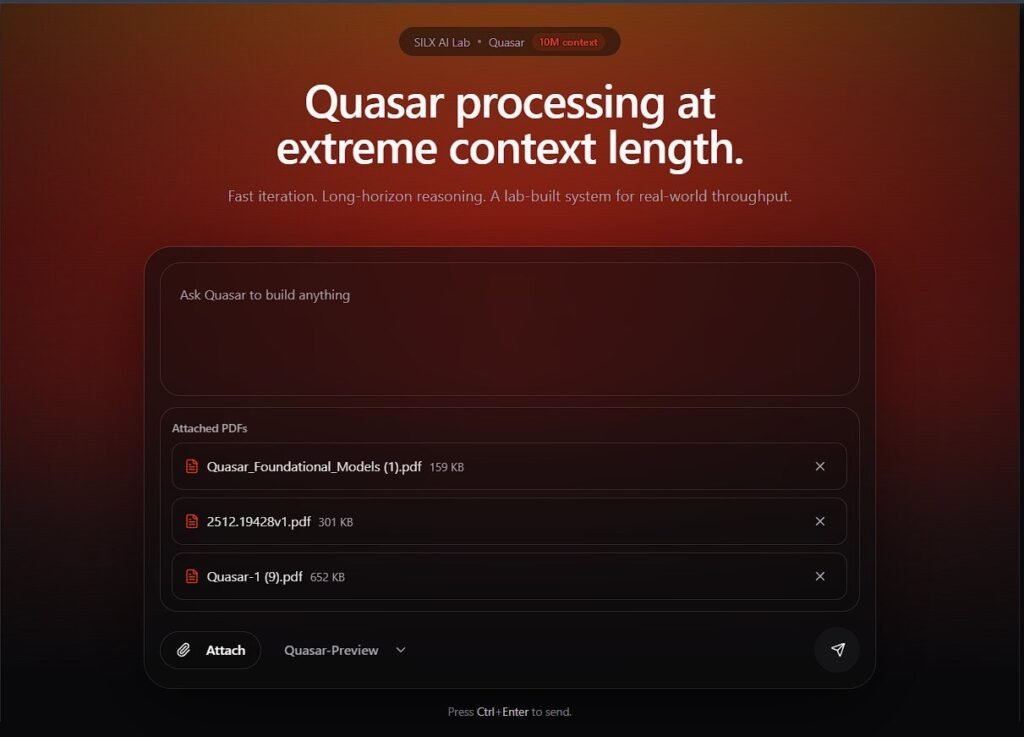
Use cases:
- Developers analyzing entire software projects
- Lawyers reviewing long contracts
- Researchers reading academic papers with perfect recall
- Writers keeping track of details across long stories
You just sign up, pay the subscription, and start asking questions about large documents. The AI remembers everything.
Open Source Models are also available for free. If you’re technical, you can download Quasar’s model weights from Hugging Face and run them yourself. The models work on consumer hardware, so you don’t need a supercomputer.
What Happens Now That It’s Live on Subnet 24
Now that Quasar is on Bittensor, it has to prove itself in public:
Miners run Quasar’s AI models and try to achieve perfect memory recall on long documents.
Validators test them with challenges, like hiding specific information in millions of words and seeing if the AI can find it.
The network rewards miners who perform best and punishes those who do poorly.
If Quasar can attract strong miners and validators and keep improving, it creates a loop: better memory performance gets rewarded, which attracts more miners, which makes the AI even better.
What’s Next
Quasar launched their 2026 roadmap in late January. The focus is:
- To publish more research on their attention mechanisms so that other teams can build on it.
- To improve performance even further, they’re targeting 10+ million tokens with the same reliability.
- They also plan to grow adoption through Quasar Copilot and partnerships with other apps.
- And to expand the miner and validator network to increase decentralization and reliability.
Enjoyed this article? Join our newsletter
Get the latest Bittensor & TAO ecosystem news straight to your inbox.
We respect your privacy. Unsubscribe anytime.
Be the first to comment