
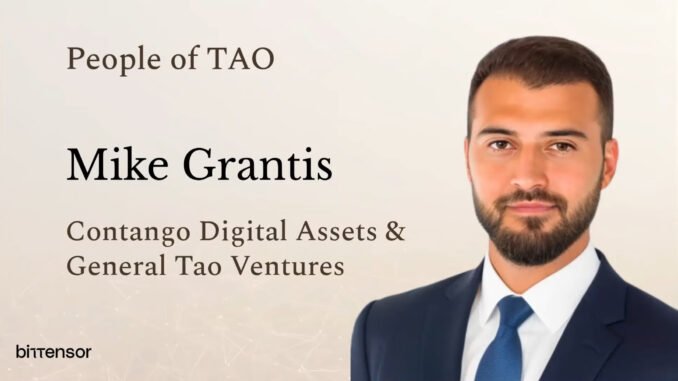
Some interviews feel routine, this one did not. When Mike Grantis joined People of TAO’s debut video chat, Louise Beattie (the host) opened with a simple invitation to introduce himself.
What followed quickly turned into a look at why one investor believes Bittensor is not just another crypto project, but a turning point in the race to decentralize artificial intelligence.
Mike explained that he has been in the blockchain space since 2016. He built a marketing company, scaled it into seven figures, launched a crypto media brand, sold it, and later co-founded the venture capital (VC) firm Contango Digital Assets.
Louise listened closely as he, Mike, described how his focus shifted over time. Early on, Contango explored the entire crypto landscape. But by mid 2023, he and his team could not ignore what was happening in artificial intelligence.
Centralization was becoming a concern and they started asking who would control the intelligence systems of the future.
That question was the beginning of everything.
The Moment Bittensor Clicked
Louise pushed further. She wanted to know whether Mike had a single moment that convinced him Bittensor was the future, or if it was gradual. Mike did not hesitate, he explained that
Someone in his investor circle shared the Bittensor whitepaper and reading it felt familiar. The structure reminded him of Bitcoin, the supply schedule matched and its tone carried the same first principles thinking. But the mission was entirely different.
Instead of securing money, Bittensor was coordinating intelligence.
He went into the Discord community and saw something that impressed him even more. The level of conversation was sharp, technical, and deeply thoughtful. It reminded him of early Bitcoin years when “the smartest people in the room were drawn to a new idea long before the world cared”. In his words, “that was the light bulb moment.”
From Investor to Builder
Louise noted that Mike had hinted at a new direction. That opened the door for him to explain what happened next.
Instead of remaining passive investors, Mike and his partners hired Bittensor-native developers and launched General TAO Ventures.
The firm committed to building across every layer of the network: Validation, mining, subnets and applications. Their belief was that the biggest winners in Bittensor will be the ones who build.
Louise described Bittensor’s pace as faster than earlier crypto cycles. Mike agreed and pointed to something even more interesting, “Bittensor can scale through sub-networks that eventually connect to one another.”
He explained Reed’s Law in simple terms, “when networks form sub-clusters that interact, value does not rise gradually. It can multiply.” That is why a future with subnets working together could become exponentially powerful.
Real Utility Beyond the Crypto Bubble
Louise observed that unlike early Bitcoin, Bittensor already produces real-world tools. Mike agreed and mentioned projects like Score, which operates in sports and computer vision without needing users to understand Bittensor at all. He also mentioned tools like Chutes, where people benefit from the output without even knowing the network behind it.
For him, that is a sign of genuine adoption. When utility grows faster than awareness, ecosystems often break out.
The Big Announcement: Project Rubicon
Project Rubicon Collaboration Lines Up
The tone shifted when Louise brought up his latest venture. Mike introduced Project Rubicon as a bridge designed to connect subnet ‘$ALPHA’ tokens to Base through Chainlink CCIP.
Using a relatable analogy, he said “Bittensor feels like an island. The technology and talent are already there, but the liquidity lives somewhere else.”
Rubicon brings subnet assets into an environment where everyday crypto users already operate. Anyone with a familiar wallet can now access $ALPHA without learning complex onboarding steps.
Every purchase on Base also creates buy pressure on the underlying token inside Bittensor, feeding liquidity back into the ecosystem.
Louise asked him to simplify the biggest benefit in plain language. Mike summed it up clearly: “It brings new buyers, new capital, and new cash flow into subnet pools. It lowers the barrier for the mainstream. And it gives subnet teams leverage when negotiating with larger exchanges.”
A Glimpse of What Comes Next
Before wrapping up, Louise asked what excites him most in the coming months. Mike revealed that General TAO Ventures is:
a. Close to 2 major acquisitions,
b. Preparing a rebrand, and
c. Launching new applications: Cartha and 0xMarkets on Subnet 35.
The team has grown to 15 members and is focused on building useful infrastructure for the entire Bittensor ecosystem.
The Person Behind the Vision
Louise closed on a more personal note. When asked for the best advice he ever received, Mike said it was simply to “keep going. Life gets noisy, people criticize, progress can be slow, but consistency wins.”
If he could choose a superpower, he joked about “controlling time”. And his favorite film is Inception because he loves stories that challenge how we think. “Classical music,” he added, “helps him work.”
Why This Conversation Matters
This episode was more than a technical breakdown or a business update, it captured a shift in mindset. Bittensor is no longer just attracting early adopters, it is attracting builders who see decentralized intelligence as a defining opportunity of the coming decade.Louise guided the conversation with curiosity. Mike answered with conviction. And together they revealed a simple but powerful takeaway: The future of intelligence may not belong to a single company or a single platform. It may belong to a network that rewards everyone who helps build it.
Enjoyed this article? Join our newsletter
Get the latest Bittensor & TAO ecosystem news straight to your inbox.
We respect your privacy. Unsubscribe anytime.

Be the first to comment