
![[OPINION] Bittensor Is Crypto’s Last Great Hope](https://taodaily.io/wp-content/uploads/2026/03/covenant-72B-1-678x381.png "covenant-72B (1)")
At the start of 2026, the crypto industry feels like it’s searching for direction. The energy from the last cycle has cooled, and conversations that once revolved around tokens and protocols are now dominated by artificial intelligence.
Builders are shifting focus, capital is rotating, and increasingly, the question being asked is simple: Does crypto still matter?
Against that backdrop, a quiet development inside the Bittensor ecosystem may have already answered that question.
This article is based on insights originally developed by 0xai.
The Breakthrough No One Reacted To, At First
On March 10, 2026, a Bittensor subnet under the order of Covenant Labs, Templar (Subnet 3), announced that it had trained a 72-billion parameter language model, the largest model so far to be trained on decentralized permissionless GPU nodes!
On its own, that might not sound unusual in today’s AI landscape, but the way it was done changes everything.
The model was trained:
a. By 70+ independent participants,
b. Without any centralized coordination,
c. Without corporate infrastructure, and
d. Using purely crypto-native incentives.
The results were publicly released, benchmarked, and verifiable. In several cases, the model outperformed comparable systems developed by major technology companies, and yet, the market barely reacted.
For nearly 48 hours, there was silence.
Only later did recognition begin to spread, followed by a sharp price movement. That delay is not just a curiosity, it’s a signal.
From Data Centers to Distributed Intelligence
To understand why this matters, it helps to revisit how AI models are typically built. Traditionally, training a large language model requires:
a. Massive GPU clusters,
b. Centralized engineering teams, and
c. Hundreds of millions in funding.
This model has defined the AI industry, concentrating power in a small group of organizations like Meta, Google, and OpenAI. Subnet 3 introduces a fundamentally different approach.
Instead of centralizing resources, it distributes them across a network of independent contributors. Individuals around the world provide compute, contribute to training, and are rewarded based on the value of their input.
At first glance, this sounds simple, in practice, it solves some of the hardest problems in distributed systems:
a. Verifying contributions without trust,
b. Preventing manipulation or low-quality input, and
c. Coordinating participants without a central authority.
Bittensor addresses these challenges through a token-driven incentive system that aligns behavior automatically.
Incentives as Infrastructure, Not Just Rewards
Templar’s success is a shift in how coordination happens, instead of relying on management or oversight, the system uses incentives as its organizing force.
Participants contribute training updates, the network evaluates their usefulness, and rewards are distributed accordingly.
No single party needs to:
a. Approve contributions,
b. Assign tasks, and
c. Enforce rules manually.
The system governs itself through economic signals, this is what makes the breakthrough meaningful.
It is not just about training a model, it is about proving that complex production systems can operate without centralized control.
Covenant-72B: A Milestone, Not a Marketing Event
The result of this process is Covenant-72B, a model that represents a meaningful step forward for decentralized AI.
Its characteristics are notable:
a. 72 billion parameters, placing it among large-scale models
b. Approximately 1.1 trillion tokens used in training
c. Around six months of distributed development
d. Contributions from over 70 global participants
Performance metrics reinforce its credibility:
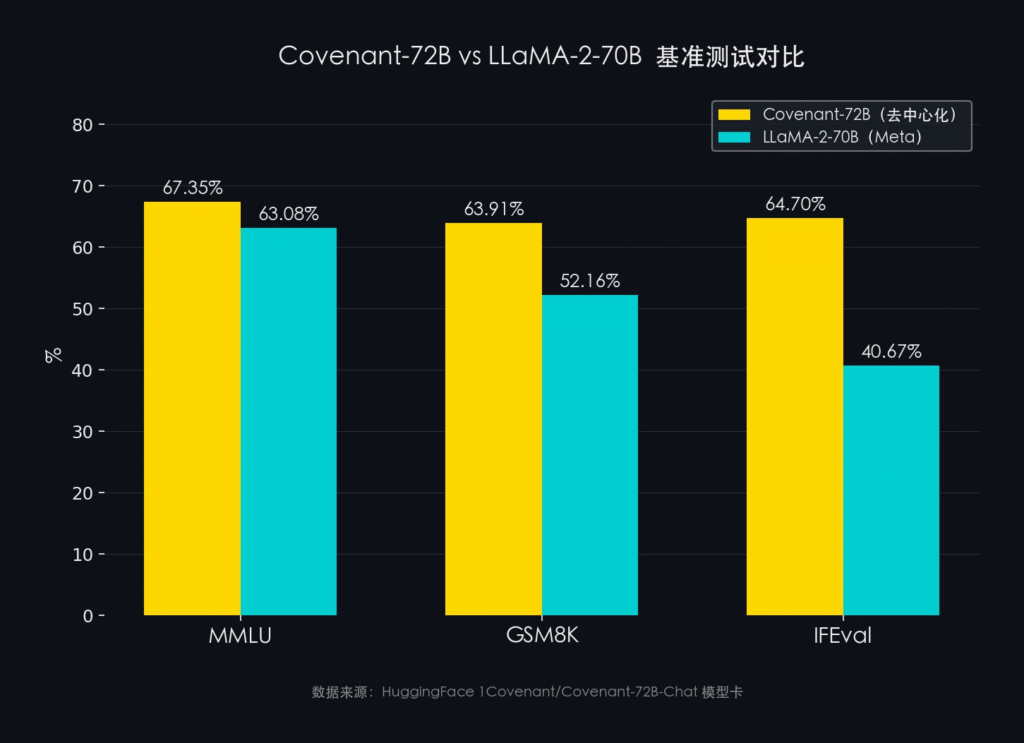
a. MMLU: 67.35%,
b. GSM8K: 63.91%, and
c. IFEval: 64.70%
The model is fully open-source, with supporting research submitted for academic review. This is not a conceptual demonstration.
It is a working system with measurable results.
Why This Changes the Shape of AI Development
The implications extend beyond a single model.
a. Open-Source AI Moves Up the Stack: Large-scale model training is no longer limited to well-funded labs. Distributed communities can now participate meaningfully at the frontier.
b. The Centralization Advantage Begins to Erode: If decentralized systems continue to improve, the structural advantage held by major AI companies may weaken over time.
c. Crypto Finds a New Role: For years, crypto has been associated primarily with financial applications. Subnet 3 suggests a broader role by coordinating real-world production systems through incentives.
d. Bittensor Crosses a Critical Threshold: This marks a transition from theory to execution, as the network has demonstrated that its model works in practice.
The Curve Matters More Than the Current Gap
It is important to remain grounded. Covenant-72B does not (not yet!) outperform the most advanced models available today. There is still a gap between decentralized systems and state-of-the-art AI, but focusing only on that gap misses the larger picture.
The trajectory of decentralized AI has been consistent:
a. Early experiments at small scale,
b. Gradual increases in complexity, and
c. A significant leap with Subnet 3.
What matters is not where the system stands today, but how quickly it is improving.
The Engineering Breakthroughs Behind the Scenes
Two technical developments made this progress possible.
a. Radical Efficiency in Communication: The system achieves over 99% compression, dramatically reducing the cost of coordination between participants.
b. Minimal Overhead, Maximum Productivity: Only a small portion of time is spent on communication, with the vast majority dedicated to actual model training.
These improvements address long-standing bottlenecks in distributed computing.
A Market Still Interpreting the Signal
The delayed reaction to the announcement reveals a broader disconnect. Different audiences interpret the same event in different ways.
a. Crypto Market Perspective: Often focused on price and narratives, it may underestimate the importance of infrastructure-level breakthroughs.
b. AI Research Perspective: Technically aware, but largely disconnected from token markets and valuation frameworks.
The result is a temporary gap between what has happened and what the market understands.
Repricing the Network: What Is Bittensor Really Worth?
If decentralized AI training continues to develop, Bittensor may need to be viewed differently.
Rather than a niche project, it could represent foundational infrastructure for a new class of systems.
At present, the market may still be valuing it as:
a. A speculative AI-related asset
b. A peripheral crypto experiment
But its actual role may be closer to being a coordination layer for decentralized intelligence, and that’s all that matters.
The Bigger Shift: From Capital Coordination to Intelligence Coordination
For most of its history, crypto has excelled at coordinating capital: Payments, DeFi, and asset issuance.
Templar (Bittensor Subnet 3) introduces something new by showing that the same mechanisms can be used to coordinate:
a. Computation,
b. Contribution, and
c. Intelligence itself.
This expands the scope of what crypto networks can do.
A Different Answer to Crypto’s Identity Crisis
The question facing crypto in 2026 is not just about price or adoption, it is also about relevance. What role does this technology play in a world increasingly shaped by artificial intelligence?
Subnet 3 offers a compelling answer: It demonstrates that decentralized networks can organize complex, high-value production without relying on centralized control; It shows that incentives can replace coordination structures that were once thought necessary; And it suggests that crypto’s future may lie not just in finance, but in enabling entirely new forms of collaboration.
Bittensor, in this context, is an early example of what that future might look like, and if that direction holds, then the question is no longer whether crypto still matters.
It is whether we have fully understood what it is becoming.
Enjoyed this article? Join our newsletter
Get the latest Bittensor & TAO ecosystem news straight to your inbox.
We respect your privacy. Unsubscribe anytime.



Be the first to comment