

By: CryptoZPunisher
Omron (Subnet 2) is Inference Labs’ attempt to build the world’s largest peer-to-peer network for verifiable artificial intelligence within Bittensor. The core of the protocol relies on Proof of Inference and, more recently, on Proof of Weight. These two zero-knowledge (zk-ML) building blocks ensure that results generated by AI models are cryptographically verifiable, without needing to redo calculations or trust a centralized authority.
A Project by Inference Labs
Omron (Subnet 2) is developed and maintained by Inference Labs, a team specialized in applying zero-knowledge techniques to distributed artificial intelligence. Their goal is to make Omron a trusted network for verifiable AI computation, applying rigorous cryptographic standards at the heart of the Bittensor protocol. The team also authored the technical proposal “Proof of Weights” and the whitepaper Sertn – A Verified Inference Network.
ELI5 – Explain Like I’m 5
Imagine you ask a robot to solve a math problem, but you want to be sure it didn’t cheat. With Omron, the robot gives you the answer and a cryptographic proof that it solved the problem itself. Other robots (validators) can instantly verify this proof without recalculating everything. It’s like a certified stamp on a homework assignment.
How Does Omron Work?
Role of Miners
- Receive input data from validators.
- Use an AI model to generate a prediction.
- Transform that prediction into a zk cryptographic proof.
- Send the prediction + proof back to the requesting validator.
Role of Validators
- Produce and send inference queries.
- Verify the returned proofs without recomputation.
- Score miners based on proof size, response time, validity, and (since v2) output accuracy.
Technical Evolution: SN2 Roadmap
Version 1 – Initial Deployment
- LSTM model specialized in staking duration prediction.
- Scoring based on: proof size, validity, latency.
- Fully operational Proof of Inference.
Version 2 – Live on SN2 Since 2024
- Introduction of multiple AI models (freedom for miners).
- Integration of output accuracy-based scoring, compared to a local reference model.
- Validators can generate their own queries or accept external ones.
- Strengthened cryptographic interaction via Verification Keys (VK) shared by miners.
- Expanded deployment on Ethereum with support for points, ezETH, and Renzo.
Proof-of-Weights Enabled
Since version 0.2.1 (mid-2024), Omron includes Proof of Weight, a zk extension that forces validators to prove they have genuinely executed the miner scoring process. This mechanism:
- prevents blind weight copying,
- reinforces reward integrity,
- enhances transparency around validators’ real contributions.
Live Stats – SN2 Dashboard

A Marketplace for Verifiable AI
Omron positions itself as a verifiable infrastructure for critical AI predictions, particularly in:
- Staking and restaking optimization (LST/LRT)
- Decentralized computation for DAOs or DeFi services
- Use cases in cybersecurity, risk scoring, and consumer AI
Its zk-proofs are already used by partners like Benqi, TestMachine, and Renzo, in environments requiring reliability, auditability, and trustless security.
Frequently Asked Questions (FAQ)
To better understand how Omron operates, here are some official highlights directly from their website:
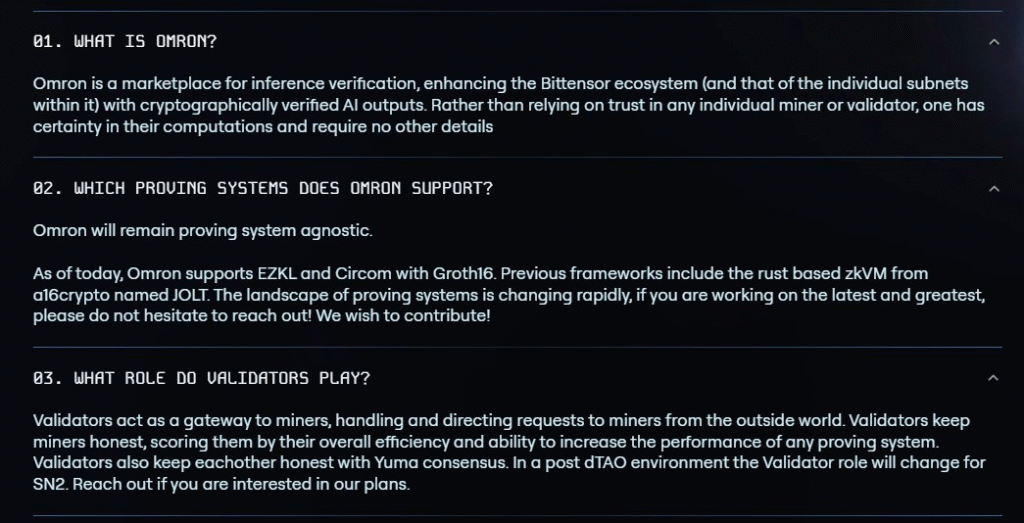
FAQ – Part 1
Covers:
- What is Omron?
- Which proving systems does Omron support?
- What role do validators play?
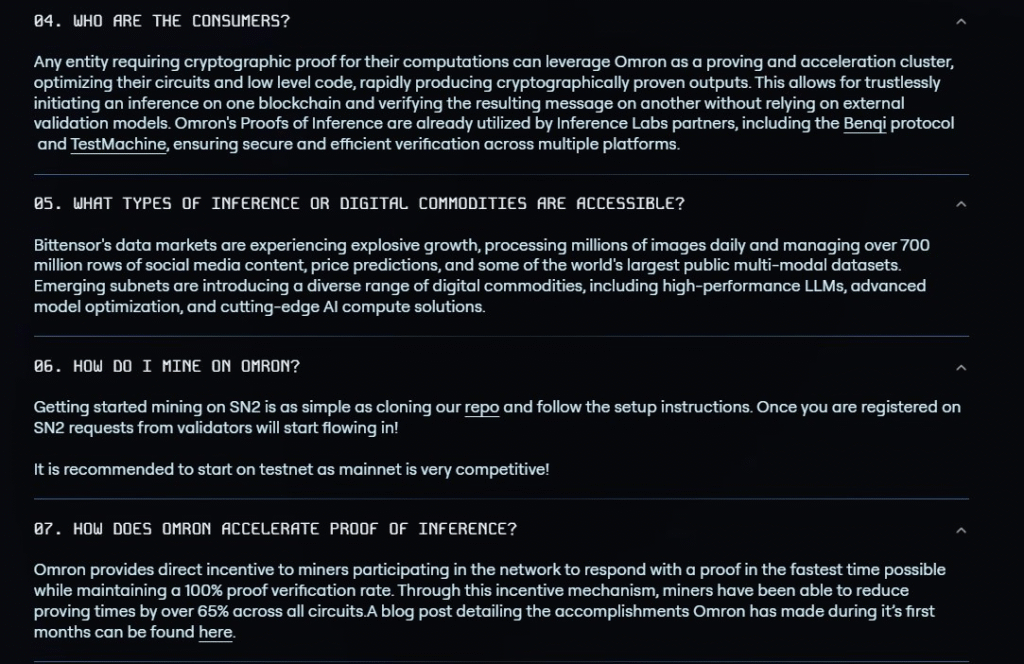
FAQ – Part 2
Covers:
- Who are the consumers of Omron?
- What types of inference or digital commodities are accessible?
- How do I mine on Omron?
- How does Omron accelerate Proof of Inference?
Limitations and Considerations
- The system is technically complex, especially for validators (VK management, local scoring…)
- zk-proof optimization remains CPU-intensive (soon also GPU?)
- Ethereum interoperability is still maturing (points, bridging, withdrawals)
A Hidden Gem in the Bittensor Ecosystem
Despite its foundational innovations, Omron remains surprisingly under the radar of dTAO investors, who often favor more visible or consumer-facing subnets. This low profile may stem from the technical depth of the project and the absence of aggressive marketing. Yet, Omron addresses a fundamental need of the Bittensor network: ensuring the reliability, traceability, and verifiability of AI predictions in an open, incentivized environment.
By delivering cryptographically verifiable proofs for both miner and validator roles, Omron strengthens the resilience of Yuma Consensus, paves the way for secure autonomous subnets, and lays the groundwork for a future standard of trustless AI in distributed systems.
Backed by Deep Tech Investors
The research-driven group DSV (Decentralized Systems Ventures) made a $50K OTC investment into Inference Labs, the team behind Omron (Subnet 2). In their announcement, DSV described Omron as “SSL for AI” — a system that guarantees your answer came from the intended model, without substitution or tampering.
They praised Omron’s use of zkML (zero-knowledge machine learning) to enable trust without revealing models or data, highlighting its usefulness in DeFi, integration with Ethereum, and a roadmap focused on rewarding quality and enabling real-world usage.
“We invest in foundational infrastructure for the future of intelligence. Not trends, not buzzwords – real, useful systems. Omron is one of them.”
Source: DSV
Sources and Useful Links
Official
- Website: omron.ai
- Inference Labs
- Documentation: docs.omron.ai
- GitHub: github.com/inference-labs-inc/omron-subnet
- Dashboard: stats.omron.ai
- WandB Dashboard: wandb.ai/inferencelabs/omron
Socials
- X (Twitter) Omron: x.com/omron_ai
- Inference Labs: x.com/inference_labs
- Sudo Ron (co-founder): x.com/sudo_ron
- Colin Gagich (co-founder): x.com/colingagich
- Hudson Graeme (core contributor): x.com/hudsongrae_me
Technical & Proofs
- Whitepaper: Sertn – A Verified Inference Network (April 2024)
- sertn-whitepaper.pdf
- “Proof of Weights” proposal: github.com/opentensor/bits/pull/10
Verifiable artificial intelligence and zero-knowledge proofs are not just technical upgrades — they fundamentally reshape how trust is established in digital systems in the 21st century.
🗺️ All links are listed on Magellan, the unique mind map of the network:
💜 Support my work if you enjoy my content and appreciate Magellan, you can support my work:
💸 Donation address: 5DnZ7Evyund7fPcBzntyVoNgzULTdyhscYCSzJA569131aGR
Enjoyed this article? Join our newsletter
Get the latest Bittensor & TAO ecosystem news straight to your inbox.
We respect your privacy. Unsubscribe anytime.
Be the first to comment