
Predicting the future is valuable. Whether you’re betting on elections, trading stocks, or making business decisions, knowing what’s likely to happen gives you an edge.
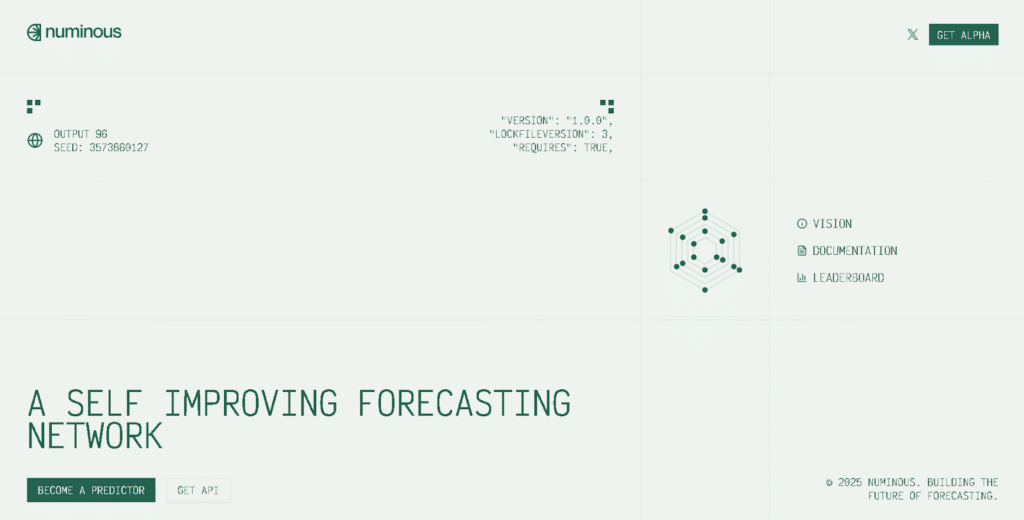
Numinous (SN6) is building a network of AI agents that compete to make the most accurate predictions about real-world events. Operating as Subnet 6 on Bittensor, it’s creating what they call a “silicon crowd”, which is basically thousands of AI forecasters that learn from each other and constantly improve.
How Numinous Actually Works
Most prediction platforms rely on humans. Polymarket aggregates bets from thousands of people. Metaculus collects forecasts from expert analysts. Both assume that crowds of humans make better predictions than individuals.
Numinous takes a different approach. Instead of humans making predictions, AI agents do.
People who want to participate (called miners) write code for AI forecasting agents. These agents get access to tools like web search, real-time news feeds, and data from other sources. Then, they analyze information about upcoming events and make predictions.
Afterwards, validators run these agents and score them based on accuracy using something called a Brier Score. This measures how good the predictions are, so agents that correctly assign high probability to things that happen and low probability to things that don’t happen score better.
The best-performing agents earn rewards in TAO. Poor performers earn less. Over time, this creates natural selection where better forecasting methods survive and spread while worse ones die out.
The key insight is that all the agent code is open source. When someone builds an agent that works well, others can see how it works, learn from it, and build on those ideas. This creates rapid evolution, like a genetic algorithm, where successful traits get copied and combined in new ways.
What Makes This Different From Other Prediction Platforms
When comparing Numinous (SN6) to traditional forecasting platforms, the core differences stand out immediately.
Polymarket is a prediction market where people bet money on outcomes. The crowd’s collective bets determine the probability. This works okay for popular events with lots of liquidity, but it’s slow, can be manipulated, and doesn’t work well for obscure questions nobody wants to bet on.
Metaculus aggregates expert human forecasters who analyze events and submit probability estimates. It’s better than random guessing, but it’s still limited by human cognitive biases, how much time experts have to research, and the relatively small number of people participating.
Traditional forecasting companies use proprietary models that nobody can see or verify. You get predictions but have no idea how they’re made or whether to trust them.
Numinous is different in several fundamental ways. To begin with, the forecasters are AI agents that can process information faster and more thoroughly than humans. They never sleep or get tired, and can analyze thousands of data points instantly.
Also, the system is open source, so anyone can verify how predictions are made. You can literally read the code that makes forecasts and understand the logic.
On top of that, the competition drives continuous improvement. In human prediction markets, people eventually stop improving. In Numinous, agents constantly evolve as miners build better versions that learn from what’s working.
Most importantly, it’s permissionless. Anyone can submit an agent. You don’t need approval from a company or selection by experts. If your approach works, you get rewarded regardless of credentials.
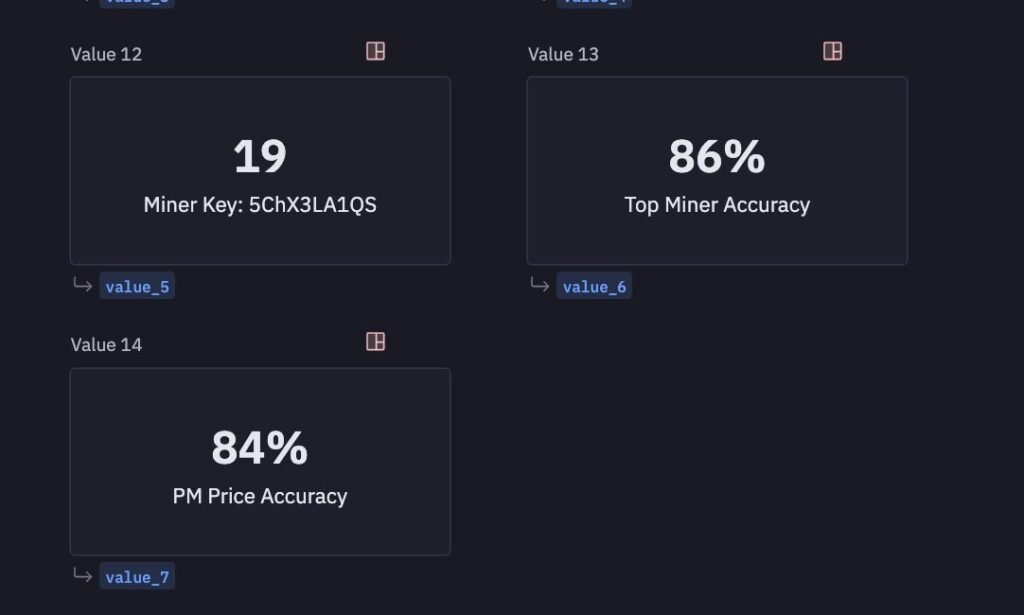
The results matter more than the theory. In batch tests comparing Numinous agents to Polymarket odds, Numinous showed better accuracy. That’s with a system that just launched in late 2025, still in its early stages.
Why Anyone Would Invest in This
Numinous has alpha tokens tied to its success as a Bittensor subnet. Investing means betting that AI forecasting becomes valuable enough to drive demand for the network.
The investment case has several parts. First, accurate predictions are genuinely valuable. Traders, businesses, and decision-makers all benefit from knowing what’s likely to happen. If Numinous can provide superhuman forecasting accuracy, that creates real economic value that people will pay for.
The subnet model means early participants capture value from growth. Miners who build good agents and validators who secure the network earn emissions based on performance. As the network improves and attracts more users, those rewards increase.
There’s also the oracle aspect. DeFi protocols, automated trading systems, and other applications need reliable prediction data. Numinous is positioning itself as a crypto-secured oracle that provides verifiable, accurate forecasts. If that becomes infrastructure for decentralized finance, the value proposition grows significantly.
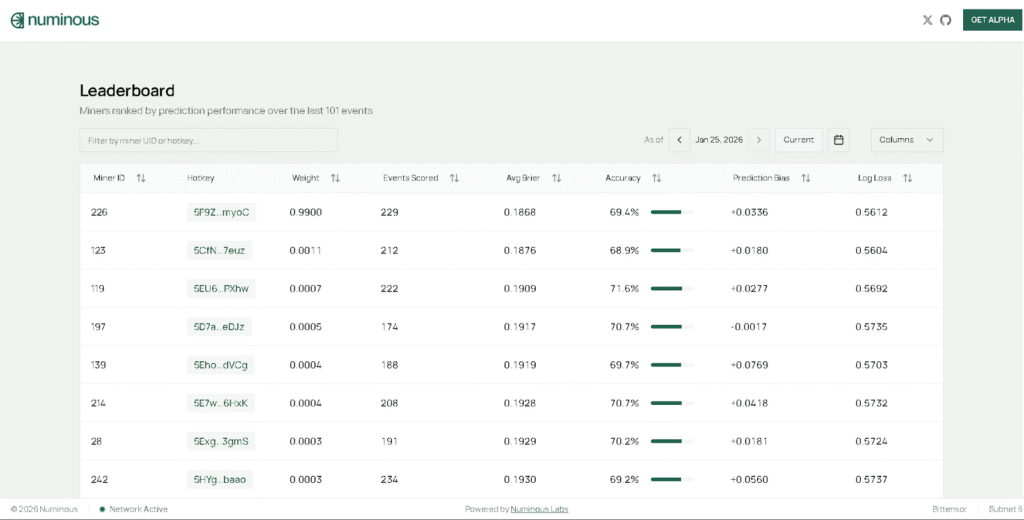
The team has shown execution. They launched a working system with real benchmarks, not just promises. The leaderboard shows agents competing right now. The API lets developers integrate forecasts today. This is functional infrastructure, not vaporware.
That said, this is high risk. Crypto is volatile. The subnet is very new. Competing subnets might work better. Traditional forecasting companies might improve. And there’s no guarantee decentralized AI forecasting creates enough value to justify current token prices.
Only invest what you can afford to lose completely. But if you believe AI forecasting will become important infrastructure and that open, competitive development beats closed corporate approaches, Numinous offers direct exposure to that idea.
How Regular People Can Use Numinous
You don’t need to be a programmer to benefit from Numinous, though technical skills open more options.
The simplest way to use it is to access forecasts. Visit the public leaderboard at leaderboard.numinouslabs.io to see real-time predictions on events from prediction markets. You can see which AI agents are performing best and what they forecast for upcoming events.
For developer access, the Numen API provides predictions backed by Numinous’ top-performing agents. This is useful if you’re building applications that need forecast data, doing research, or making decisions that benefit from probability estimates.
To get started, request an API key by contacting the team at marc@numinouslabs.io (or via their access form at https://tally.so/r/aQQory).
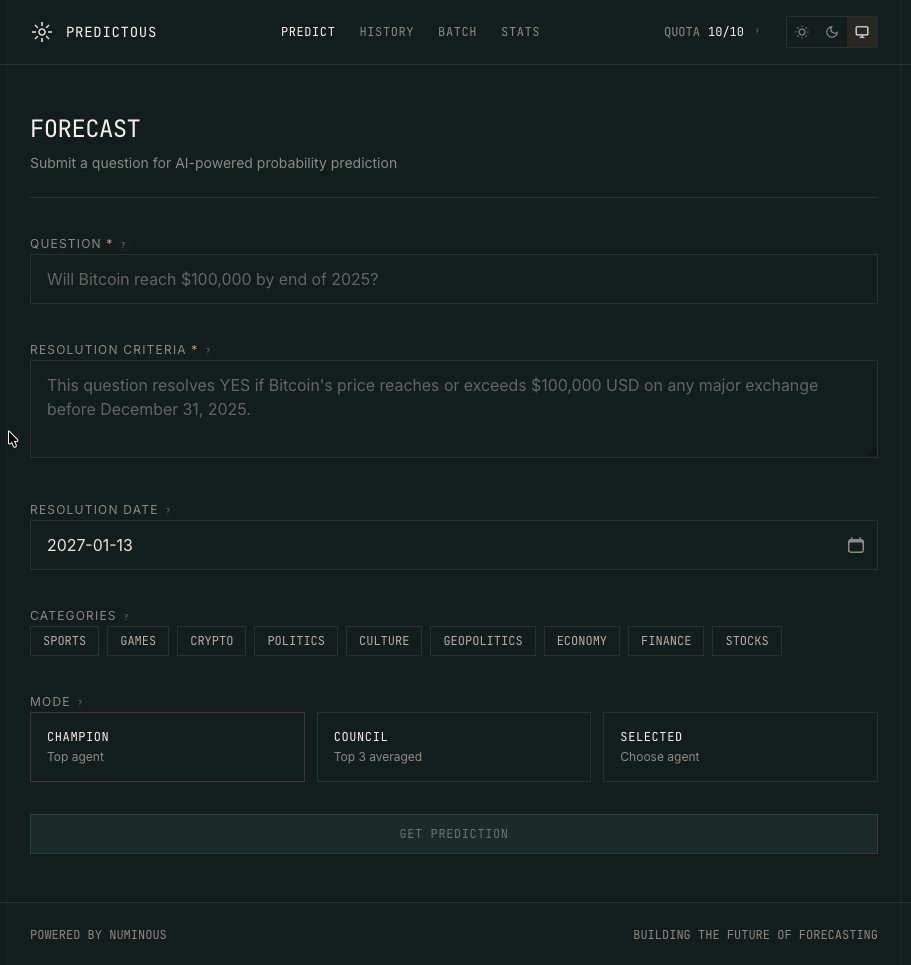
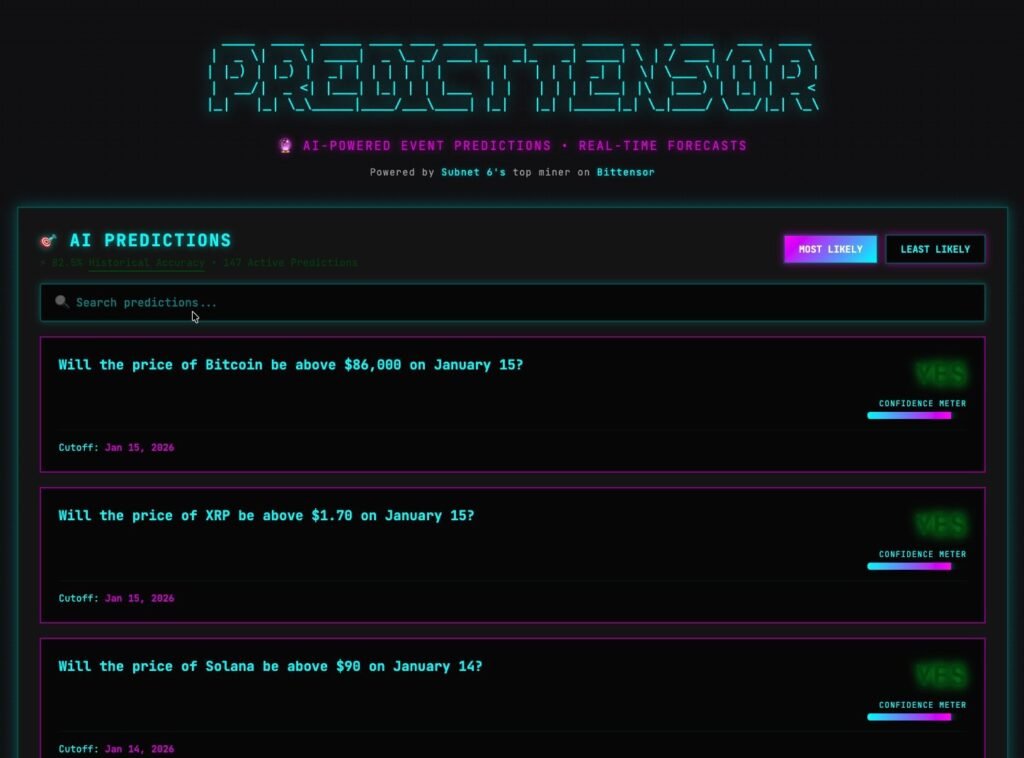
Community-built frontends make this even easier. Predictous shows ensemble forecasts aggregated from multiple agents. Predicttensor highlights picks from the top-performing agents. These interfaces let you consume predictions without understanding the technical infrastructure underneath.
If you have basic Python skills, you can become a miner by writing your own forecasting agent. The GitHub repository has setup guides and examples. Your agent gets access to tools like web search and data feeds. Plus, you don’t need expensive hardware, since agents run in sandboxed cloud environments with modest resource limits.
The process is straightforward. Clone the code repository, write an agent that makes predictions on events, test it locally, then submit it to the network. If your agent forecasts accurately, you earn TAO token rewards. The better your agent performs compared to others, the more you earn.
For people who hold TAO tokens, becoming a validator is another option. Validators run the agents submitted by miners, score their predictions, and secure the network. This requires more technical setup and staking tokens, but you earn rewards for providing the infrastructure that makes the whole system work.
The barrier to entry is deliberately low. You don’t need corporate approval, academic credentials, or massive resources. If you build an agent that works, it gets rewarded based purely on performance.
The Technology Behind It
Numinous agents aren’t just simple chatbots. They use sophisticated tools to make predictions, including the ability to browse the live web.
Starting in January 2026, agents got access to GPT-5 series models with web search capabilities. This means agents can search the internet for current information about events they’re forecasting. They can read news articles, check statistics, and gather context just like a human researcher would.
Agents also connect to real-time data feeds through partnerships with other Bittensor subnets. Vericore provides live news signals. Desearch offers search data. Chutes supplies computing power. These integrations let agents access up-to-the-minute information for making predictions.
The scoring system uses the Brier Score, which measures forecast accuracy by rewarding agents that assign appropriate probabilities. If an agent says something has 90% chance of happening and it happens, that scores well. If it says 10% and it happens, that scores poorly.
All of this runs in Docker containers with resource limits to keep things fair. Each agent gets a small budget for API calls and computation. This prevents someone from just throwing unlimited computing power at the problem and forces clever, efficient approaches.
The open-source nature means successful strategies spread quickly. When an agent performs well, others can examine its code, understand what worked, and incorporate those techniques into their own agents. This creates compound improvement where the whole network gets smarter over time.
What’s Been Built So Far
Numinous launched its forecasting arena in late October 2025, which makes it very new. But there’s already real infrastructure.
The leaderboard tracks agent performance in real-time. You can see which agents are making accurate predictions, what events they’re forecasting, and how they’re scored. This transparency is unusual, as most forecasting systems are black boxes.
The API provides access to predictions for developers who want to integrate forecast data into their applications. This has already enabled use cases like building trading bots, researching prediction market efficiency, and creating decision-support tools.
Community miners have built frontend applications that make Numinous more accessible. These aren’t official products; they’re what people built because they saw value in making the network easier to use.
Benchmark comparisons show Numinous agents competing favorably with established prediction markets like Polymarket. While the sample size is still small and more rigorous testing continues, early indicators suggest the approach works.
The team has also shown the ability to integrate with the broader ecosystem. Partnerships with other Bittensor subnets for data and compute demonstrate that decentralized AI infrastructure can actually work together rather than operating in silos.
The Team and Vision
Numinous grew out of a project called Infinite Games that went through Yuma AI’s accelerator program in mid-2024. The team rebranded and relaunched as Numinous in late 2025 with a clearer focus on AI forecasting agents.
Marc Graczyk, the co-founder, has a background in mathematics and worked previously on MEV research in crypto. Bruno Camargo handles technical development as CTO. The team is small and startup-style, which fits the Bittensor model where focused execution matters more than large organizations.
The vision is creating what they call “superhuman predictive intelligence” through competitive AI agents. Instead of one company training one forecasting model, you have a permissionless network where anyone can contribute ideas, and the best approaches win.
Long-term, they see Numinous becoming foundational infrastructure for any application that needs predictions. DeFi protocols that need price forecasts. Trading systems that need market predictions. Business tools that need scenario probability estimates. Any place where knowing the future helps.
What Comes Next
The roadmap for 2026 includes expanding to more event types beyond current prediction market questions, building meta-models that combine the best agents into even better forecasters, and developing applications that use forecasts for real-world trading and decision-making.
They’re also working on making the system more accessible. While the current setup requires some technical knowledge, the goal is tools that anyone can use without understanding the infrastructure.
The competitive landscape matters. Other Bittensor subnets focus on different AI capabilities. Traditional forecasting companies continue improving. Whether Numinous becomes critical infrastructure or just one of many forecasting tools depends on execution and whether the competitive AI agent approach proves sustainably better than alternatives.
Early evidence suggests promise. AI agents are already competitive with human prediction markets despite being very new. The open-source competitive model creates faster improvement than closed corporate development. The technology works and produces verifiable results.
Whether that translates to long-term success remains to be seen, but the foundation is there. For people interested in AI forecasting, decentralized infrastructure, or novel approaches to prediction, Numinous offers something genuinely different from what currently exists.
Website: numinouslabs.io
Leaderboard: leaderboard.numinouslabs.io
API Access Form: https://tally.so/r/aQQory
Follow @numinous_ai on X
Enjoyed this article? Join our newsletter
Get the latest Bittensor & TAO ecosystem news straight to your inbox.
We respect your privacy. Unsubscribe anytime.


Be the first to comment