
There is a famous quote recently highlighted by @const_reborn: “It’s tough to make predictions, especially about the future”. For a long time, forecasting meant relying on humans who often made mistakes. Now, Numinous Labs, the development team behind Bittensor’s Subnet 6 (SN6), is attempting to solve this by turning prediction into a verifiable, competitive science.
Recently, the team launched Eversight, a platform that is quickly being dubbed “the most accurate predictive agent in the world.” But Eversight is not just another chatbot guessing at tomorrow’s news. It is the consumer-facing interface for the massive, decentralized neural network Numinous has built to calculate the exact odds of future events.
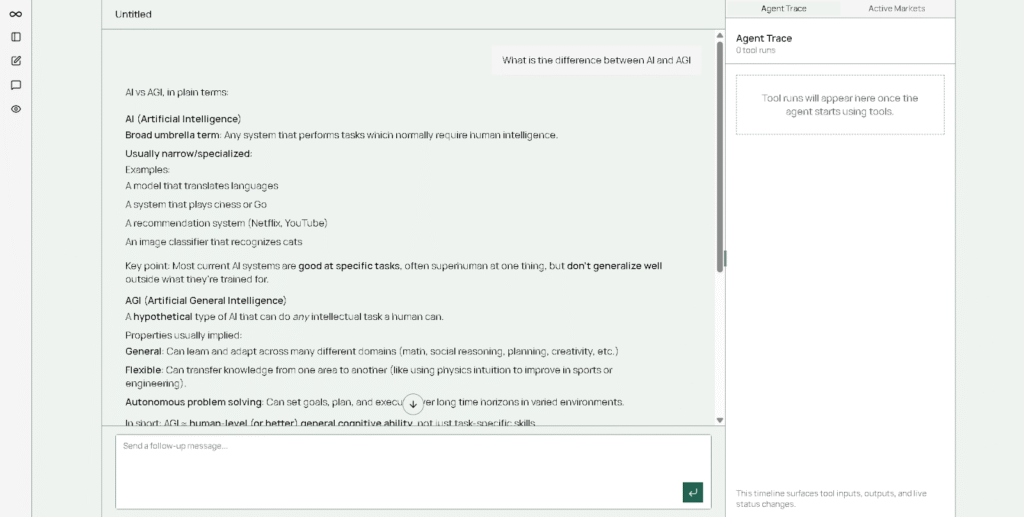
Here is a look at what it feels like to use the Eversight platform, and why it represents a major shift in how AI handles real-world probabilities.
The Dashboard Experience: Probabilities, Not Just Text
Loading up the interface at eversight.numinouslabs.io reveals a sleek, chat-based UI that initially feels familiar. However, the experience diverges sharply from standard interactions with models like Gemini, Grok, or OpenAI.
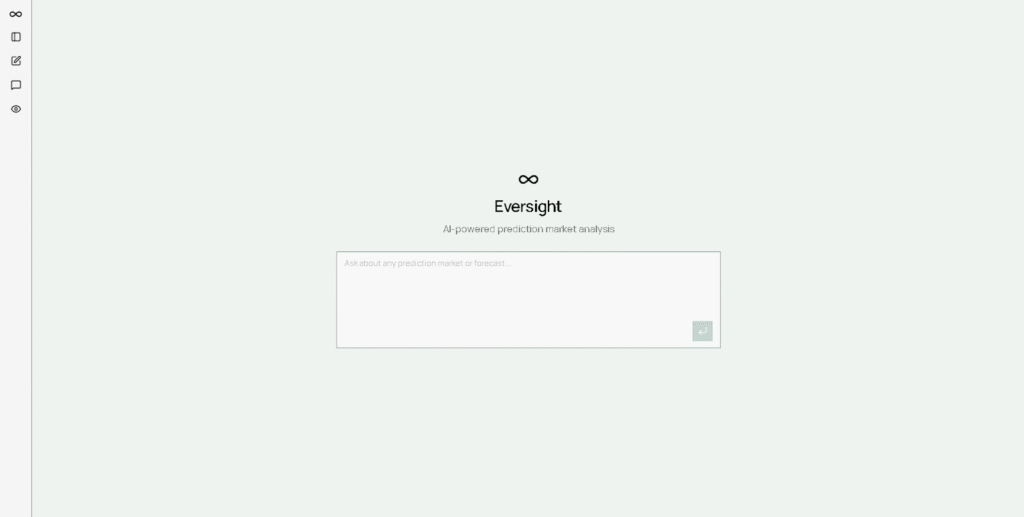
Instead of asking the AI to write an email or summarize a document, queries are strictly forward-looking: “What is the probability of this candidate winning the election?” or “Will this company hit its Q4 EPS target?”
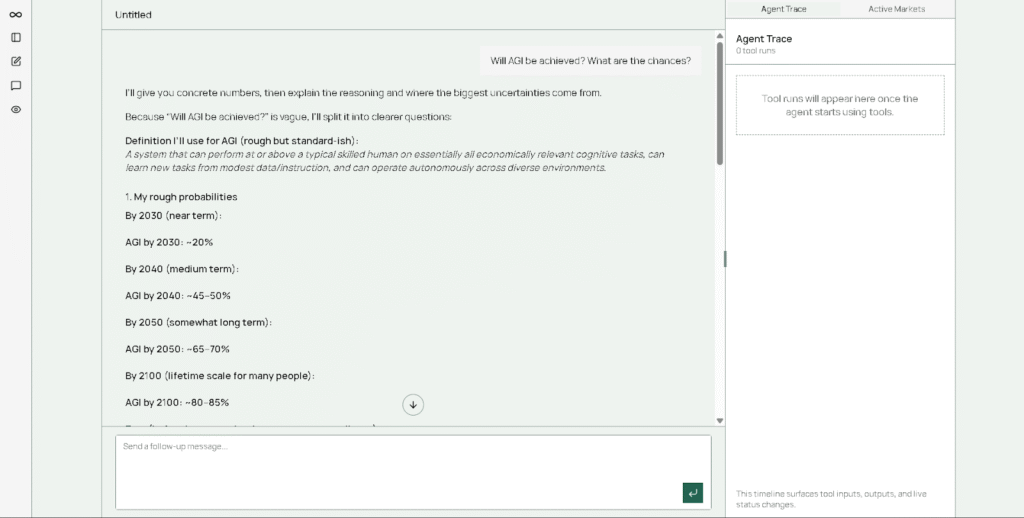
When you submit a prompt, it triggers a complex backend process. The output isn’t just a single, hallucinated guess. Instead, the platform delivers a highly detailed probabilistic estimate. The response breaks down the aggregate odds, showcasing transparent, traceable sources pulled from live prediction markets (like Polymarket and Kalshi), real-time news feeds, and social media sentiment.
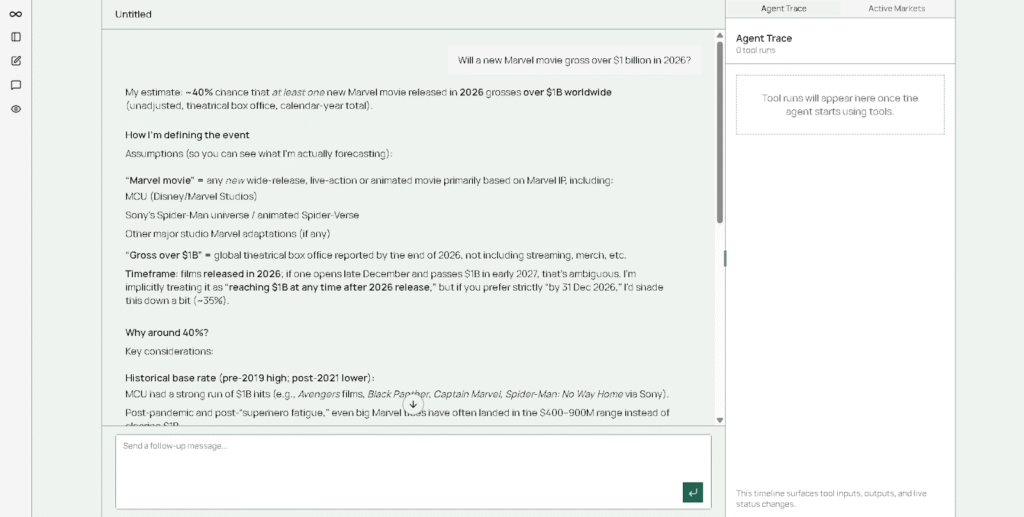
For niche queries where a dedicated prediction market doesn’t exist, such as specific local weather patterns or app store rankings, the system synthesizes available data to provide a “best-effort” statistical forecast.
Under the Hood: Mining Predictive Intelligence
The secret to Eversight’s accuracy lies in its architecture. It operates as the frontend for Numinous (Subnet 6) on the Bittensor blockchain.
When a question is entered into Eversight, it isn’t routed to one giant server. It is broadcast to a decentralized network of roughly 180 independent AI agents.
- The Arena: These agents are submitted by “miners” and operate in isolated sandboxes.
- The Competition: They constantly pull data and compete to provide the most accurate forecast for thousands of synthetic and real-world tasks daily.
- The Scoring: The network grades these agents using strict metrics like the Brier score (a mathematical way to measure the accuracy of probabilistic predictions). Top agents currently boast Brier scores as low as 0.1179 and hit 75-83% accuracy across hundreds of events.
- The Evolution: Miners are paid for accuracy, so only the best agents stay in the game. Agents that fail to predict accurately are pushed out, while successful strategies are iterated upon, preventing the system from “overfitting” to past data.
Weaknesses and Limitations
Despite strong benchmarks, Eversight has identifiable limitations worth understanding.
- Data dependency creates vulnerability. The system only works as well as its data sources. If prediction markets are thin or manipulated, if news feeds miss crucial developments, or if social sentiment is misleading, agents will struggle. For niche events without good data, estimates become less reliable.
- There is also a trade-off in specialization. Because Eversight is hyper-optimized for forecasting future events, it is not a replacement for general-purpose AI. If you ask it to write code, summarize history, or generate creative writing, it will likely underperform compared to standard models like Claude or GPT-4. It is designed to answer “what will happen,” not “write this for me.”
- Crypto ecosystem volatility affects the network. Bittensor runs on TAO tokens. If token prices crash or miner participation drops, the competitive ecosystem weakens. The platform is tied to blockchain economics in ways traditional AI services aren’t.
Being a product launched in early 2026, it is still navigating the friction of an early-stage release. Users should expect occasional bugs and interface inconsistencies that haven’t been polished out yet.
How to Access It
The platform is live at eversight.numinouslabs.io.
The process appears straightforward. Visit the site, sign up for access, and start querying. The interface is chat-based; users input questions about future events and receive probabilistic responses.
For API access, check Numinous Labs’ on X @numinous_ai.
No detailed pricing is public yet, so early adopters get free access. Revenue models will likely emerge as usage grows and value is demonstrated.
Who is Eversight Built For?
The platform’s current trajectory suggests it is aiming for both the retail and institutional markets:
- Prediction Market Traders: Users active on Polymarket or Kalshi can use the tool as an advanced research companion to find an edge in the odds before placing bets.
- Quants & Hedge Funds: Through its API, financial institutions can integrate Eversight’s “superhuman odds feeds” directly into their trading algorithms to assess macro risks or commodity price fluctuations.
- The General Public: Anyone seeking data-driven forecasts for sports outcomes, political events, or cultural phenomena.
The Bottom Line: Moving From “Generative” to “Predictive”
Ultimately, Eversight represents a fundamental shift in what we expect from AI. For the last few years, the world has been captivated by Generative AI (models that are celebrated for how well they can write, code, or create art). But generating convincing text is not the same as being correct. A standard chatbot can hallucinate a fact with total confidence and suffer no consequences.
Numinous Labs has taken a different approach: Predictive AI driven by financial incentives.
By allowing hundreds of independent agents to compete in an arena where they are financially rewarded for accuracy and penalized for failure, the network strips away the “confident nonsense” often found in large language models. In these current times, it is no longer enough for an AI to sound smart; it has to be right.
The result is a “truth machine” that gets smarter with every correct prediction and every failed guess.
Website: eversight.numinouslabs.io
Follow @numinous_ai on X
Enjoyed this article? Join our newsletter
Get the latest Bittensor & TAO ecosystem news straight to your inbox.
We respect your privacy. Unsubscribe anytime.



Be the first to comment