
Drug discovery starts with an overwhelming problem. There are billions of possible molecules, but only a tiny fraction will ever become real medicines.
The challenge is not just finding molecules that bind to a target. It is finding the right molecules early enough, before time and capital are wasted downstream.
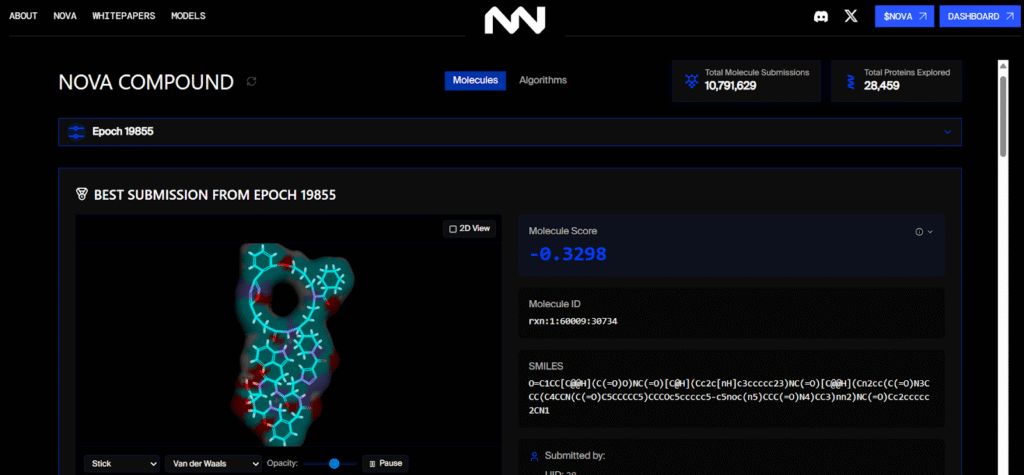
This is the problem NOVA Compound is designed to solve. Built on NOVA (Bittensor’s Subnet 68), NOVA Compound serves as a decentralized virtual drug screening platform where discovery is driven by competition, incentives, and continuous improvement.
With a newly upgraded scoring function, NOVA is now getting better at one of the most critical transitions in drug discovery: moving from hits to real lead candidates.
What Bittensor’s Subnet 68 Does
NOVA (on Bittensor’s Subnet 68) is a decentralized drug discovery network on Bittensor that turns early-stage drug screening into a global, incentive-driven competition, using crowdsourced AI models and compute to rapidly search massive chemical space for viable drug candidates.
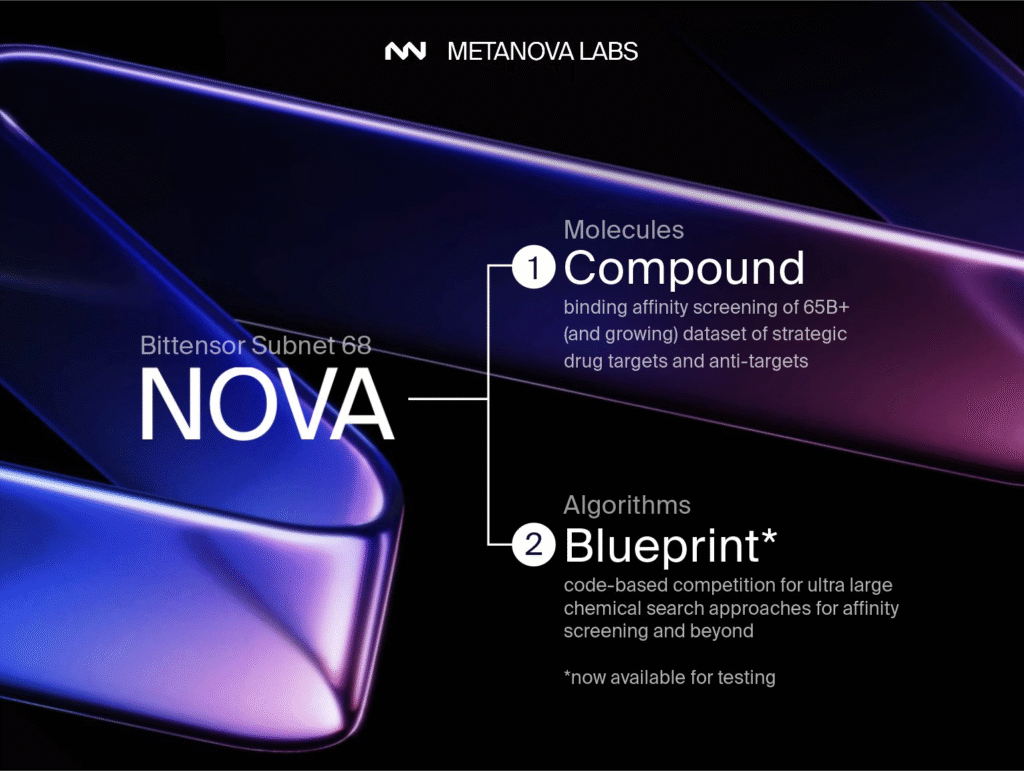
To achieve its core aim, NOVA runs on Compound and Blueprint.
a. Nova Compound runs continuous decentralized virtual screening, where miners propose molecules and validators score them with shared AI models to quickly identify the most promising compounds for a given biological target.
b. Nova Blueprint is a parallel competition network where miners build and submit better search algorithms, allowing the network to constantly upgrade how it discovers drugs by adopting the highest performing methods across the system.
NOVA Compound at a Glance
By design, NOVA Compound operates as a live, open competition. It leverages Bittensor’s decentralized architecture to conduct business on the ecosystem, where:
a. Miners explore massive chemical space and submit candidate molecules,
b. Validators evaluate those molecules using a trusted reference model, and
c. Rewards flow to submissions that show the strongest and most selective binding behavior.
Instead of relying on a single lab or closed pipeline, NOVA Compound distributes discovery across a global network. The result is faster exploration, broader diversity, and incentives that reward useful science rather than raw compute.
To ensure fairness and consistency, all submissions are evaluated using Boltz-2, a state-of-the-art protein ligand interaction model developed by MIT (Massachusetts Institute of Technology) and Recursion Pharmaceuticals.
Boltz-2 acts as a neutral referee, scoring molecules across many targets without bias.
Why Scoring Matters More Than it Sounds
In virtual screening, scoring is not just a measurement, it also shapes behavior. Whatever the scoring function rewards, miners will optimize for.
If the scoring favors the wrong traits, the system can quickly converge on molecules that look good numerically but fail later in real experiments.
This is especially important at the Hit-to-Lead stage:
a. While Hits answer the question: Does this molecule bind at all?
b. Leads answer the harder question: Is this molecule strong, selective, and practical to develop?
Mistakes at this stage compound rapidly. Poor prioritization means more failed experiments, higher costs, and slower progress. Improving scoring here has an outsized impact on everything that follows.
The New Scoring System: From Volume to Quality
Traditional virtual screening systems often excel at generating large numbers of hits. Fewer are good at surfacing the molecules that still look promising once real-world constraints are applied.
NOVA’s latest scoring update was designed to address exactly this gap. Instead of chasing raw binding signals alone, the approach emphasizes:
a. Agreement between multiple signals rather than reliance on one,
b. Efficiency over sheer molecular size, and
c. Early emergence of lead-like behavior.
The goal is to find better candidates earlier.
What Changed in the New Scoring Function
Boltz 2 provides two complementary signals when evaluating a molecule. One reflects how likely binding is, the other estimates how strong that binding might be.
Previously, these signals were often considered in isolation. The new scoring function combines them and adjusts for molecule size, reducing a common bias toward larger, less practical compounds.
In practice, this means:
a. Molecules that score well for the right reasons rise to the top,
b. Oversized or noisy candidates are deprioritized, and
c. False positives are filtered out earlier.
Importantly, this improvement does not require retraining Boltz 2 or adding heavy computation. It is a smarter use of information that already exists.
What the Results Show
When tested across multiple therapeutic targets, the updated scoring consistently improved performance. Key outcomes included:
a. Stronger separation between true binders and non-binders,
b. Better prioritization of high-quality candidates, and
c. Fewer low-value molecules making it through early filters.
In some cases, the improvement was substantial enough to meaningfully reduce wasted experimental effort later on. That translates directly into lower costs, faster iteration, and higher confidence decisions.
Why This Works in a Decentralized System
NOVA does not treat scoring as static. The team continuously observes how miners respond to incentives: Where submissions cluster too quickly, where diversity collapses and where signal quality improves.
Those observations feed back into mechanism design.
This is one of the core advantages of building on Bittensor. Instead of locking discovery logic into a fixed pipeline, NOVA can evolve its incentives as the network learns. With this, better scoring leads to better behavior and better behavior, invariably, leads to better science.
What This Means Going Forward
The new scoring function strengthens NOVA Compound without changing its core architecture. Still:
a. Miners are still free to explore creatively,
b. Validators remain neutral and consistent, and
c. The system stays open, competitive, and scalable.
However, the outcomes improve. More lead-like molecules appear earlier, less effort is wasted downstream and discovery becomes more-efficient, not just faster.
This is incentive design doing real-work.
Conclusion
Drug discovery is expensive because mistakes made early are paid for later. By improving how hits are identified and promoted toward leads, NOVA Compound reduces those mistakes before they compound. The result is a screening system that is not just broader, but smarter.
This update shows how strong models like Boltz 2 become even more powerful when paired with thoughtful incentive engineering. It shows that better scoring does not just improve predictions, it improves ‘even’ outcomes.
And in drug discovery, that difference matters.
Enjoyed this article? Join our newsletter
Get the latest Bittensor & TAO ecosystem news straight to your inbox.
We respect your privacy. Unsubscribe anytime.


Be the first to comment