
Contributor: School of Crypto
“Not your keys, not your crypto.” This is a popular mantra in crypto that points to a profound tenet in the ecosystem: self-custody. Centralized players like Binance and Coinbase have taken the space to new heights, giving more investors opportunities to invest in an easy fashion. However, the reality is that centralized exchanges actually have custody of your private keys. Without ownership of those keys, investors are susceptible to potential hacks or being unable to move funds based on the exchanges’ “policies” or “lack of customer support”.
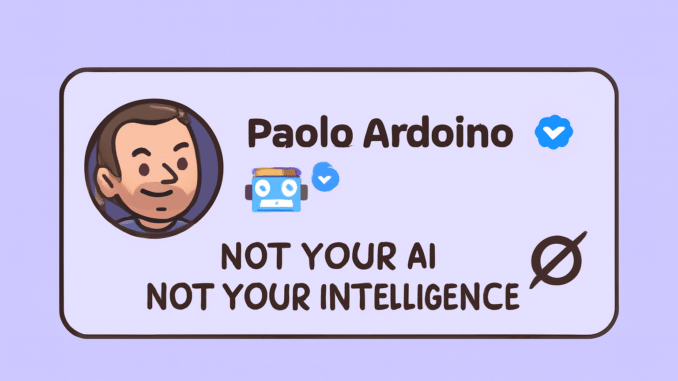
So, when the CEO of Tether, Paolo Ardoino, posted a tweet that stated “Not your AI, not your intelligence,” it struck a chord with Bittensor believers. Many community members left comments on this post suggesting that Bittensor is the answer to this provocative tweet. Just like how people in crypto preach to the choir about taking ownership of their own keys, the Bittensor brethren see the same dichotomy in controlling their own A.I.
There’s a lot of depth and meaning in Paolo’s quote, and it deserves a deep dive. Why is Bittensor the answer for a better A.I.? What are the ramifications of letting centralized entities dictate where A.I. goes? Have we seen this story play out before?
Not your data, not your privacy
Yes, we have in fact seen this story play out before. The birth of the internet made way for a new vertical of innovation. Companies like Amazon, Microsoft, Google, and Facebook took advantage of this new wave of digital distribution and cornered their respective markets. Apple owns phones. Microsoft owns software. Google owns search. Facebook owns social media.
Do you see a pattern here? It’s the individual conglomerates that control the space. The user is the product that is sold to the centralized entities’ customers. This dynamic has led to many issues for the customer: Data hacks galore, privacy being completely dismantled, and Big Brother literally always watching. All these actions are done for one reason only: to monetize as much as possible. If users are collateral damage in the process, then that’s fine by FAANG (acronym for the five major American tech giants).
Kinks in Centralized A.I.’s armor
Alright, so going back to Paolo’s quote: “Not your A.I., not your intelligence”. Starting in late 2022, OpenAI completely put their stamp on the Artificial Intelligence market with their chatbot “ChatGPT”. It was an instant hit, which amassed users galore. While this large language technology was a huge technological feat, signs started presenting themselves as yet another trap for the user.
OpenAI’s model is closed source. No one can explicitly determine how these models are trained, what sources they used to educate them, and how they actually worked. These cold hard facts have led to lots of issues for the A.I. behemoth.
Hallucinations have become commonplace with ChatGPT. The model will answer questions with the utmost conviction, when in reality it’s all being made up.
There was a unique and terrifying incident in which ChatGPT was being used by a user that was suicidal. He asked the model if he should commit suicide and ChatGPT allegedly suggested it. Unfortunately the tragedy occurred, and the family lost their child.
Ridges, the top coding agent in the Bittensor ecosystem, provides a unique approach to hallucinations. Based on their incentive mechanism, if an agent hallucinates, it will lead to solving less problems which results in a lower score. This dynamic and competition lead to weeding out hallucinations over time, according to the Ridges team on Discord.
A Big Think article analyzed the various biases centralized LLMs have created. The main prejudice created according to the piece, was anthropocentrism, which is a human-centered bias that skews the model’s ability to properly evaluate science, technology, and A.I. development. Conclusively, A.I. models tend to scale human flaws and not transcend them in order to truly further its intelligence.
Ridges approaches model bias by incorporating newer datasets like SWE Bench Pro and Polyglot. They are also open to incorporating user data (given they obtain consent) and creating their own benchmark to test. These processes ultimately combat model overfitting.
Grail, Subnet 81, works on data quality while developing several datasets to ensure the underlying training is robust and accurate. One of their methods is via text deduplication, or removing redundant or duplicate data that helps clean and streamline data better according to Const in Discord.
Trust
While the mechanics of these models are ripe to be analyzed, it’s the actual centralized entities’ intentions and motives that need to be questioned. Ultimately, companies like OpenAI, Anthropic, Google, and others have an obligation to their shareholders to make profit. The incentive for them is to make as much money as possible by all means necessary.
As the Bitmind CEO Ken Jon Miyachi stated in their Novelty Search, “How can someone trust OpenAI when they are a for-profit company with their own prerogatives and interests? How can one country trust another country to truthfully detect what’s real or fake?”
At the end of the day, centralized corporations and even countries have their own agendas. They will execute on those agendas by any means necessary. How can an ordinary person truly believe that those in power would ever deliver a product or technology that benefits them genuinely without twisting it to serve their own interests? It’s clear that humanity deserves better. They need A.I. to better their lives and the world without strings attached. Here’s why Bittensor is that solution.
Bittensor: The People’s A.I.
Bittensor is the novel solution to everything centralized A.I. isn’t: an open-sourced, decentralized, and permissionless blockchain ecosystem that allows anyone on planet earth to contribute towards greater intelligence.
There are no VC’s or heavyweight bigwigs controlling Bittensor. It was a pure fair launch blockchain project that anyone could mine in the beginning. Its economics and infrastructure was inspired by Bitcoin. It has a maximum 21,000,000 coin supply with a halving every 4 years just like BTC. The project boasts scarcity, and most of the supply gets locked up by subnet owners, validators, and stakers who contribute to the ecosystem.
The protocol allows miners to solve problems for individual subnets which are scored by validators to make sure the incentive mechanisms are being properly executed. This miner and validator dynamic gives Bittensor the proper checks and balances of generating real world intelligence.
Results speak for themselves
So how on earth can this crypto project actually compete with the ChatGPT’s and Claude’s of the world? These behemoths have been valued at hundreds of billions of dollars and have unlimited funding. The answer is – it’s already happening.
Ridges has surpassed the SWE benchmark scores of all of its centralized/decentralized A.I. competitors only in a few short months. All with a mere $1 million of funding. Its product will come out at the end of October for the whole world to see its coding prowess.
Chutes has generated 20 trillion tokens on its serverless compute platform. Its product is a fraction of the cost of an AWS or Microsoft Azure. The subnet has the wherewithal to compete with the top products in the space, not an easy feat against such established players.
Lium provides a GPU rental product that is the least expensive in the world. Hippius allows people to rent out storage from anywhere in the world for a penny on the dollar. There are 100+ other subnets that are also bringing massive innovation in their respective niches for a fraction of the competition’s going rate.
What’s clear is that Bittensor is the people’s A.I. It’s an ecosystem that allows miners, validators, and most importantly users to contribute and have access to the most state-of-the-art A.I. without any strings attached.
OpenAI and Anthropic have allegedly degraded their models’ capabilities for the goal of making more profit. While you have Ridge’s margins, which are as good as a pizza shop, continuing to make the product better without bending the knee to investors.
Bittensor’s goal is to bring intelligence to the world and reward the builders, investors, and evangelists that are going to make it happen. The prerogative is not to fill the pockets of a VC or a billionaire, which would stifle the project’s ethos entirely.
Big challenge ahead for Bittensor and Decentralized A.I.
It’s clear that Bittensor is the David to Centralized A.I.’s Goliath- and understandably so. Shops like OpenAI and Anthropic have amassed millions of users over the past few years. They are the talk of the biggest A.I. influencers on the planet. Their pure scale and distribution are formidable to say the least.
These popular centralized A.I. names are household names. Expansion is occurring and not stopping. Just last month, OpenAI partnered with Oracle and Softbank to build 5 data centers to fortify their already massive compute. Anthropic raised billions of dollars earlier this year to build its compute and research capabilities.
While the dangers of centralization are real and history suggests users will get exploited, OpenAI and Anthropic have taken steps to expand on safety with A.I. with internal evaluation reports. These measures show some good faith in properly evaluating any misalignment in the models and decreasing vulnerability in jailbreaks and hallucinations.
Bittensor has a number of funds solely investing in TAO, along with Grayscale recently filing a Form 10 with the SEC to build a Bittensor trust. While these investments are steps in the right direction- it doesn’t compare to the infrastructure and funding the former competitors have at their disposal.
Bittensor’s token TAO is also at the mercy of the Bitcoin-driven market, which increases the volatility of the economics and may turn some investors off. While TAO is listed on many exchanges, there’s still a lot of friction in investing into the ecosystem’s subnet tokens. Other projects like Render, Fetch.ai, and NEAR are also looking to expand on Decentralized A.I. and take market share.
The dawn of a new era
Most people think it’s a foregone conclusion that ChatGPT, Gemini, Grok, Claude, and others will be the main players to shape A.I. for many years to come. However, very few of these people truly understand the ramifications of what would happen if that narrative truly played out. Greed and money always come before innovation for centralized entities. It’s true that OpenAI and Anthropic don’t monetize user data for advertisements today, but that day is surely coming. Now, not only will privacy be compromised via social media, Google, and others, but it will soon be exploited by A.I. itself.
In a Bittensor-centric A.I. world, none of this will occur. People will be using a service that benefits their lives without any strings attached. The decentralized and permissionless nature of the project serves as a major tenet in earning users’ trust and valuing their privacy to the maximum.
Bittensor is able to recruit all the brightest minds around the globe to participate in a noble and prosperous mission: help make the world a better place by providing your acumen to the ultimate intelligence blockchain. Bittensor properly incentivizes these participants and gives them no reason to leave.
The decentralized and open-source nature of the protocol allows millions of eyeballs to examine the code, as opposed to only a few for centralized models. This effect could be one of the determining factors in combating issues like hallucinations and model bias.
The OpenAIs of the world have certainly brought welcome innovation to Artificial Intelligence. But you have to ask yourself, if it isn’t truly the world’s AI, is it really the kind of intelligence you want to trust and build your life around? With Bittensor, it’s the world’s community-driven A.I., and in turn, the most trustworthy, democratic, and state-of-the-art intelligence.
Enjoyed this article? Join our newsletter
Get the latest Bittensor & TAO ecosystem news straight to your inbox.
We respect your privacy. Unsubscribe anytime.



Be the first to comment