
Bittensor is entering a phase where execution matters more than theory. The conversation is no longer about whether decentralized intelligence can work, but whether it can scale into real, production-grade systems that deliver measurable value.
Against this backdrop, the strategic alignment between Minos and Manifold Labs signals something deeper than a partnership; it reflects a deliberate move toward building vertically integrated, high-performance subnets that are designed to operate at the standards of real-world industries.
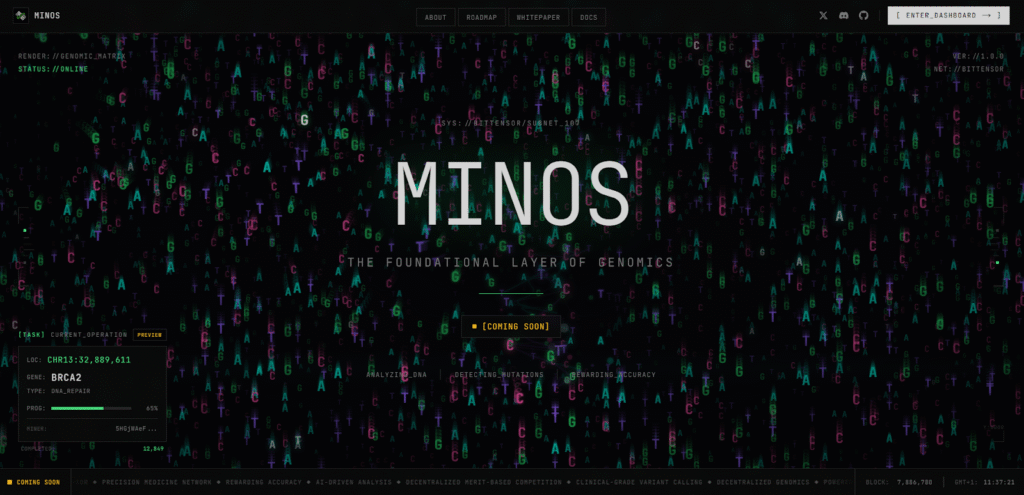
As Minos prepares for mainnet, this collaboration positions it not simply as another experimental subnet, but as a serious attempt to establish genomics as a foundational pillar within the Bittensor economy.
The Strategic Role of Manifold Labs
Manifold Labs, the team behind Targon (Subnet 4), brings more than technical credibility. Their experience comes from building and scaling one of Bittensor’s most recognized subnets, where the challenges extend far beyond compute into coordination, incentives, and long-term network sustainability.
This engagement is not limited to surface-level support. It spans critical layers that determine whether a subnet can move from launch to lasting relevance:
a. Incentive design that aligns miner behavior with meaningful output,
b. Validator infrastructure that ensures reliable and reproducible evaluation,
c. Network operations that support uptime, efficiency, and scalability, and
d. Ecosystem positioning that determines how the subnet fits into the broader Bittensor economy.
By embedding this experience directly into Minos, the goal is to avoid the common pitfalls of early-stage subnets and accelerate toward a system that is both technically sound and economically viable.
What Minos is Building
Minos (Subnet 107) introduces a new category to Bittensor by focusing on genomic variant calling and benchmarking. At its core, it transforms a highly specialized scientific problem into a competitive intelligence market, where miners are rewarded for producing configurations and algorithms that can accurately identify mutations in genomic data.
The system operates through a structured and continuous challenge loop:
a. Every 72 minutes, a new synthetic genome is generated as a BAM file,
b. Hidden mutations are injected at the read level using HelixForge,
c. Miners perform hyperparameter search on state-of-the-art variant calling tools,
d. Submissions consist of configurations, not outputs, and
e. Validators execute these configurations independently and evaluate results using industry-standard tools such as hap.py
This design introduces a critical property: trustless verification. Miners are not asked to submit results that could be manipulated. Instead, they provide the method, and validators reproduce the outcome, ensuring that performance is both transparent and verifiable.
As the system evolves, competition extends beyond tuning existing tools into developing custom algorithms, pushing the subnet toward deeper innovation rather than surface-level optimization.
From Synthetic Data to Real-World Impact
One of Minos’ most important contributions lies in its use of large-scale synthetic datasets. By generating millions of genomes with controlled mutations, the subnet creates an environment where models can be trained, tested, and validated with a level of precision that is difficult to achieve using traditional datasets.
This approach enables:
a. Improved variant calling accuracy, with the ambition of reaching clinical-grade standards,
b. A reliable benchmark layer for evaluating genomic models,
c. A scalable source of high-quality training data for frontier AI systems, and
d. New pathways for genomic discovery and identification.
In effect, Minos is not just solving a narrow problem. It is establishing a source of truth for genomic intelligence, where performance is continuously tested against known ground truth rather than assumed correctness.
Why This Partnership Matters for Bittensor
The collaboration between Minos and Manifold Labs reflects a broader shift within Bittensor. Subnets are no longer isolated experiments competing only on emissions. They are becoming specialized markets that require strong infrastructure, clear incentives, and real demand to sustain themselves.
This partnership reinforces several key trends:
a. The move toward production-grade subnets with real-world applications,
b. The importance of experienced operators in guiding new subnet development,
c. The emergence of verticalized intelligence layers, where each subnet owns a specific domain, and
d. A growing focus on verification and benchmarking, not just raw output.
By combining Manifold’s operational expertise with Minos’ domain focus, the result is a subnet that is better positioned to contribute meaningfully to the network rather than simply participate in it.
Toward a Genomics-Native Intelligence Layer
Minos is effectively defining what genomics looks like in a decentralized AI system; it introduces a framework where data generation, model evaluation, and algorithmic competition are tightly integrated into a single, continuous loop.
With Manifold Labs providing strategic guidance, this framework is being shaped with an emphasis on sustainability, scalability, and alignment with the broader network.
The ambition is not incremental, it is to set a standard.
Conclusion
As Bittensor matures, the subnets that endure will be those that combine technical depth with economic clarity and operational discipline. The Minos and Manifold Labs partnership represents a clear step in that direction, bringing together domain-specific innovation and proven subnet expertise to build something that can extend beyond experimentation.
At this rate, Minos might not only establish genomics as a core vertical within Bittensor, but also demonstrate how specialized intelligence markets can be designed, validated, and scaled in a decentralized environment. In doing so, it contributes to a larger transition already underway, where Bittensor evolves from a network of possibilities into an ecosystem of functioning, revenue-generating intelligence systems.
Enjoyed this article? Join our newsletter
Get the latest Bittensor & TAO ecosystem news straight to your inbox.
We respect your privacy. Unsubscribe anytime.
Be the first to comment