
Full article credit to Crypto Pilote.
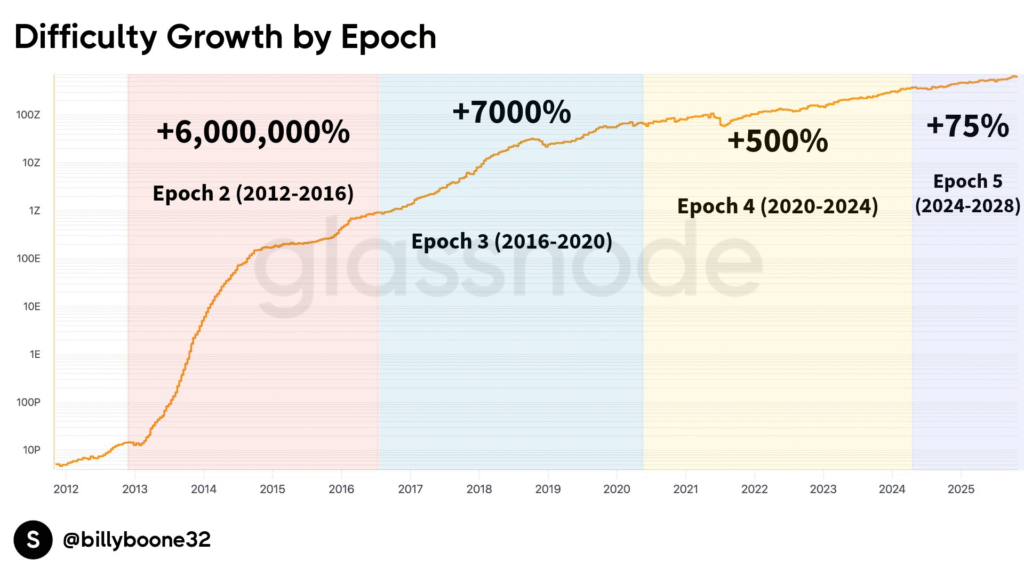
In a world where events unfold by the hour, Bitcoin’s fifth halving (expected around April 2028) feels like a lifetime away. For BTC miners, though, it might as well already be here. With mining difficulty and electricity costs relentlessly climbing, competition has grown so fierce that adapting is no longer optional. It’s a matter of survival. Where miners once relied on BTC’s price appreciation alone, they now have to innovate and diversify their revenue streams. Throughout this article, we’ll explore the challenges they face, and how those very challenges could end up strengthening Bittensor.
Miners against uncertainty
Let’s quickly cover the basics. Miner profitability depends on four factors:
- Halving -> Identical for everyone, non-negotiable but predictable
- Hashrate -> Depends on competing miners, non-negotiable
- Electricity cost -> Can be negotiated upfront, but requires heavy infrastructure
- Hardware -> Negotiable, fast and easy to adjust
To stay competitive in an environment where hashrate keeps rising, miners need to upgrade their machines roughly every 4 years. Even if BTC-only rigs can be offloaded on the secondary market, this still represents a significant cost on top of electricity and mining farm infrastructure. Add to that an immature BTC with an unpredictable price, and you end up with a razor-thin business where visibility shrinks with every halving.
How do you justify investing in heavy machinery to stay ahead when you have zero guarantee your revenue will follow, because it simply doesn’t depend on you?
Miners are left with two options:
- Chase ever more powerful hardware
- Diversify, halving after halving, to hedge against BTC’s volatility
While the first option is familiar territory for them, the second is only starting to emerge with the rise of AI.
BTC and AI are siblings facing different issues
Today, one of AI’s biggest challenges is the exponential surge in demand. Between the skyrocketing size of models to train and the explosion in inference requests happening worldwide, infrastructure is struggling to keep up. This explains the severe tension on the components market and NVIDIA’s remarkable success in recent years. There is a real need for more computing power to process more data. One might assume the bottleneck is hardware: not enough machines to go around. That’s not entirely wrong, but producing machines is ultimately a supply chain problem. It will always be possible to source hardware by paying a premium or turning to the secondary market. Moreover, as Templar recently demonstrated, AI engineering isn’t just about more powerful machines. It is also possible to rethink model approaches or architecture to achieve better results with the same resources.
For AI, the real problem lies in electrical infrastructure.
Demand is exploding and supply is struggling to keep up. Companies entering the space can’t afford to wait the 3 to 5 years it takes to build new data centers from scratch
This is a key difference from BTC miners, who face the opposite problem: electricity available, but locked into their single-purpose ASICs. Unlike existing data centers, BTC miners have no ability to reallocate their computing power to another task. They find themselves at a dead end: machines that become obsolete quickly, profitability that is hard to control, and very little flexibility. So they adapt.
The numbers don’t lie. While BTC’s price is deep in a bear market, BTC’s hashrate is, for the first time, experiencing a medium-term downward trend. The reason is simple: miners are moving away from BTC to hedge their risk, drawn by AI’s better returns. You can learn more about that here.
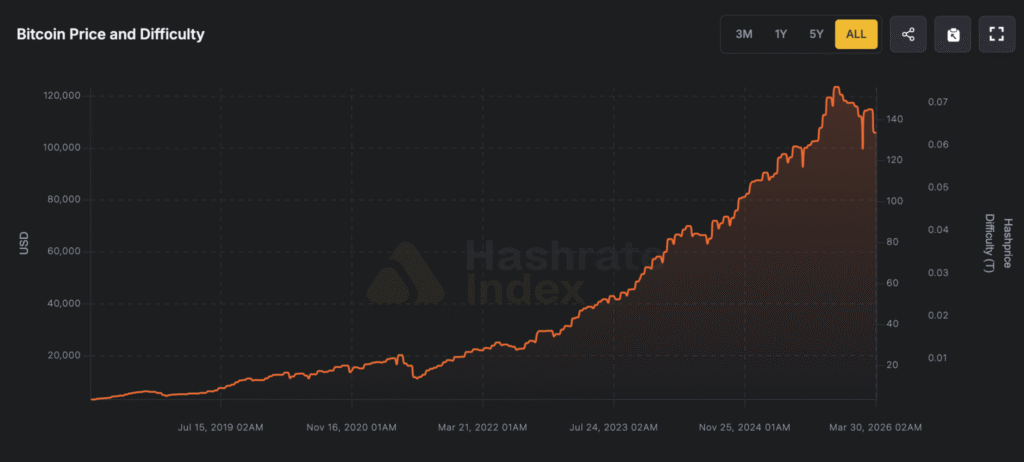
And for good reason: the infrastructure required to run a data center is roughly the same as for running ASICs, yet AI profitability per MWh can be up to 5x higher. Even giants like Anthropic or OpenAI, already locked into power agreements with Microsoft or Google, find it insufficient. They need alternative providers to secure the capacity required to stay ahead. BTC miners are uniquely positioned to fill that gap. Their energy infrastructure is essentially ready to go. The trade-off is flexibility: while AI is more profitable, BTC can be plugged and unplugged within minutes, making it a natural grid stabilizer. That flexibility is precisely what allowed many miners to negotiate highly competitive electricity contracts, the same contracts that now give them an edge in the AI market.
That edge will be necessary, because the switch isn’t free. AI hardware requires active cooling, which drives up operating costs, unlike BTC mining, which tolerates heat without damaging equipment. Yet when you look at the speed and scale of capital being deployed for this transition, it’s clear this isn’t a temporary lifeline to survive a bear market. It’s a multi-decade strategic bet.
- @BitdeerOfficial, the world’s top miner with 6.85% of global hashrate, will sell its BTC production continuously to fund its AI division (while still investing in mining).
- They are focusing on purchasing the GB200, NVIDIA’s latest ultra-versatile chip. This new machine can handle training, inference, and also process large-scale data streams, making it essential for weather forecasting, drug discovery, and trajectory calculations. The GB200/GB200 NVL72 platform is positioned for demanding AI workloads and large-scale compute use cases.
- MARA, ranked second at 5.82% of hashrate, has liquidated 30% of its BTC holdings, 15,000 BTC (~$1.1B), to pay off its 2030 bonds and fund its AI push. A clear strategic pivot, leveraging their core expertise in high-power infrastructure.
Decentralization is a necessity
Whether in BTC mining or AI, the sector is heavily concentrated in the US. Alone, they account for 40% of global hashrate and 45% of global AI computing power.
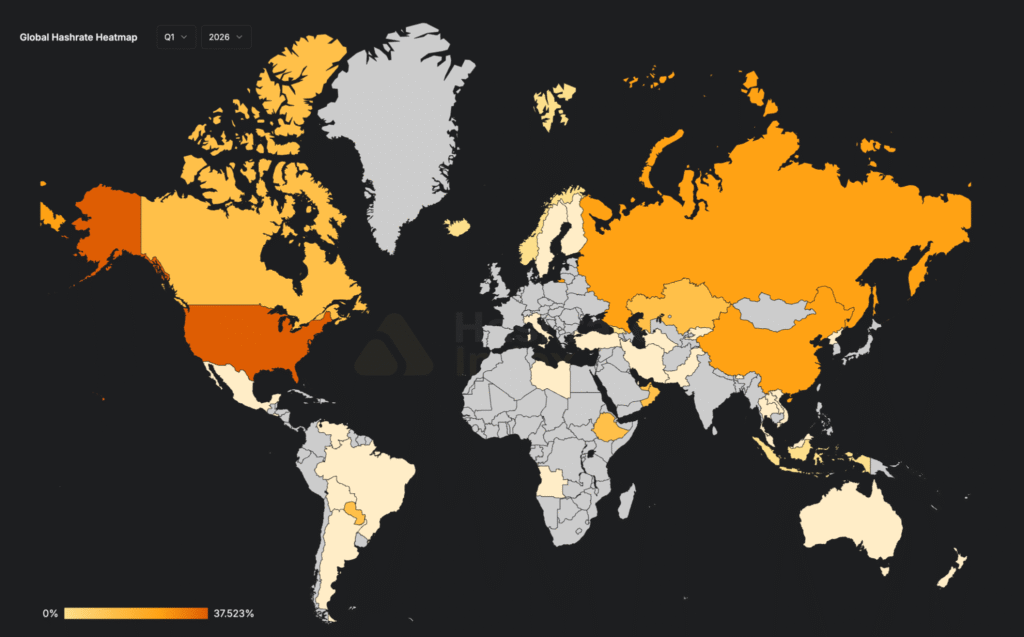
The other half is scattered across the globe in small clusters, often in regions that are difficult to connect. Yet they face the same long-term profitability challenges outlined above. It’s easy to anticipate that they too will pivot toward AI to future-proof their operations, just as the giants are already doing. The difference is that, unlike their American counterparts, these smaller players won’t benefit from geographic proximity to big AI companies, stable infrastructure (power, connectivity, hardware), or a clear regulatory framework.
So how do you replicate the giants’ strategy under these adverse conditions? You need a coordination network built for harsh environments. One that can handle disconnections, low bandwidth, and limited computing power.
Ignition of the expansion phase for Bittensor
Whether power comes from giants or small clusters, Bittensor is built for exactly this. It is currently the only network capable of making this strategy accessible to everyone across the globe.
The way big players are preparing for this makes me feel I’m right. They focus on agent powered by the NVIDIA GB200, a highly versatile chip capable of training, inference, and processing large data streams critical for weather forecasting, drug discovery, and trajectory modeling. This opens the gate to AI beyond LLMs and Subnets are ready for that.
With its 128 subnets, Bittensor offers a wide range of tasks: weather forecasting, prediction, agents, storage, inference, and more. Each cluster, whatever its constraints, can find a task that matches its hardware and expertise. Bittensor’s architecture handles connectivity losses and orchestrates decentralized computing power, as it already proves every day across popular subnets like @zeussubnet, @ridges_ai, @chutes_ai, or @tplr_ai and its 72B parameter model.
I wouldn’t be surprised to see, in the coming months, former BTC miners across the globe redirecting their power to the Bittensor network. Cleaning up their balance sheets, while quietly becoming the backbone of something far bigger than themselves: an open-source, decentralized intelligence, built by thousands, owned by no one, that the world will one day recognize as the only credible alternative to the silent monopolization of AI.
So, the miners will not have simply chosen to survive. They will have become the infrastructure of the future.
Enjoyed this article? Join our newsletter
Get the latest Bittensor & TAO ecosystem news straight to your inbox.
We respect your privacy. Unsubscribe anytime.



Be the first to comment