
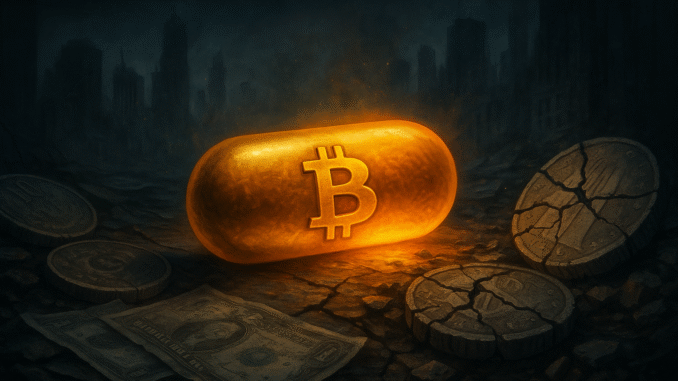
“Clean money is just as important as antibiotics. It’s just as important as fat. It’s just as important as clean electricity. It makes the world a better place.”
Money has been secretly poisoned for decades. It is printed by governments to pay for immediacies, manipulated by central banks to stem crises, and the average man suffers without even realizing it. Wages are devalued, savings disappear, and the more you labor, the less it seems your labor is significant. That is the disease Saylor is talking about, a plague sweeping the globe right before our very eyes.
Bitcoin, to him, isn’t revolutionary; it’s a solution. It does not fight the system by tearing it down; it simply replaces the rotten part of the system with something else. So when Saylor calls Bitcoin “clean money,” he is not exaggerating; he is describing what happens when transparency replaces deception and computation replaces politics.
Every civilization that has ever existed has collapsed for the same reason: its money collapsed before its people. Rome debased its coins, Weimar printed its marks, and Argentina inflated away its faith. Each one ended with hunger, crime, and despair. People didn’t lose hope because they were apathetic; they lost hope because their labor no longer produced stability. But what if that could never happen again?
That is where Bitcoin fills the gap. It does not guarantee wealth; it guarantees honesty. A finite supply. A system that cannot be bought or bribed. A ledger that writes down truth without asking anybody’s permission. When people have a unit of currency that cannot be watered down, they can plan decades into the future. And when they can plan, they can build.
Saylor compares it to the scientific revolutions that saved human life. Infection was a death warrant before antibiotics. Disease spread faster than doctors could cure it before clean water. Such breakthroughs did not merely improve life expectancy; they transformed the quality of life itself. So he argues that clean money could stop unnecessary misery in economies, just as clean water once stopped it in cities.
The power of his comparison is that it’s a simple one. You don’t need to be a codebreaker to understand purity. You know what clean drinking water tastes like. You know what it’s like to have food you can trust. The same way, Saylor argues, one day you will know what it’s like to save money that does not lie.
There’s also an ethical dimension to it. When money corrupts, corruption is king. When corruption is king, trust is murdered. Clean money brings that back. It invests in discipline instead of speculation, patience instead of fear. And that shift, more than charts of price or halvings, is what could redefine wealth in the next century.
Saylor doesn’t guarantee that Bitcoin will make everyone rich; he guarantees that it will clean up the world. That’s the difference between a cult sell and a civilizational upgrade. If he is right, the story of Bitcoin is not a story about numbers getting bigger; it is about a species clearing up its last great pollution, the money it uses to survive.
Enjoyed this article? Join our newsletter
Get the latest Bittensor & TAO ecosystem news straight to your inbox.
We respect your privacy. Unsubscribe anytime.


Be the first to comment