
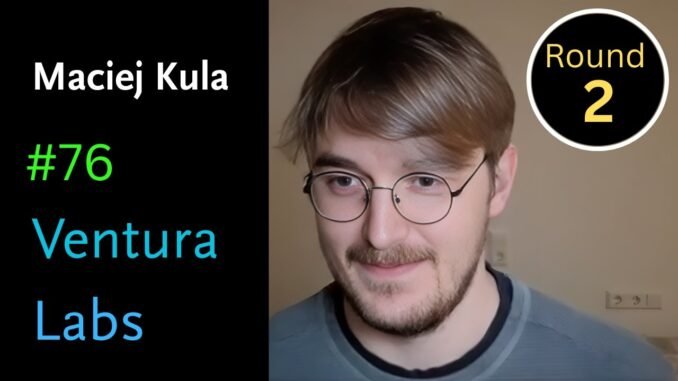
Bittensor is entering one of its most defining periods. The first $TAO halving is approaching, TAO Flow has replaced price-based emissions, chain buys are finally being discussed openly, a new encrypted mempool is now rolling out, and proxy security is becoming a standard practice across the network.
These changes have raised questions. Questions like “How will emissions be affected? How should subnet owners think about liquidity? What happens to rewards? And what does this moment say about the long-term direction of the protocol?”
To bring clarity, Ventura Labs brought back Maciej Kula of Latent Holding who also doubles as the creator of Learn Bittensor.
On this episode, Maciej broke down misconceptions, explained what is actually changing, and emphasised that Bittensor cannot be understood through surface mechanism but by understanding the fundamentals.
Introducing Latent Holdings, Learn Bittensor and the Goal of Education
Maciej was welcomed to the podcast, noting his return for a second appearance. He was asked to make clarity about the difference between Latent and Learn Bittensor.
Maciej explained that Learn Bittensor began as an independent project designed to make the network more accessible.
As Latent took over the docs and the educational layer, both resources grew in parallel. As analyzed by him, the differences are that:
1. Learn Bittensor
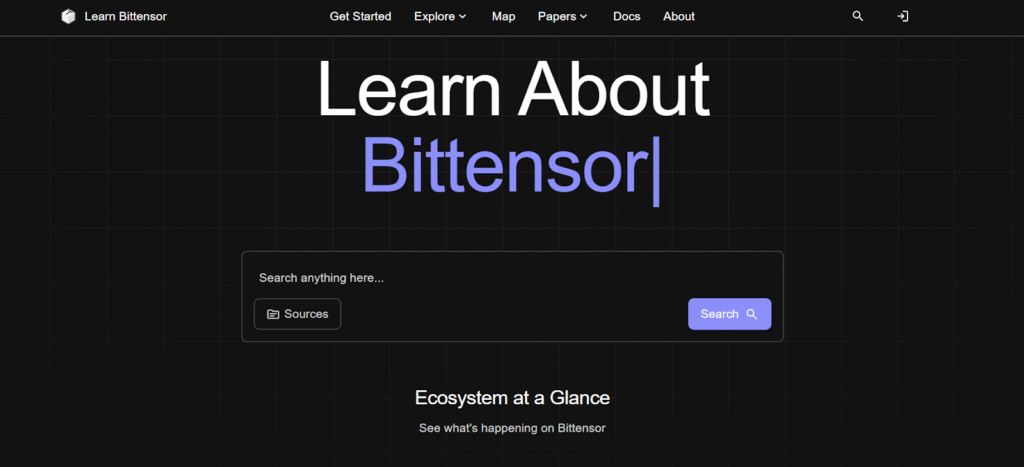
a. Uses simple language
b. Helps absolute beginners
c. Provides step-by-step navigation guides
d. Focuses on the “Why” behind every concept
2. The Official Docs
a. Target builders and developers
b. Provide technical explanations
c. Contain code examples
d. Cover APIs (Application Programming Interface), SDK (Software Development Kit) usage, and subsystem behavior
Together, they now create a complete pathway for newcomers and advanced users alike. While means might be different, the aim is to create a guided learning path that takes anyone, even people with zero crypto knowledge, from fundamentals to a full understanding of Bittensor.
Where Users Are Still Confused: The Missing Mental Model
When asked which parts of the system users still misunderstand, Maciej explained that the largest gap is not about isolated mechanics but about the lack of a foundational framework.
To this, users see changes like TAO Flow and immediately ask how it affects prices, emissions or rewards, but they are not asking the deeper question. Questions about the purpose of $TAO emissions and the exact behaviour of the protocol incentivizing.
This again reinforces the fact that without understanding the foundation, every upgrade would always feel confusing.
Chain Buys: A Mechanism Many Did Not Know Existed
The conversation moved into chain buys, a feature many believed was new. Maciej clarified that chain buys existed since February during the early stages of dTAO (dynamic $TAO). He walked through how the system works, noting that:
a. When emissions divided by price exceed a threshold, the chain would need to inject more subnet ‘$ALPHA’ tokens than allowed,
b. To avoid uncontrolled inflation, $ALPHA injections are capped,
c. Any excess $TAO is used by the chain to buy $ALPHA,
d. These buys increase the price and rebalance the system, and
e. The purchased $ALPHA is recycled and not held by the chain.
This keeps pools stable and prevents runaway minting.
Toward the First Halving: What the Halving Does and Does Not Change
Maciej was asked about the upcoming $TAO halving and why sentiment is so divided online. He explained that many people believe the halving reduces rewards for participants, but that stance is incorrect.
While $TAO halving only affects how much liquidity is injected into subnet pools, it does not reduce:
a. Miner incentives,
b. $ALPHA dividends,
c. Validator rewards, and
d. Root-staking rewards.
The only impact is on pool liquidity. With lower injections, newer subnets will experience more volatility, especially when staking and unstaking.
Dual Halving Schedules: $TAO and $ALPHA Do Not Halve Together
The effect of the halving on $ALPHA’s issuance was explored and Maciej provides an in-depth analysis into this. He noted that ‘$TAO and $ALPHA have different halving schedules:
a. $TAO halving affects liquidity injections, and
b. $ALPHA halving affects block issuance to participants.
Both processes are independent, meaning that $ALPHA can still reach the maximum injection of one per block when price and emissions align, even after $TAO is halved.
This ensures subnet economics remain functional.
Why TAO Flow Was Needed: Removing Liquidity as a Distorting Force
The conversation shifted to TAO Flow and Maciej was asked if he viewed it as a good change. Maciej explained that TAO Flow solved several long-standing issues.
He noted that under price-based emissions:
a. High prices attracted disproportionate emissions,
b. Those emissions built large liquidity cushions,
c. Subnets could maintain high emissions even with no organic activity, and
d. New subnets struggled to gain traction because they needed unrealistically high prices.
However, TAO Flow removes liquidity from the equation entirely, only real inflows matter. This means that emissions reward genuine demand rather than artificial price positioning.
How EMAs (Exponential Moving Average) Shape Emissions: A Rolling Memory of Network Behavior
When the discussion pivoted into how far back the inflow EMA looks. Maciej explained that the EMA technically stretches back forever, but its influence decays over time.
The most meaningful period is the recent three months, which account for roughly 80% to 90% of the signal.
Remaining Pain Points: MEV (Maximal Extractable Value) and the Need for Transaction Privacy
When asked what issues still needed attention, Maciej pointed to MEV as the biggest remaining challenge. Large wallets suffered from frontrunning and sandwiching, which increased slippage and discouraged active trading.
The new encrypted mempool addresses this directly:
a. Users can submit transactions invisibly,
b. No one can inspect pending transactions,
c. Attackers cannot position transactions ahead of yours, and
d. Interfaces will automatically encrypt user transactions.
This upgrade positions Bittensor ahead of many chains still struggling with MEV.
Security Through Proxies: Why Every User Should Consider Them
When the discussion shifted to proxy wallets. Maciej explained why proxies matter, he noted that with them:
a. Users can protect their cold wallet by letting a secondary wallet handle specific actions,
b. Staking proxies allow staking without exposing the primary key,
c. Transfer proxies limit how much can ever leave the wallet in a single action,
d. Owner proxies help subnet operators manage upgrades safely, and
e. Root claim proxies allow validators to adjust claim types without exposing full permissions.
To him, proxies isolate risk and significantly strengthen user security.
Understanding Root Claims: A Major Change Coming to the Default Setting
Then, the conversation turned to the upcoming upgrade to root claims. Currently, root stakers receive $TAO because validators auto sell $ALPHA. With the new design:
a. A new mode called Delegate becomes the default,
b. Validators choose whether to Keep or Swap for their nominators,
c. If validators choose keep, nominators receive many different $ALPHA tokens,
d. If validators choose swap, nominators continue receiving $TAO,
e. There is still debate on whether keep should be the validator default (many users may not want to hold one hundred twenty eight different alpha tokens without opting in).
Maciej emphasized that this change should be communicated widely because many users may not be active on Discord or Twitter.
The Root Proportion Question: What Actually Moves It
Asked how the new system affects root proportion, Maciej clarified that root proportion is driven by:
a. The total $TAO staked on root,
b. The total $ALPHA issued across all subnets, and
c. A constant proportional factor.
If $TAO on root decreases or $ALPHA issuance increases, root proportion naturally declines. This has already happened since February.
Thinking Like an Expert: Understanding Foundations Rather Than Memorizing Mechanics
To close the conversation, Maciej was asked how users can become true experts. He offered a simple principle.
Maciej advised against memorizing mechanics to understand fundamentals. He also emphasized that if some questions are answered, like:
a. What emissions are meant to incentivize,
b. How liquidity affects price,
c. Why inflows matter, and
d. Why incentives must align with economic behaviour.
Then, every change makes sense, and when the system evolves again, everything need not to be re-learnt. These same fundamentals are to be applied.
Final Thoughts
This conversation made one thing clear: That Bittensor is evolving fast, but the core principles remain stable.
Incentives exist to encourage demand, liquidity must be managed, security must strengthen over time, and participants who understand fundamentals will always navigate changes more confidently than those who only follow headlines.
The halving, TAO Flow, chain buys, MEV protection, proxies and root claim updates are not isolated events. They are steps toward a more efficient, more secure and more economically aligned network.
If the foundation is understood, the direction is also found and understood.
Enjoyed this article? Join our newsletter
Get the latest Bittensor & TAO ecosystem news straight to your inbox.
We respect your privacy. Unsubscribe anytime.


Be the first to comment