
As AI writing tools like ChatGPT become common, telling human writing from AI-generated text gets harder. Students submit AI-written essays. Job applicants use AI for resumes. Content creators pass off AI articles as original work. Teachers, employers, and publishers need reliable ways to spot AI text.
It’s AI solves this problem through a decentralized detection system that consistently beats every major competitor in accuracy tests. Running as Subnet 32 on Bittensor, it claims 99% accuracy with less than 1% false positives, meaning it rarely mistakes human writing for AI. The platform analyzes text patterns that distinguish human writing from AI output, providing detailed reports that show exactly which parts were likely written by machines.
Since its launch in March 2024, the platform has consistently outperformed centralized giants like GPTZero in independent benchmarks, and anyone can use it for free right now.
What It’s AI Actually Does
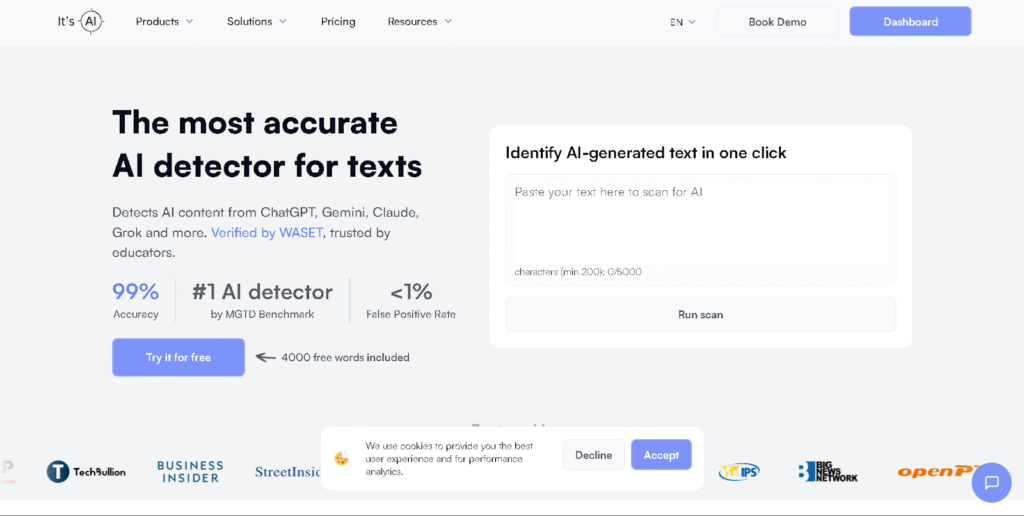
It’s AI analyzes text to determine whether a human or AI wrote it. You paste in an essay, article, email, or any piece of writing, and within seconds, it tells you the probability that it was generated by AI.
The system works by looking for patterns in how text is structured. AI models write in statistically predictable ways, certain word combinations appear more frequently, sentence structures follow patterns, and the overall “voice” has subtle markers. Human writing is messier, more varied, and less predictable.
It’s AI uses machine learning models trained on millions of examples of both human and AI-generated text. It calculates something called perplexity, which measures how surprised the model is by each word choice. AI-generated text has low perplexity because it’s predictable. Human text has higher perplexity because people make unexpected word choices.
The platform provides detailed reports showing not just whether text is AI-generated, but exactly which sentences and even which words were likely written by a machine. This heatmap visualization helps users understand what specific parts of a document are suspicious.
What makes It’s AI different from similar tools is that it runs on Bittensor’s decentralized network. Instead of one company’s AI model doing the detection, hundreds of independent “miners” compete to provide the most accurate detection. This competition constantly improves the system.
How It’s AI Works Differently From Centralized Competitors
Most AI detectors like GPTZero, Originality.ai, or ZeroGPT are run by single companies with proprietary systems. They develop their detection models internally, update them when they get around to it, and you have to trust their accuracy claims.
It’s AI works completely differently through decentralized collaboration on Bittensor. Validators on the network create challenging test cases using a dataset of 18 million human texts plus AI-generated variations. Miners submit their best detection models to evaluate these texts. The most accurate miners earn rewards.
This creates constant competition to improve accuracy. Every miner is trying to beat the others, so innovation happens faster than in corporate research labs. When new AI writing tools emerge, the network adapts quickly because hundreds of miners are independently working on detecting them.
The results speak for themselves in independent benchmarks. On the MGTD benchmark (a unified testing framework with over 2 million text samples in 30+ languages), It’s AI scored 0.92 AUC compared to GPTZero’s 0.887 and Originality.ai’s 0.825. On the RAID benchmark, it achieved 98.3% accuracy versus GPTZero’s 95.8%.
These aren’t small differences. A few percentage points in accuracy means fewer false accusations when students actually wrote their own work, and better detection when AI was actually used. For teachers and employers making decisions based on these results, accuracy differences of several percentage points matter enormously.
The decentralized approach makes the system more transparent and also prevents the system from becoming outdated. Anyone can examine how the detection works, verify the benchmarks, and even contribute improvements. This prevents stagnation, unlike centralized detectors who often struggle to keep up with new AI models like GPT-5 or Claude. By the time they update their systems, new versions have emerged. Its AI’s competitive network adapts continuously as miners update their models to handle the latest AI writing tools.
Why Anyone Would Invest in SN32 Alpha
It’s AI has a token called SN32 alpha that represents a stake in the subnet’s success. The token has a fixed supply of 21 million (similar to TAO’s scarcity model) with halvings approximately every four years.
The investment case centers on real-world utility. It’s AI already generates around $2,000 monthly from enterprise subscriptions, and that’s growing as more schools, publishers, and companies adopt the platform. Revenue comes from premium subscriptions, API access, and educational partnerships.
The AI detection market is massive, estimated at over $3 billion and growing fast as AI-generated content explodes. GPTZero raised funding at a $50 million valuation. ZeroGPT gets around 10 million monthly visits. It’s AI outperforms both in accuracy benchmarks while operating on a fraction of their budget through decentralization.
Token holders can stake their SN32 alpha to earn yields. Historical yields have ranged from 50% to over 100% APY based on the subnet’s performance within Bittensor’s emission system. As the platform gains users and proves its superiority in benchmarks, the token should capture value from that success.
The team has been strategic about token economics. They’ve used their own funds to buy back tokens and avoid dumping on the market. Unlike many crypto projects that sell all their tokens immediately, It’s AI’s team is committed to holding and supporting long-term value.
There’s also the broader Bittensor ecosystem effect. As Bittensor grows and proves that decentralized AI works, successful subnets like Its AI benefit. The network’s shift toward utility-driven tokenomics rather than pure speculation aligns incentives for building real products people actually use.
The risks are typical for crypto: market volatility, competition from better-funded centralized alternatives, and uncertainty about whether decentralized models can sustain competitive advantages long-term. But for people who believe AI detection is increasingly important and decentralized solutions work better, SN32 alpha offers direct exposure to that idea.
How Regular People Actually Use It’s AI
You don’t need to understand blockchain or Bittensor to use It’s AI. It’s designed like any normal website with simple interfaces for checking text.
The basic process is straightforward. Visit its-ai.org or app.its-ai.org, paste your text into the box (up to 4,000 words for free), and click check. Within seconds, you get a detailed report showing the probability that the text was AI-generated, with color-coded heatmaps highlighting suspicious sections.
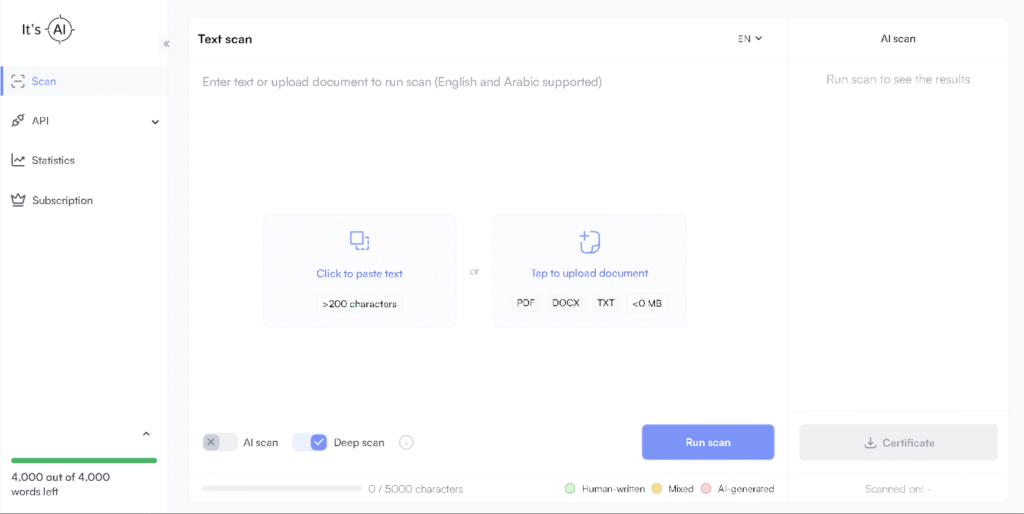
The free tier gives you 5 deep scans per month plus basic checks. Deep scans break down every sentence and word with probability scores, so you can see exactly which parts might be AI-generated. For most casual users, like teachers checking a few essays, writers verifying their work, or job seekers making sure their resume reads human, the free tier is plenty.
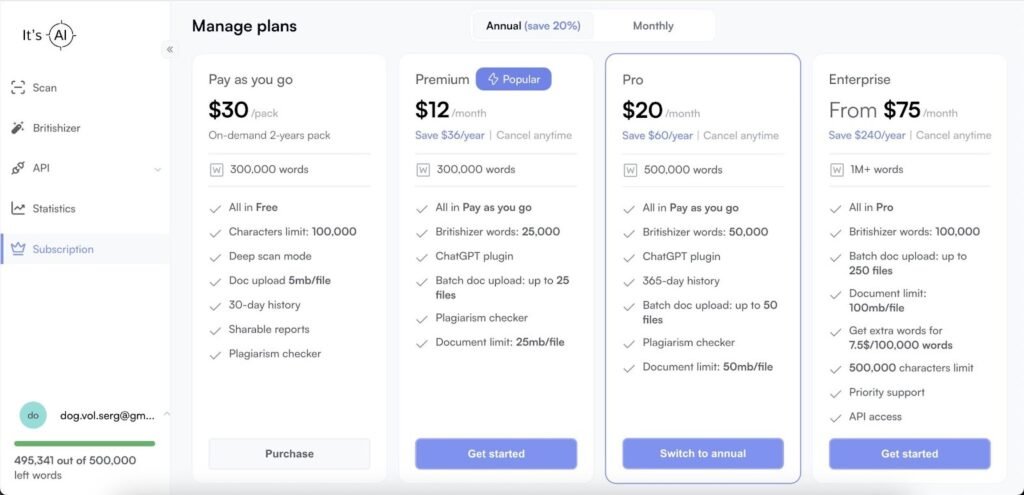
For heavier use, paid plans start at $12 monthly for 300,000 words. That’s enough for teachers with multiple classes or writers producing lots of content. Educational pricing is especially affordable at $5 per student per year, with teachers getting full Pro access. This makes it feasible for entire schools to deploy.
The Chrome extension adds convenience if you check a lot of web content. Install it from the Chrome Web Store, highlight any text on any website, and get instant detection results without leaving the page. This works for checking social media posts, online articles, forum comments, or anything you encounter while browsing.
There’s also a ChatGPT plugin that lets you analyze text without leaving ChatGPT’s interface, and Zapier integration for automating workflows. If you regularly process documents, the API and Python SDK let you build custom solutions like batch-checking hundreds of documents automatically.
Coming soon are integrations with Moodle and Google Classroom, which will let teachers check assignments directly within the platforms they already use for managing coursework. This removes friction and makes AI detection a seamless part of the grading workflow rather than a separate task.
The “Britishizer” tool is a quirky additional feature that rewrites AI text to sound more human, specifically in British English. While this might seem to defeat the purpose of detection, it’s useful for writers who want to use AI as a starting point but make the output feel genuinely human before publishing.
For anyone involved in education, content creation, hiring, or publishing, It’s AI provides practical tools without requiring any technical knowledge. You’re using a sophisticated decentralized AI system, but from your perspective, it’s just a simple web interface that tells you whether text is genuine.
The Real-World Impact
It’s AI has moved beyond theory into actual deployment. In November 2025, they secured a pilot program with Jess Dubai School, one of the top 15 schools in the Middle East, to test the detector on student work starting in January 2026.
This matters because it proves the technology works in real educational settings, not just in controlled tests. When a prestigious school trusts It’s AI for academic integrity, it validates both the accuracy and the practical applicability of the platform.
The platform now gets about 300 daily organic visitors, with people finding and using it because it solves a real problem they have. Traffic has tripled over recent months as awareness spreads and more people need AI detection tools.
Media coverage has expanded, too, with features in AP, TechBullion, and Business Insider. The founder, Sergey Volnov, has done interviews explaining how decentralized AI detection works and why it’s superior to centralized alternatives.
By early 2026, monthly revenue reached around $2,000 from enterprise subscriptions. While that’s modest, it demonstrates that paying customers see enough value to subscribe rather than use free alternatives. For a decentralized project competing against well-funded companies, generating any revenue shows the model is working.
What Makes This Matter Beyond Just Detection
It’s AI represents something bigger than just another tool for spotting AI writing. It’s proof that decentralized AI can outperform centralized corporations at specific, important tasks.
The AI detection market will only grow as AI writing becomes more common. Schools need it. Publishers need it. Companies need it. Anyone who cares about content authenticity needs it. The question is whether that market gets served by a few dominant companies or by open, decentralized alternatives.
If It’s AI succeeds, it validates the Bittensor model of using token incentives to coordinate distributed AI development. That has implications far beyond detection; it suggests decentralized networks can tackle many AI problems better than corporate research labs.
For users, the decentralized approach provides transparency you can’t get from black-box systems. When GPTZero says text is AI-generated, you trust their proprietary algorithm. When It’s AI says the same thing, you can see how that conclusion was reached because the system is open.
The platform is still relatively early. It launched less than two years ago and continues adding features, improving accuracy, and expanding partnerships. Whether it becomes the dominant detection tool or just one of many options depends on execution and adoption.
But the core technology works. The benchmarks prove it. Real schools are using it. Paying customers see value. And the decentralized model enables continuous improvement without massive corporate overhead.
For anyone checking text authenticity, It’s AI offers a free, accurate, and constantly improving tool. For anyone invested in decentralized AI’s success, SN32 demonstrates that competitive markets beat corporate monopolies even in cutting-edge technology domains.
Website: its-ai.org
Check out their GitHub at It-s-AI/llm-detection
Follow @ai_detection on X
Enjoyed this article? Join our newsletter
Get the latest Bittensor & TAO ecosystem news straight to your inbox.
We respect your privacy. Unsubscribe anytime.


Be the first to comment