
The question running through every SN3 holder’s mind this morning is simple: do I hold, buy the dip, or cut my losses?
Templar’s alpha token is trading at a steep discount to where it was 48 hours ago. The team that built it is gone. The vibe most associated with it has walked away. If you’re looking at your portfolio and feeling a knot in your stomach, that’s a rational response to a genuinely uncertain situation.
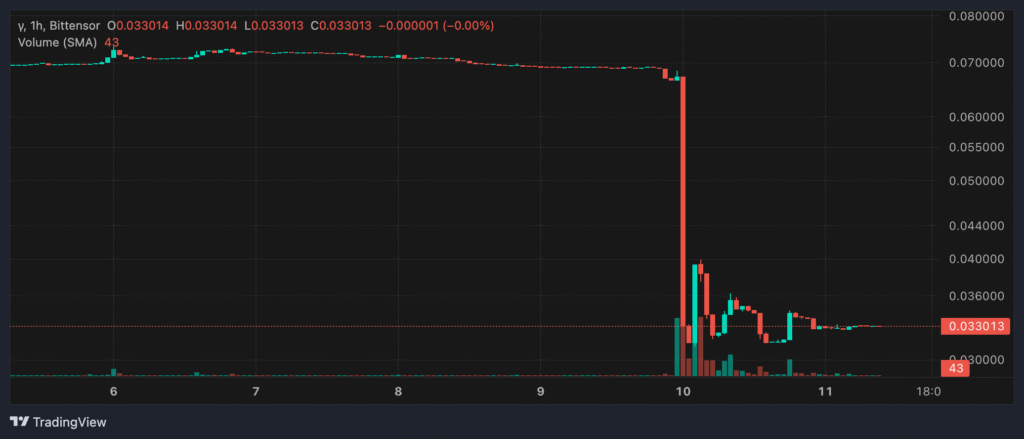
But uncertainty and zero are not the same thing. And the case for SN3 right now hinges on a distinction that most people in the Bittensor ecosystem have never had to think about until today: the difference between a team and a subnet slot.
The Subnet Slot Thesis
Here’s the thing that gets lost in the noise. When you buy alpha tokens on Subnet 3, you are not buying equity in Covenant AI. You are not buying shares in Sam Dare’s company. You are buying a position in Subnet Slot 3, and that is a piece of Bittensor infrastructure that exists independently of whoever happens to be operating it.
Templar, the brand, may be associated with Covenant AI. But Subnet 3, the slot, persists. It’s still there. The alpha tokens are still there. The miners who know the technology inside and out are still there. The mechanism that distributes emissions is still there.
What left was the team’s management layer. The slot itself, the thing your tokens actually represent, did not walk out the door.
This distinction matters enormously for how you think about valuation. If you believed SN3’s value was entirely derived from Sam Dare’s personal involvement, then yes, that value has taken a severe hit. But if you believed the value was in the subnet’s position within the Bittensor network, in its community of miners, in its established reputation as the home of decentralized pre-training, and in the proven technical infrastructure that produced a 72-billion-parameter model, then most of what you were paying for still exists.
The question is whether a new team can pick it up and run with it.
What Const Said About the Plan
Jacob Steeves (Const) addressed this directly in a recent Twitter Spaces hosted by Subnet Summer, and his answer was more concrete than most holders probably expected.
The short version: the subnets are being revived. Const described the technical layer that Covenant built on top of SN3 as a “thin layer” of front-end work that is not particularly difficult to replace. He noted that he originally came up with the name Templar himself and intends to keep the subnet operating under that name.
The plan has two phases. In the near term, Const says the team has enough stake to shift ownership keys to developers who were already part of the Covenant operation: people who know the codebase, understand the mining infrastructure, and can restart validation without building from scratch. The subnets would resume functioning, running the same workloads, pursuing the same objectives, potentially in a “headless” configuration, which was the original design intention anyway.
The longer-term play is more ambitious. Const wants to push through a mechanism for token-holder voting that would allow SN3’s alpha holders to elect a subnet owner. If implemented, this would make Subnet 3 one of the first truly community-owned subnets on Bittensor; governed not by a single founder’s discretion but by the collective conviction of the people who hold its tokens.
The Bull Case
If you’re considering buying SN3 at current levels, here’s what you’re betting on.
The slot retains its strategic value. Subnet 3 is the home of decentralized pre-training on Bittensor. It produced Covenant-72B — the model that drew endorsements from Nvidia’s CEO and Anthropic’s co-founder, powered a 90% rally in TAO, and proved that permissionless LLM training works at scale. That history doesn’t disappear because one founder left. A new team inheriting SN3 inherits that reputation, that miner community, and that institutional recognition.
The technical work is reproducible. The core innovations (SparseLoCo optimizer, distributed training coordination, the Gauntlet software) of Templar were built on Bittensor’s open infrastructure. Miners who participated in the Covenant-72B training run understand the technology intimately. They don’t need Sam Dare to run another training job.
You’re buying at distressed prices. The alpha token is trading at a level that prices in maximum uncertainty: team departure, narrative damage, community panic. If the revival plan works even partially, current prices represent a significant discount to where SN3 was trading pre-Covenant’s exit.
Community ownership could be a catalyst. If Const follows through on token-holder voting and SN3 becomes a genuinely community-governed subnet, that’s a new narrative, one that could attract attention and capital beyond what a single-team-operated subnet could generate. The story of “the subnet that survived its founder leaving and became community-owned” is arguably more compelling than “the subnet run by one guy.”
The Bear Case
Buying here is not without real risk. Intellectual honesty demands laying out what could go wrong.
Execution risk is high. There is no confirmed new team yet. Const says developers from the Covenant operation can be recruited, but that hasn’t happened yet. The transition from “one team runs everything” to “community-owned headless subnet” is unprecedented on Bittensor.
The narrative may not recover quickly. Covenant-72B was a flagship story, the kind of achievement that made mainstream media and drew institutional attention. That story is now tangled up with drama, accusations, and a rug-pull narrative. Even if SN3 resumes operations, it may take a significant new achievement to rebuild the momentum that the Covenant brand had generated.
Even Const acknowledges the uncertainty. It’s worth noting that Const himself, while outlining the revival plan, was candid with holders: “There is some uncertainty about what’s going to happen.” The plan is directionally clear, but the details are still being worked out in real time; you should price that in.
The Bottom Line
The honest answer is that SN3 right now is a bet on Bittensor’s thesis about itself.
If you believe that a decentralized network’s value lies in its community, its miners, its mechanism design, and its subnet infrastructure, not in any single founder, then current prices are arguably a mispricing. The slot persists. The technology is proven. The miners are skilled and are still much present. A new team is being assembled. And the potential introduction of community governance could make SN3 a stronger, more resilient project than it was under single-team control.
If you believe that a subnet is only as good as its founder and that Covenant AI’s departure takes the magic with it, then SN3 at any price carries risk that no discount compensates for.
The next few weeks will tell us which view is correct.
This opinion article is for informational purposes only and does not constitute financial advice. Always do your own research before making investment decisions.
Enjoyed this article? Join our newsletter
Get the latest Bittensor & TAO ecosystem news straight to your inbox.
We respect your privacy. Unsubscribe anytime.


Be the first to comment