
Hrish Lotlikar, CEO @hrishlotlikar | Max Woon, CTO
As modern consumers we produce vast digital data, but almost none of it is tied to real locations
Every day, billions of phones, cameras, sensors and social feeds capture fragments of the physical planet. Yet this information floats in disconnected platforms. It has no unified place in space. In fact, the digital world has never had a reliable understanding of location, context or presence.
As spatial computing develops and AR glasses move toward mass adoption, that limitation becomes defining. If AI agents are to navigate streets, discover events, understand environments or assist people in real time, they need an intelligent map of Earth. Not one made of static coordinates, but a living system that understands what is happening, where, and when.
That capability does not exist. The internet was never designed to be spatial. And existing maps, built for navigation, were never designed for AI.
SuperWorld steps directly into that gap. It proposes something ambitious: a programmable geospatial layer mapped across the entire planet. 64.8 billion digital plots, each one a coordinate where AI, people and real-world activity can attach content, intelligence and economic value.
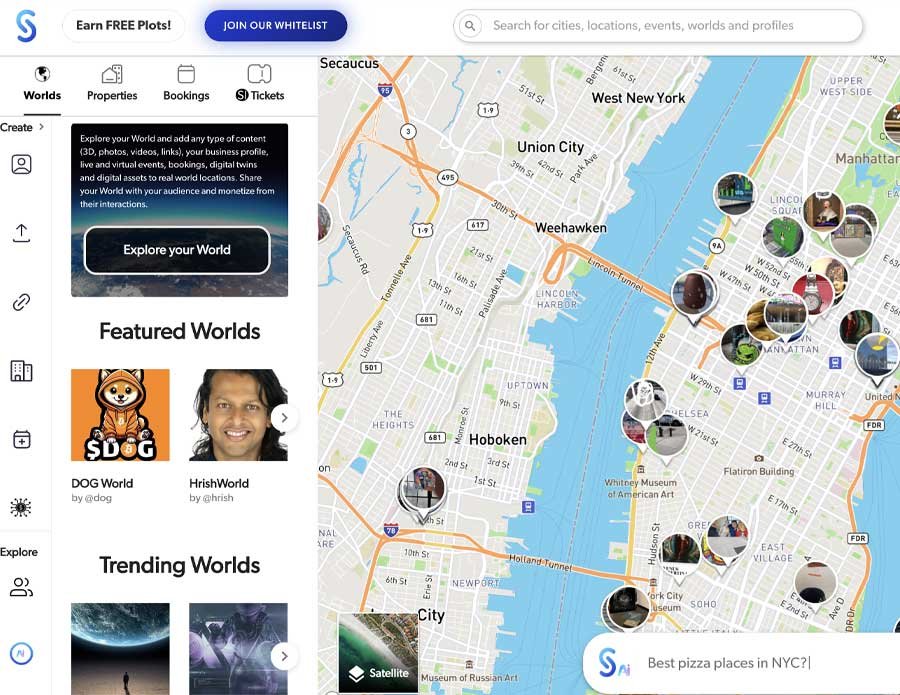
In short, SuperWorld aims to rewrite Earth as a computational surface.
A fragmented physical world demands an intelligent spatial layer
The problem begins with geography. Phones generate geotagged posts that may or may not be truthful. Venues change, events move, and social feeds scatter inconsistent signals across millions of tiles. Even the simple question “Did this photo actually come from this place?” is notoriously difficult. SuperWorld says: ‘miners must solve geoconsistency, relevance and entity resolution at scale, transforming noisy data into reliable intelligence’.
Without this foundation, spatial computing collapses. AR experiences cannot persist. Real-world AI agents cannot trust their environment. Recommendations, discovery engines and local search become guesswork rather than grounded reality.
And without trusted location intelligence, commerce breaks too. You cannot build bookings, reviews, events or digital media tied to physical space if the system cannot verify the ‘where’.
This is why the most advanced AI systems still live primarily online. They have no native sense of place.
SuperWorld recognises that if humanity is to merge the digital and physical worlds, it must start by solving the intelligence of geography.
SuperWorld’s solution: a geospatial AI network anchored to real locations

SuperWorld’s core innovation is a planetary-scale coordinate system where every plot corresponds directly to a real piece of Earth. The platform layers AI models on top of these coordinates to understand the world, generating and validating spatial content according to what is physically plausible.
To make this work at global scale, SuperWorld trains multimodal geospatial models capable of interpreting satellite imagery, GIS inputs, AR annotations, text, images and 3D objects. In layman’s terms, the system teaches AI to “see” the real world, compare data signals, and decide whether content belongs in a specific place.
This intelligence does more than detect consistency. It powers discovery engines that return what’s relevant to you within a radius. It resolves duplicate businesses. It ranks local events. It associates digital content with physical activity. And it enables proofs that content is authentic to its location.
The result is a world where digital layers can persist on top of physical space, where creators can place content anywhere on Earth, and where users can earn income when others interact with their digital or physical recommendations.
Why Bittensor matters: a decentralised intelligence substrate for a planet
Mapping the programmable layer of Earth is a monumental computational challenge. No centralised system can reliably evaluate billions of tiles, nor should the ownership of the global spatial layer be controlled by any single company.
That is where Bittensor enters the picture.
SuperWorld uses the Bittensor network as the decentralised intelligence substrate required to run a planetary-scale spatial system. TAO stakers help bootstrap the computation, competition and consensus mechanisms that keep the layer improving over time.
SuperWorld outlines how miners and validators operate. Miners scrape, correlate and refine geospatial signals into high-quality intelligence. Validators measure that intelligence against hidden ground-truth data, scoring relevance, accuracy and geo-consistency. This system turns spatial understanding into a competitive market, where the best intelligence rises and the network improves itself.
Put simply, the Bittensor subnet acts like a decentralised brain. Instead of one system trying to understand the world, thousands compete to give the most accurate answers, and the network rewards whoever performs best.
This is how a spatial internet becomes possible.
The team bringing the spatial internet to life
SuperWorld is led by founders Hrish Lotlikar and Max Woon, who have spent years developing the underlying platform, the AR layer and the digital land architecture. Their vision now converges with Bittensor’s rise. By shifting a portion of their system into a geospatial AI subnet, they align incentives not with land speculation but with real-world intelligence and utility.
This is a company moving beyond Web2.5 into a new category: decentralised spatial intelligence. Their work pulls together geospatial modelling, AR, real-world assets and on-chain property rights into one coherent layer.
A vision of the future: Earth as a living digital organism
If SuperWorld succeeds, the physical world becomes computationally alive. Cities will expose a second layer of meaning and information. Autonomous agents will navigate by understanding context rather than coordinates. Creators will drop persistent experiences anywhere on Earth. And every physical location will host a digital economy tied directly to its real-world activity.
This is more than a map. It is the foundation of the spatial internet: a world where digital information sits exactly where the real world needs it.
And for TAO holders, this moment is pivotal. By powering the intelligence that binds AI to geography, they help create the substrate on which the next century of computing will run.
Earth becomes programmable. Intelligence becomes spatial. And a new internet, one rooted in place, begins.
Stay up to date: watch out at app.bitstarter.ai for the launch of SuperWorld’s crowdfund on Bitstarter.
Enjoyed this article? Join our newsletter
Get the latest Bittensor & TAO ecosystem news straight to your inbox.
We respect your privacy. Unsubscribe anytime.


Be the first to comment