
For years, advanced trading infrastructure has lived behind closed doors. The situation was that institutional desks had the tools, and retail traders rarely did. But now, that divide is starting to narrow.
Projects building on decentralized AI are beginning to rethink how trading systems are designed, who gets access to them, and how performance is verified. Among the most ambitious efforts is Taoshi, a project building an ecosystem of platforms designed to bring institutional grade trading infrastructure to a broader market.
Through a network of interconnected products such as Vanta Trading and Hyperscaled, Taoshi is attempting something unusual in financial markets.
It is rebuilding the prop (proprietory) trading model itself, using decentralized AI, blockchain verification, and automated payouts.
The main aim is to create an open trading infrastructure where strategies, capital access, and execution tools are no longer restricted to a small group of insiders.
The Vision: A Decentralized AI Trading Network

Taoshi moves to democratize access to sophisticated trading strategies and wealth building tools. It operates on top of Bittensor, a blockchain designed to coordinate decentralized AI systems.
By tapping into this network, Taoshi can leverage distributed machine learning models to analyze financial markets and generate insights.
The long-term ambition is to build a global decentralized trading network powered by AI.
That vision rests on several key principles:
a. Decentralized infrastructure that removes reliance on centralized intermediaries
b. Blockchain transparency so performance and payouts can be verified on chain
c. AI-driven analysis to help traders interpret complex market data
d. Open participation for both individual traders and institutions
Instead of a closed platform, Taoshi is building an ecosystem where multiple operators, traders, and AI agents can interact within the same infrastructure.
How Taoshi ‘Opened’ the Year with Vanta Trading
The first major milestone arrived earlier this year with the launch of Vanta Trading.
In early 2026, Taoshi introduced Vanta Trading, the first proprietary (prop) trading firm built as an entity miner on Bittensor Subnet 8.
Traditional prop firms often operate through centralized verification systems and typically require profit splits that heavily favor the firm, Vanta Trading takes a different approach.
The platform uses a decentralized validator network to handle performance verification and payout execution. Through this unique proposition, it has conveniently delivered a:
a. KYC-verified platform,
b. Funded accounts scaling up to $2.5 million,
c. Automated USD (United State Dollars) payouts,
d. No profit split taken by intermediaries, and
e. On-chain performance verification.
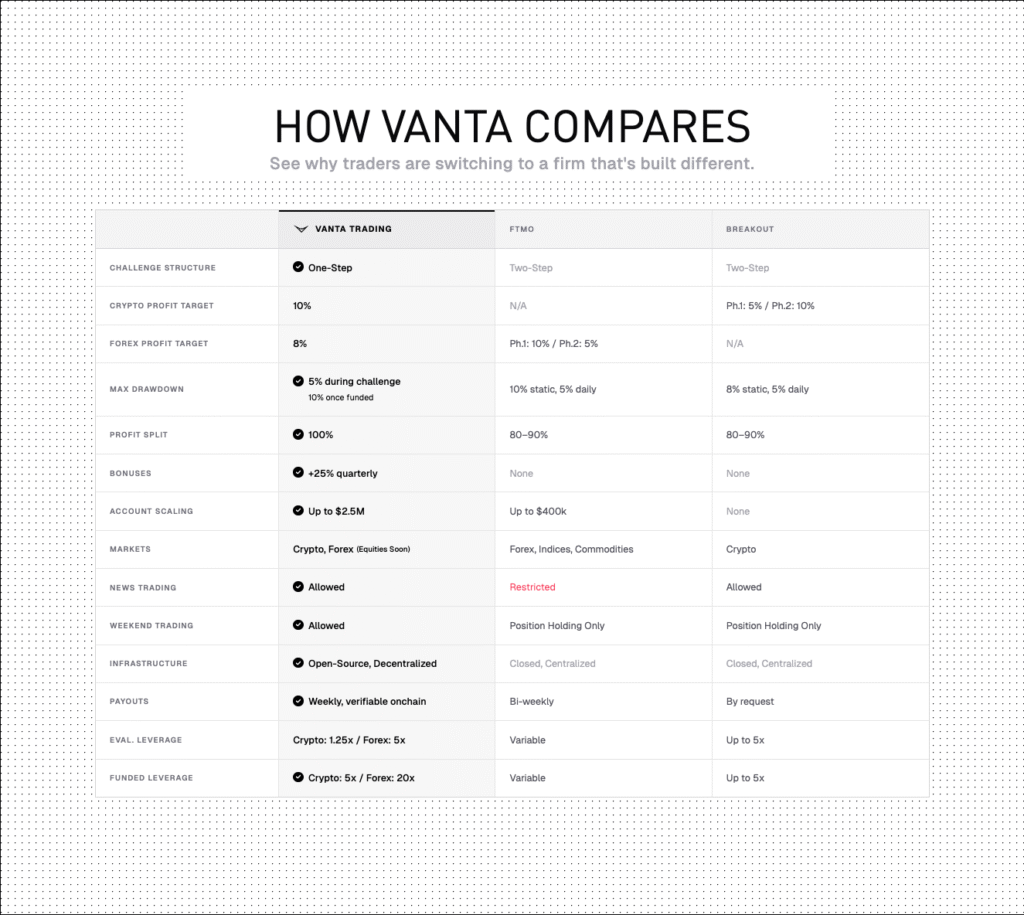
This places Vanta Trading in direct competition with established prop firms such as FTMO and Breakout Prop. However, the infrastructure behind it operates very differently.
The Entity Miner Architecture
A major technical innovation behind Vanta Trading is its entity miner model. Here’s how it works: Within Vanta, each miner normally occupies a single slot, and because subnets have a technical ceiling of 256 slots, scaling traditional miners would eventually hit a hard limit.
Entity miners easily solved this constraint: Instead of representing a single trader, one entity miner can support an unlimited number of subaccounts.
This architecture allows:
a. Thousands of traders to operate through a single miner slot,
b. Large-scale prop trading infrastructure without hitting subnet limits, and
c. Efficient growth without expanding the validator footprint.
In practice, it means a single miner can represent an entire trading firm.
Early Traction
Even before a full marketing rollout, Vanta Trading has already demonstrated early demand. Since launch, the platform has:
a. Onboarded 50 paying traders,
b. Achieved traction with minimal marketing, and
c. Validated the demand for decentralized prop trading infrastructure.
The next phase focuses on distribution. And to scale through this phase, Taoshi plans to launch full-scale:
a. Paid search campaigns,
b. Reddit advertising,
c. Re-targeting strategies, and
d. Listings across prop trading directories and comparison sites.
If traction continues, Vanta Trading could quickly become a recognizable name within the prop trading ecosystem.
The Next Major Product: Hyperscaled
The next step in Taoshi’s roadmap is even more ambitious. In March 2026, the team is launching Hyperscaled, a platform designed to expand the Vanta model into an open marketplace of prop firms.
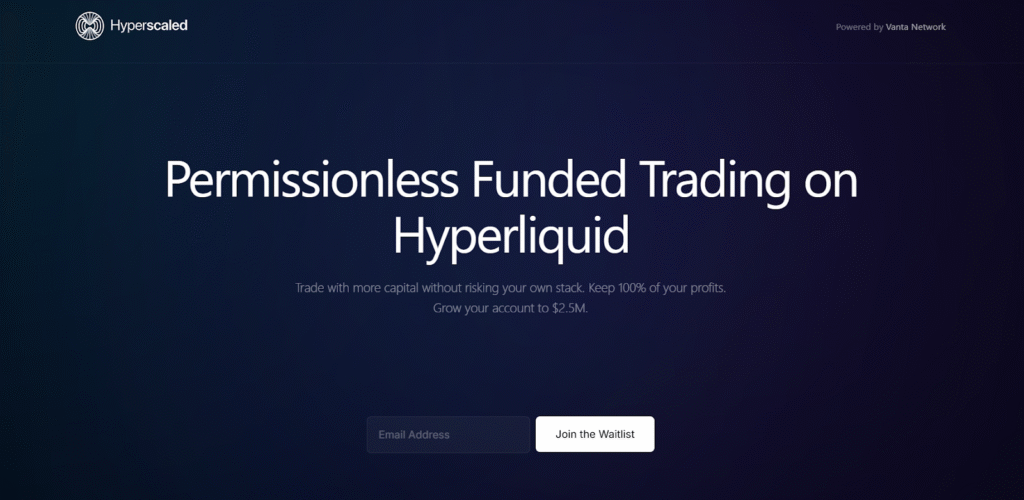
Rather than operating as a single trading firm, Hyperscaled functions as infrastructure. Thus, any operator will be able to spin up their own prop firm by deploying an entity miner within the system.
The platform enables traders to:
a. Pay in stablecoins,
b. Connect funded accounts directly to Hyperliquid,
c. Begin trading immediately, and
d. Receive automated on chain payouts.
Funded accounts on the platform can scale up to $2.5 million, similar to the Vanta Trading structure, but the key difference is scale.
Hyperscaled is designed as a network of prop firms rather than a single platform.
Built for AI Agents
One of the most unusual elements of Hyperscaled is its agent-first architecture. Alongside the platform, Taoshi is releasing a developer SDK (Software Development Kit) and CLI (Command Line Interface) that allows programmatic interaction with the system.
Through this interface, developers and trading agents will be able to:
a. Browse available entity miners and pricing tiers,
b. Purchase funded trading accounts,
c. Connect accounts to wallets,
d. Execute trades automatically, and
e. Monitor positions and payouts.
Every feature is accessible programmatically.
This means AI agents can operate entirely without a human interface, as thus, an autonomous trading agent could theoretically acquire a funded account, analyze market data, execute a strategy, and receive payouts automatically
All within a continuous automated trading loop.
Built-In Rule Enforcement
To ensure system stability, Hyperscaled includes a rule engine embedded directly into the SDK. This system enforces trading constraints before trades are submitted.
Examples include:
a. Leverage limits,
b. Pair restrictions,
c. Maximum drawdown thresholds, and
d. Exposure caps.
If a trade violates these parameters, the SDK produces structured error messages that both traders and automated agents can interpret.
This prevents silent failures while making the system compatible with fully autonomous trading pipelines.
The Payout Infrastructure
Another critical component arriving in the coming months is the full-payout stack. Taoshi plans to introduce automated infrastructure that will handle profit calculation, stablecoin payouts, and identity verification
Payouts will be issued directly to trader wallets in $USDC, while identity verification will be handled through Privado ID.
Importantly, KYC requirements only activate at the moment of payout, ensuring that trading access is kept wide open while ensuring compliance only where necessary.
For automated trading agents, verification can even be triggered programmatically through webhooks and callback systems.
The 2026 Roadmap
Taoshi’s development timeline outlines a rapid expansion of the ecosystem. The major highlights includes:
a. March 2026: Launch of Hyperscaled platform, and the release of agent first SDK and CLI tools
b. April 2026: Full entity miner pipeline goes live, and traders and agents begin deploying funded accounts across multiple prop firms
c. Late April 2026: Marketing and growth tooling introduced for entity miners
d. May to June 2026: Backtesting integration through QuantConnect Lean, expanded market data integrations, and open application process for new prop firm operators
Toward an Open Trading Infrastructure
If the roadmap unfolds as planned, Taoshi may be building something larger than a single product. It is assembling a full stack ecosystem for decentralized trading within which traders gain access to funded capital, operators launch new prop firms, AI agents execute automated strategies, and blockchain infrastructure verifies performance
The coolest thing about this is that all are coordinated through decentralized systems rather than centralized financial intermediaries.
The result is a trading infrastructure that looks less like a traditional prop firm and more like an open financial network.
If decentralized AI continues expanding as quickly as many expect, Taoshi’s experiment could become an early blueprint for how the next generation of trading platforms will operate.


Be the first to comment