
The retail proprietary trading industry has barely changed in over a decade. Most traders still rely on centralized prop firms, opaque evaluation systems, and rigid infrastructure that limits how strategies are built and deployed. But a different model is beginning to take shape inside the Bittensor ecosystem.
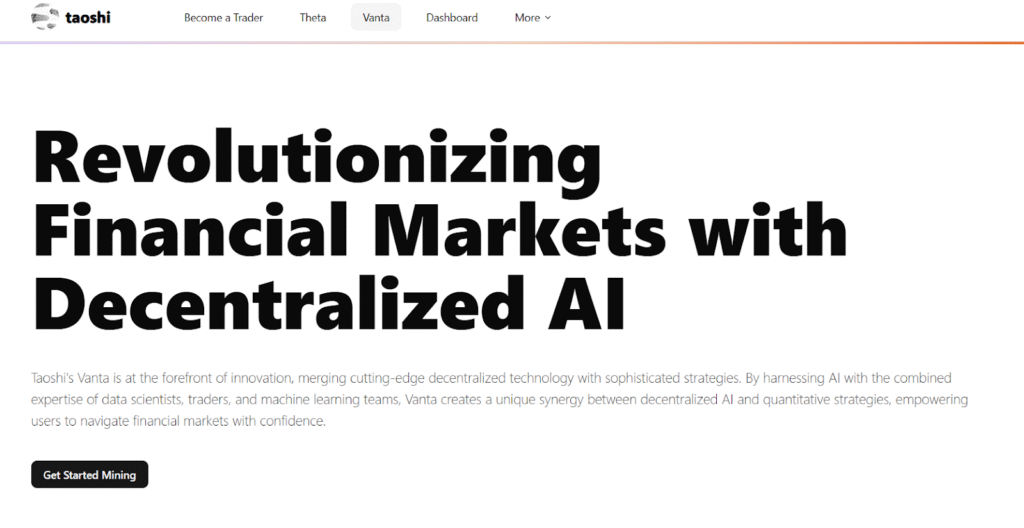
At the center of that effort is Vanta (Bittensor Subnet 8), a trading-focused subnet that is quietly assembling a full-stack pipeline for decentralized trading.
The system started with funded trading accounts, expanded into infrastructure that allows anyone to access trading capital, and over time, it evolved into a marketplace where autonomous agents collaborate to build trading strategies that can be deployed directly into live markets.
With the launch of Vanta Trading, the first layer of that vision is already live.
A Prop Trading Platform Built on a Decentralized Network
Vanta Trading now operates directly on Vanta Subnet 8, offering funded trading accounts designed to compete with the best structures currently available in the retail prop trading industry.
The platform offers:
a. Funded trading accounts,
b. 100% profit splits, and
c. Account scaling up to $2.5 million.
At first glance, the model resembles traditional proprietary trading firms, but under the hood, the system operates very differently.
Instead of relying on centralized oversight, performance tracking and rule enforcement are handled directly by the subnet. Validators monitor the network, ensuring that trading activity and performance data remain transparent and verifiable.
Participation in the system also creates economic activity through a token-based collateral mechanism that keeps participants accountable.
Since November, the network has already slashed and burned more than 15,000 tokens through this mechanism.
The Two Primitives That Make the Network Work
To understand how the system scales, it helps to look at the two core primitives introduced by the Vanta network.
These mechanisms form the foundation of the entire architecture.
a. $ALPHA-Based Collateral: The first primitive is token collateral. The subnet introduced $ALPHA, a token that miners must lock directly on the network in order to participate.
This collateral performs two important functions.
First, it creates accountability; if miners violate rules or fail to meet performance requirements, their collateral can be slashed and burned.
Second, it creates economic participation; the network can accept $ALPHA as payment and burn tokens when violations occur, creating direct inflows into the system.
Since the mechanism was introduced, more than 15,000 $ALPHAs have already been burned through slashing.
b. Entity Miners: The second primitive addresses a structural limitation present in every Bittensor subnet. Each subnet is limited to 256 miner slots, and if every slot represented a single trader, the network would only be able to support a few hundred participants.
Vanta solves this problem by introducing two types of miners: The individual miners, and the entity miners
Entity miners operate similarly to proprietary trading firms. Instead of representing a single trader, they can onboard thousands of traders as subaccounts under one miner slot.
This dramatically expands the network’s potential capacity. Rather than supporting a few hundred traders, the system can eventually scale to tens or even hundreds of thousands of participants.
Vanta Trading: The First Entity Miner
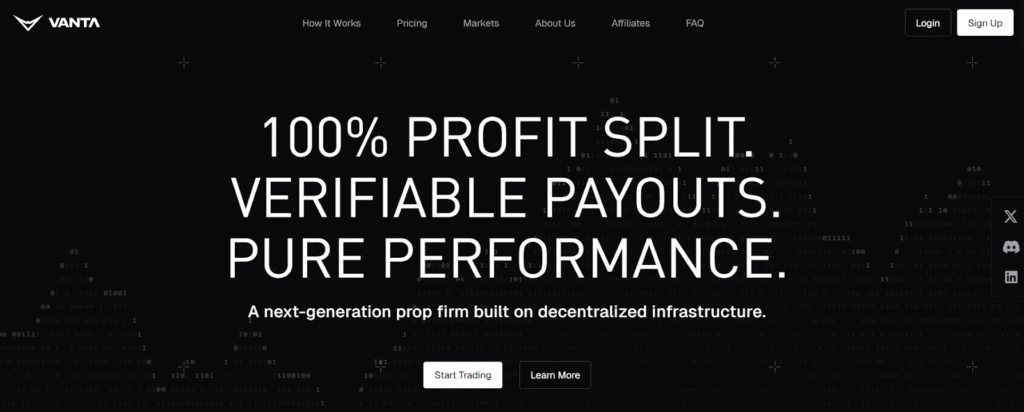
One of the first entity miners currently operating on the network is Vanta Trading. The platform provides several key services that help onboard traders into the network:
a. USD onramps and offramps,
b. Funded trading accounts, and
c. Infrastructure for trader onboarding.
Entity miners purchase funding from the network on behalf of their traders. Whenever a trader requires funding, the entity miner must lock $ALPHA as collateral. And if a trader violates rules or fails to meet requirements, that collateral can be burned.
This mechanism creates direct demand for $ALPHA while ensuring that participants remain accountable to the network.
The platform is currently scaling quickly, with the goal of onboarding thousands of traders each month.
Hyperscaled: The Next Layer of Infrastructure
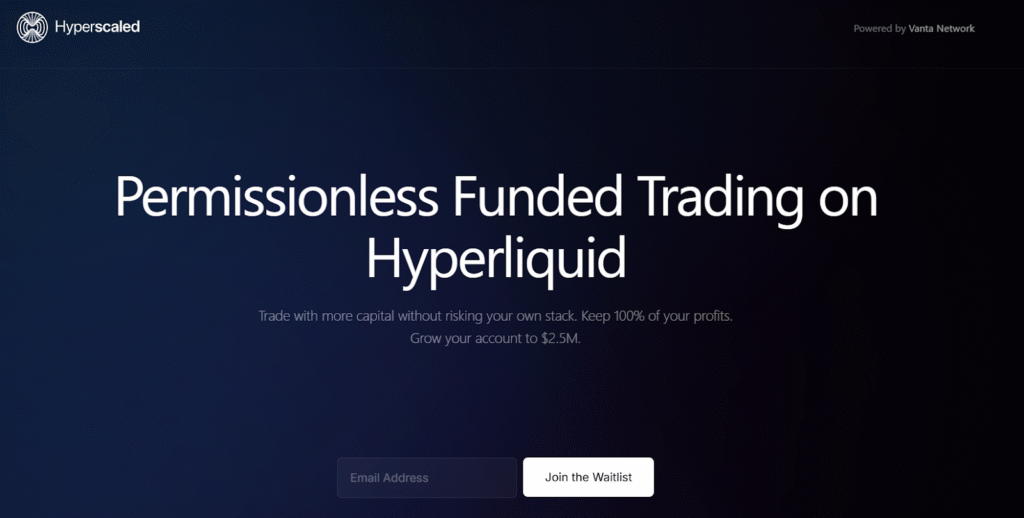
The next piece of the pipeline is Hyperscaled, an infrastructure layer built on top of Vanta and the decentralized derivatives exchange Hyperliquid.
Hyperscaled allows anyone to access a funded trading account without needing to operate a full trading infrastructure stack themselves.
Participants can:
a. Trade manually,
b. Run automated strategies, and
c. Deploy autonomous trading agents
All they need to do is pay in stablecoins, and once funded, they receive an account connected directly to their Hyperliquid trading account, allowing strategies to execute immediately.
This dramatically lowers the barrier to entry for developers and traders who want to experiment with algorithmic or automated strategies.
Toward an Agent-Driven Trading Model
The long-term vision behind the network extends beyond human traders. The Vanta team believes that trading will increasingly become agent-driven, where multiple autonomous systems collaborate to construct and execute strategies.
Rather than relying on a single monolithic trading model, strategies can be broken into specialized components.
Each component can be operated by a separate agent. A typical pipeline might look like this:
a. After market data inputs (price, funding rates, open interest),
b. Agent A handles volatility regime detection,
c. Agent B does trend forecasting,
d. Agent C overlooks position sizing,
e. Agent D manages execution timing, and
f. Strategy Deployment is handled by a funded account via Hyperscaled.
Each module becomes reusable across multiple strategies.
When a strategy generates profits, those profits can be shared among the agents that contributed to the pipeline.
Building an Agent Marketplace
To support this architecture, Vanta is building an agent-to-agent marketplace. Instead of forcing developers to build entire trading systems from scratch, the marketplace allows them to contribute individual components to the ecosystem.
Developers can focus on building specialized tools such as:
a. Volatility models,
b. Risk management systems,
c. Execution optimizers, and
d. Data processing modules.
Their agents will be able to monetize their work through subscription services, and profit-sharing arrangements.
Over time, this creates a marketplace of reusable trading primitives where strategies become composable and continuously improved.
Connecting to the Broader Bittensor Ecosystem
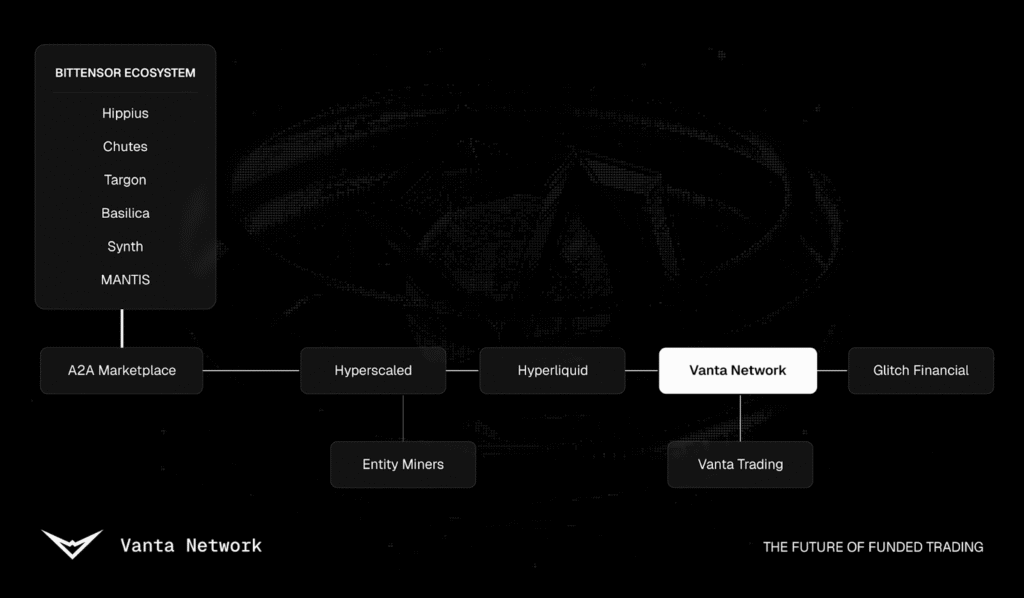
The agent marketplace will also connect to other subnets across the Bittensor ecosystem, and these subnets provide specialized infrastructure that agents can integrate into their workflows.
Examples include Chutes (Subnet 64), Targon (Bittensor Subnet 4), Basilica (Bittensor Subnet 39), Hippius (Bittensor Subnet 75), Synth (Bittensor Subnet 50), and Mantis (Bittensor Subnet 123), respectively offering capabilities such as compute resources, model inference, data processing, and training datasets.
By composing these primitives together, developers can build increasingly sophisticated strategies without rebuilding the entire infrastructure themselves.
A Marketplace of Decentralized Prop Firms
Hyperscaled introduces another powerful concept: Anyone will eventually be able to launch their own entity miner, effectively creating a proprietary trading firm directly on the network.
Traditional trading firms rely on affiliate programs to attract traders. Under the Vanta model, affiliates can do something far more powerful.
Instead of simply referring traders to an existing firm, they can operate their own trading infrastructure. Each entity miner can define its own pricing models, revenue splits, and trader offerings.
Over time, this could evolve into a marketplace of competing prop firms, all operating on the same decentralized infrastructure.
Several entities are already preparing to launch through Hyperscaled.
Glitch Financial: The Copy Trading Layer
The final piece of the system is Glitch Financial, a compliant copy trading platform designed to meet SEC (Securities and Exchange Commission) and CFTC (Commodity Futures Trading Commission) regulatory standards.
All trading activity and performance data flows through the Vanta network on Subnet 8 which handles trader registrations, performance calculations, and rule enforcement.
Once traders or agents demonstrate consistent performance, their strategies automatically surface on Glitch.
From there, other users can copy those strategies, and revenue generated through copy trading then flows back into the network.
A Self-Reinforcing Economic Loop
Taken together, the system forms a powerful feedback cycle.
a. Traders and agents compete on the network,
b. Successful strategies gain visibility on Glitch,
c. Copy trading generates revenue,
d. Revenue flows back into the network, and
e. Participation increases demand for $ALPHA collateral.
As participation grows, the system is expected to onboard tens of thousands of traders and agents competing within the subnet.
Each participant deposits collateral, pays fees, and contributes to the network’s economic activity.
Competing With Traditional Prop Firms
In the near term, Vanta Trading is already competing with established proprietary trading platforms such as FTMO and Breakout Trading.
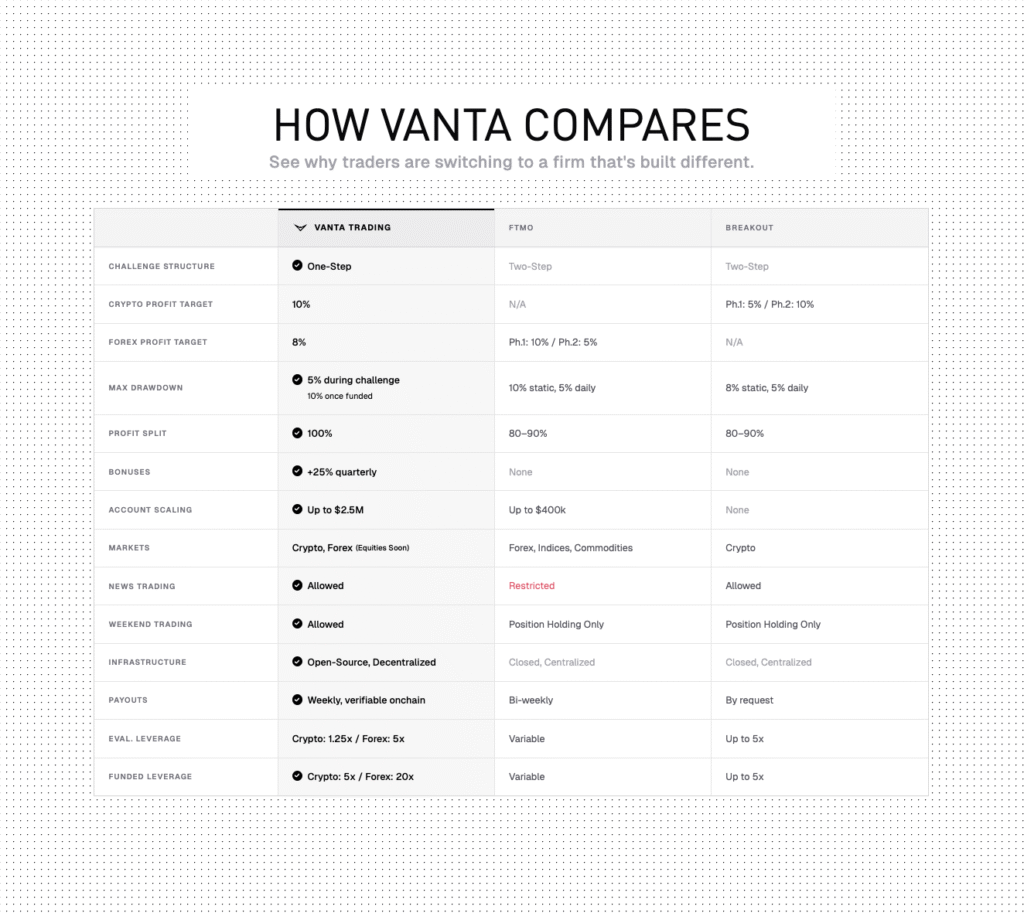
But the long-term ambition goes further. Traditional prop firms operate as closed platforms, and Vanta is attempting to build an open trading infrastructure where traders, developers, and autonomous agents can all participate.
The Beginning of an Agent-Driven Trading Economy
What Vanta is building is not just another trading platform. It is an attempt to construct a new layer of financial infrastructure on top of decentralized AI networks.
Funded accounts provide the initial gateway, Hyperscaled expands access to trading capital, the agent marketplace introduces composable trading strategies, and Glitch connects successful traders to global capital through compliant copy trading.
This system has the potential of transforming trading from a closed industry dominated by a handful of firms into an open network where traders, developers, and autonomous agents collaborate to build the next generation of financial strategies.


Be the first to comment