
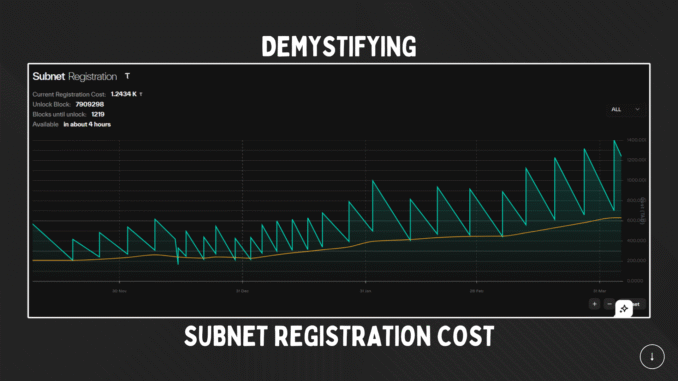
If you are not tracking subnet registration cost, you are missing the only real-time signal of builder conviction on Bittensor ($TAO).
While price moves on narratives, liquidity, and external market conditions, registration cost, on the other hand, reflects something far more grounded, which is how much capital builders are actively willing to commit for access to the network.
This is not speculative, it is not reactive, and it cannot be gamed through sentiment. It is a direct expression of demand for intelligence infrastructure.
While most attention remains fixed on $TAO and individual subnet performance, registration cost quietly captures the underlying reality. It shows whether builders are entering, competing, and staying, and that makes it one of the clearest indicators of where the network is actually heading.
A Pricing Mechanism That Reflects Real Demand
Subnet registration on Bittensor is governed by a dynamic, market-driven system that adjusts continuously based on participation: There is no fixed fee and no centralized control.
The cost evolves in response to demand, creating a live feedback loop between builders and the network.
The mechanism is simple in structure and powerful in implication:
a. Each subnet allows a limited number of registrations per epoch, typically three,
b. When all available slots are filled, the registration cost increases in the next epoch,
c. When only some slots are filled, the cost remains unchanged, and
d. When no slots are taken, the cost decreases.
This structure ensures that pricing always reflects real activity. Builders are not just choosing to participate, they are competing for access, and the cost adjusts accordingly.
Over time, this transforms registration from a technical step into an economic signal.
From Open Access to Capital Commitment
In its early phase, the cost of subnet registration was inexpensive. It was explorative, allowing builders to experiment freely and test new ideas without meaningful financial constraints. That phase served its purpose.
Today, the network has moved into a different stage. Launching a subnet requires real capital, and more importantly, it requires conviction.
This shift introduces a natural selection layer:
a. Builders must allocate meaningful capital upfront,
b. Subnets must justify their existence through performance and utility, and
c. Low-effort deployments are priced out before they even begin.
This results in a network that is no longer defined by experimentation, but by competition.
Scarcity of Intelligence Infrastructure
The closest parallel to this mechanism is Ethereum gas, where users compete for limited block space. As demand increases, costs rise, pricing out less valuable transactions.
Bittensor ($TAO) applies this logic to a different resource: The scarce asset is not block space, but intelligence infrastructure, which includes subnet slots (128 active subnets), validator attention, and access to emissions. Registration cost becomes the price of entering and competing within this system.
This creates a structural shift in how value is formed:
a. Subnet slots become economically scarce positions,
b. Builders compete not just to launch, but to sustain relevance, and
c. Capital flows toward subnets that demonstrate measurable utility
At higher cost levels, participation itself becomes a signal of quality.
The Recycling Mechanism and Why It Matters
One of the most overlooked aspects of subnet registration is what happens to the $TAO that is spent. Unlike traditional systems that burn fees, Bittensor recycles them.
The process works as follows:
a. $TAO used for registration is converted into alpha,
b. That value is returned to the unissued supply pool, and
c. The supply is reintroduced into emissions over time
This distinction matters more than it appears: Burning permanently removes supply, while recycling redistributes it across time. Registration cost therefore becomes a mechanism for delaying emissions rather than destroying value.
This introduces several important dynamics:
a. It extends the network’s emission timeline,
b. It aligns costs with long-term participation rather than short-term destruction, and
c. It embeds registration expenses into the economic model of builders and miners.
Critically, these costs are not recoverable, they represent a permanent commitment to participation.
What the Current Data Is Actually Signaling
At present levels, the data is unambiguous:
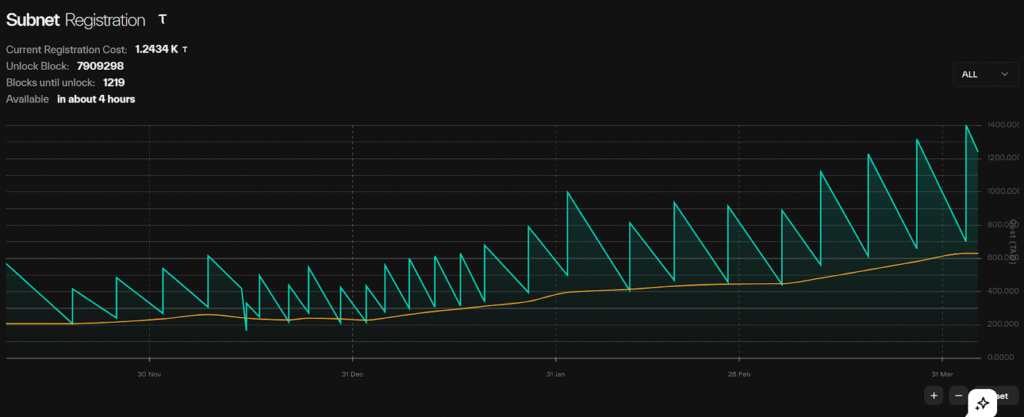
a. Registration cost remains elevated at approximately 1,245 $TAO (taken as at April 06),
b. The network is at 128 active subnets, and
c. Demand for slots continues to persist despite rising costs.
This is not a transient spike, and sustained pricing at this level reflects consistent builder demand and continued capital allocation into the network.
More importantly, it signals a shift in participant profile:
a. Serious teams are entering and competing,
b. Subnet slots are becoming more valuable over time,
c. Capital is concentrating in higher-quality deployments, and
d. The barrier to entry is reinforcing overall network quality
These are structural signals, not cyclical ones.
The Signal That Separates Noise From Conviction
Bittensor does not make its most important signals obvious. The metrics that matter are often quiet, embedded within the system rather than amplified through narratives.
Subnet registration cost is one of those signals.
It measures conviction, not attention. It reflects capital commitment, not speculation. And it reveals, in real time, whether the network is attracting builders who are willing to compete for scarce infrastructure.
Ignore it, and you are left reacting to the price.
Track it, and you begin to understand where real value is forming.
In a network designed around incentives, that difference is everything.
Enjoyed this article? Join our newsletter
Get the latest Bittensor & TAO ecosystem news straight to your inbox.
We respect your privacy. Unsubscribe anytime.


Be the first to comment