
There is a reason why some of the most sophisticated builders in crypto are quietly shifting their attention toward Bittensor. It is not just another blockchain, not even another AI narrative. It is something far more fundamental, a network where intelligence itself becomes an economic primitive.
For the first time, you are not simply building a product, you are designing a market for intelligence, where contributors compete, collaborate, and get paid based on measurable performance. If done right, this is how billion-dollar systems emerge from aligning incentives at scale.
However, most people approach Bittensor the wrong way. They either rush into “the code” without understanding the system, or they copy existing subnets without forming a clear thesis. Both paths lead nowhere!
If you want to build something that lasts, you need to slow down, think deeply, and move deliberately. Let’s walk through it properly.
STEP I: Understand the System First (Chill on the Code)
Before you go into technicalities, you need a mental model. Without it, everything else will feel like random moving parts.
Here’s a little tip for you: Every Bittensor subnet runs a simple and powerful loop:
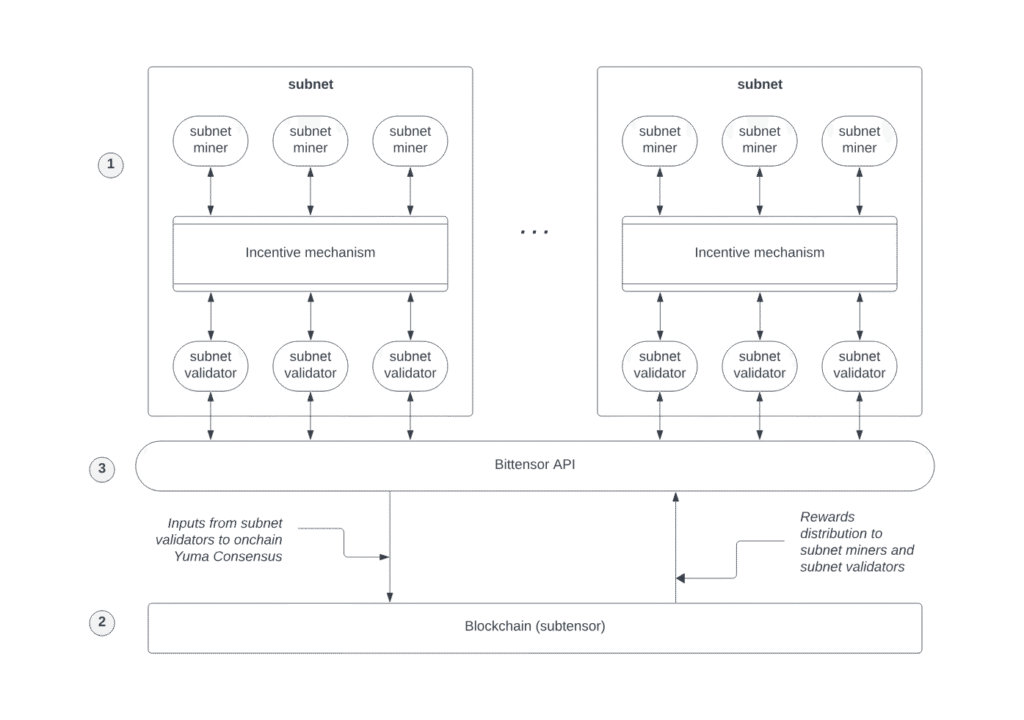
a. Validators ask questions,
b. Miners produce answers,
c. Validators evaluate those answers,
d. Scores are converted into “weights,”
e. Weights are written on-chain, and
f. $TAO emissions follow performance.
Everything else you see in the codebase is just infrastructure supporting this loop.
What this actually implies is that you are not building an app in the traditional sense, you are designing a competitive environment, an ecosystem where:
a. Miners act as producers of intelligence,
b. Validators act as judges of quality,
c. The protocol acts as the marketplace, and
d. Bittensor’s native coin, $TAO, acts as the reward mechanism.
If your subnet does not produce meaningful competition or measurable value, it will not matter how clean your code is.
If your reward function is weak, your subnet is weak, and if your validator logic is shallow, your subnet is shallow. (Everything else is secondary!)
So before you even think about implementation, you need to understand what you are trying to measure and why it matters.
STEP II: Design the System (Plan… Then Plan Again)
This is where most people fail, and it is also where billion-dollar ideas are born. Bittensor ($TAO) does not reward effort. It rewards well-designed incentive systems.
So the real question is not “what am I building?” It is “what behavior am I incentivizing?”
1. Start With a Clear Use Case
After carefully conducting a market research and also, a deep inquiry into Bittensor subnet, your subnet must answer one simple question: What kind of intelligence is valuable enough that people should pay for it?
Examples could include high-quality text generation, financial predictions, data labeling or cleaning, search and retrieval systems, and scientific or medical modeling.
But choosing a category is not enough, you need to define what “good” looks like inside that category.
2. Design Your Incentive Mechanism
This is the heart of your subnet, the following needs to be clearly defined:
a. What validators will ask: What kind of queries are being sent to miners
b. What miners must produce: The format, quality, and constraints of responses
c. How responses are evaluated: Deterministic scoring, heuristics, or model-based grading
d. How rewards are distributed: What gets rewarded, what gets ignored, and what gets penalized
3. Think in Terms of Game Theory
A strong subnet creates a game where:
a. Good actors are consistently rewarded,
b. Bad actors are naturally filtered out, and
c. Optimization leads to real-world value, not just gaming the system.
A weak subnet does the opposite, where miners learn how to exploit your scoring instead of improving quality.
4. Validator Design Matters More Than You Think
Your ‘validator’ is not just a component, it is the brain of your network. It decides which miners to query, how often to query them, how to interpret responses, and how to update scores over time
If your validator logic is lazy or random, your entire subnet becomes noise.
5. A Simple but Powerful Rule
Do not overbuild your miner early. Instead, focus on reward design first, then refine validator logic, only then optimize miner performance.
Because in Bittensor, the market structure defines the outcome, not the individual participant.
STEP III: Go to Testnet First (This Step Saves You)
It might be tempting to go straight to mainnet, especially if you are confident in your idea. But, that might be a very big mistake!
Testnet exists for a reason, and ignoring it is one of the fastest ways to burn capital without learning anything. Launching on testnet allows for:
a. Zero-Cost Experimentation: You can test your subnet without risking real $TAO,
b. Debugging your Incentive Design: You will quickly see whether your scoring logic works or collapses,
c. Understanding Real Network Behavior: Simulations are not enough, you need live interaction, and
d. Learning the Tooling (btcli, Registration, Syncing): These workflows matter more than you expect.
What You Should Be Testing
While on testnet, focus on:
a. Whether your reward function produces meaningful differentiation,
b. Whether miners can exploit your system,
c. Whether your validator selects and scores effectively, and
d. Whether weight updates reflect actual performance.
This is where your subnet either becomes robust or falls apart, and it is far better to discover that here than on mainnet.
The Hidden Advantage
Most people rush past testnet, but if taken seriously, they gain an edge by:
a. Refining your mechanism while others guess,
b. Understanding failure modes early, and
c. Building confidence in your system before capital is involved.
This alone can separate serious builders from everyone else.
STEP IV: Go All In (Finney, No Half Measures)
Once your design is solid and battle-tested, it is time to commit. Launching on the mainnet is not just a technical step, it is a capital and conviction decision.
At this stage:
a. You are burning real $TAO to create your subnet,
b. You are competing for attention, stake, and credibility,
c. Your validator must perform under real economic pressure, and
d. Your incentive mechanism is now exposed to adversarial actors.
This is where theory meets reality.
What You Need to Get Right
Hold on, before launching, ensure:
a. Your incentive mechanism is clear and tested
b. Your validator logic is consistent and defensible
c. Your subnet has a strong, understandable value proposition
d. You can attract both miners and validators
Because a subnet without participants is just an idea.
At this stage, you are no longer just building code. You are creating a market, attracting supply (miners), attracting demand (users or downstream applications), and managing incentives like a founder, not an engineer.
This is how subnets evolve into businesses.
Why This Can Become a Billion-Dollar Company
What makes Bittensor ($TAO) unique is not just decentralization, it is the ability to turn intelligence into a continuously improving, economically aligned system.
If you get it right:
a. Your subnet becomes the best place to produce a specific type of intelligence
b. Contributors compete to improve quality
c. The network gets better over time
d. Demand grows as output quality improves
e. TAO emissions reinforce the flywheel
This is not a one-time product launch, it is a living system, and the most valuable systems in the world are not static (They are self-reinforcing!)
Final Thoughts
Building on Bittensor is not easy, and it is not supposed to be, it forces you to think differently:
a. Not in terms of features, but incentives
b. Not in terms of users, but participants
c. Not in terms of code, but coordination
Most people will underestimate how hard this is, but for those who take the time to understand the system, design carefully, and execute with discipline, the opportunity is massive.
Because at the end of the day, you are not just building a subnet, you are building a market for intelligence.
And if you get that right, everything else follows.
Enjoyed this article? Join our newsletter
Get the latest Bittensor & TAO ecosystem news straight to your inbox.
We respect your privacy. Unsubscribe anytime.


Be the first to comment