
In most financial forecasting systems, predictions come from a single model. That model might be sophisticated, and would have been trained on years of data.
But at the end of the day, it is still one architecture making assumptions about how markets behave, and markets have a habit of breaking assumptions.
This is where Synth takes a fundamentally different approach.
Instead of relying on one model, Synth creates a competitive forecasting network where dozens of independent models compete in real-time to predict financial markets.
The system continuously evaluates their performance and builds a meta model from the best performers. This singular system results in a dynamic forecasting that learns from live competition, not a static prediction engine.
What Synth Actually is
Synth is a decentralized prediction engine, built on the Bittensor Subnet 50, that produces probabilistic forecasts for financial markets, rather than simple price targets.

Instead of answering a question like “What will Bitcoin cost tomorrow?” Synth attempts to answer a more useful one: “What are the most likely paths Bitcoin’s price could follow?”
To do this, the system incentivizes miners to build probabilistic models using ‘well-known’ techniques such as Monte Carlo simulations, stochastic volatility models, and GARCH-based forecasting, as well as other machine learning architectures.
These models simulate thousands of potential price trajectories for assets like Bitcoin ($BTC), capturing complex market behavior including: volatility clustering, fat tail risk, sudden price shocks, and regime shifts in market conditions
The goal is to produce a distribution of outcomes, not a single guess.
Validators and the Scoring System
After the forecast period ends, validator nodes evaluate each miner’s predictions. Real market data is sourced through price oracles through which validators then compare predicted price paths with the actual price trajectory.
Accuracy is measured using a statistical metric known as the Continuous Ranked Probability Score, or CRPS.
This scoring rule evaluates two key qualities:
a. Calibration: whether the predicted distribution matches real outcomes, and
b. Sharpness: whether the predictions are precise without being overconfident.
CRPS penalizes two common forecasting mistakes equally:
a. Confidently wrong predictions where the distribution is too narrow, and
b. Overly vague predictions where the distribution is so wide it becomes meaningless.
The only way to perform well consistently is to represent market uncertainty realistically.
Multi-Horizon Scoring
To prevent models from optimizing only for the final outcome, Synth evaluates forecasts across several time intervals. Each forecast is scored at:
a. 5 minutes,
b. 30 minutes,
c. 3 hours, and
d. 24 hours.
This forces models to capture both short-term market dynamics and long-term trends as scores are calculated in basis points, allowing different assets to be evaluated on equal terms.
The 10-Day Rolling Competition
Individual forecast scores can be noisy, even strong models occasionally perform poorly when markets behave unexpectedly.
Synth addresses this by maintaining a 10-day rolling performance window.
Here is how it works:
a. For each forecasting round, scores are normalized relative to the best performer
b. The top model receives a score of zero
c. Other models are ranked based on how far behind the leader they were
These normalized scores feed into a 10-day exponentially weighted average, which determines each miner’s standing.
This design ensures that:
a. consistently strong models rise quickly
b. degrading models lose influence within days
c. short-term volatility does not dominate rankings
The system balances stability with adaptability.
Leaderboards and Token Rewards

Synth maintains a live leaderboard that tracks miner performance. After each forecasting round:
a. miner scores are updated
b. historical performance is blended with recent results
c. the leaderboard rankings are recalculated
At the end of each day, these rankings determine how token emissions are distributed across miners.
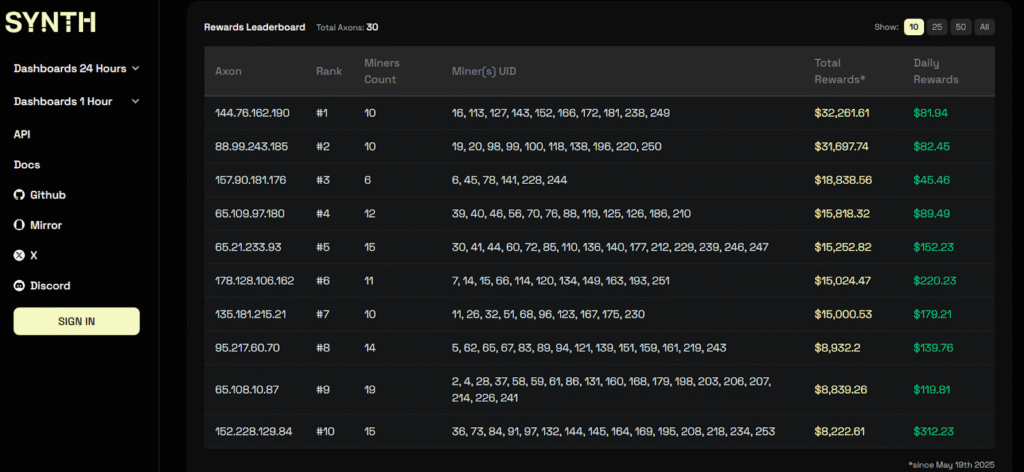
Rewards are allocated using a softmax style weighting, meaning that higher ranked miners earn a larger share of rewards, and lower ranked miners still receive baseline emissions.
This incentive design encourages continuous model improvement while preserving diversity across modeling approaches.
The Meta Model
One of the most powerful aspects of Synth is the way it aggregates forecasts. Instead of exposing the raw predictions from every miner, the system builds a meta model.
Synth currently maintains two primary leaderboards:
a. High-Frequency Leaderboard: Forecasts 1-hour into the future, with 1-minute resolution, and it’s updated every 12 minutes, and
b. Daily Leaderboard: Forecasts 24-hours ahead with a 5-minute resolution, and it’s updated every hour.
To increase stability, Synth also publishes meta leaderboards that aggregate performance across longer periods:
a. 6-day window for high frequency forecasts, and
b. 14-day window for daily forecasts.
Only the top 10 miners from each leaderboard contribute to the meta model. This filtering process removes weaker signals while preserving the strongest forecasting outputs.
What the API (Application Programming Interface) Actually Returns
Developers interact with Synth through the official API.
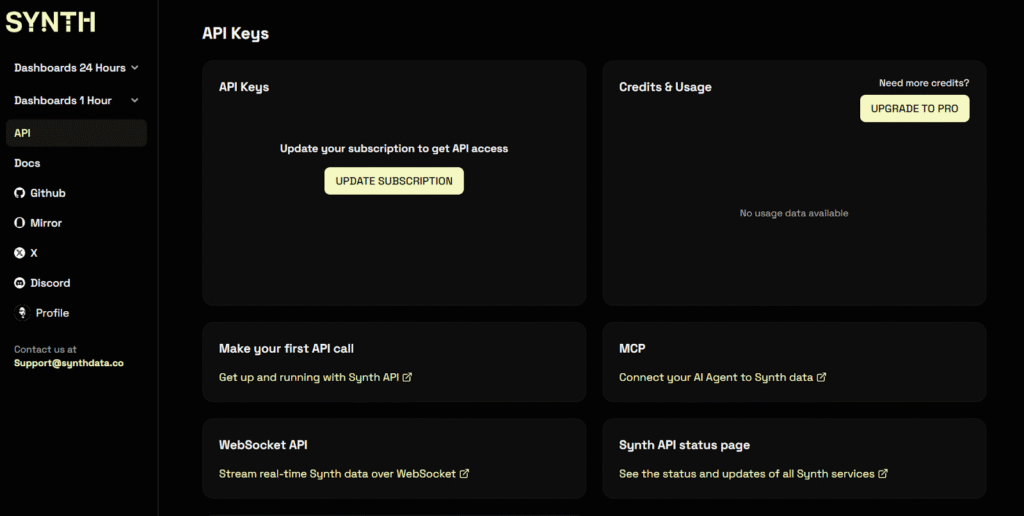
The API does not return a single predicted price. Instead, it provides probability distributions across multiple percentiles.
SynthData currently supports two primary forecasting horizons:
a. 24-Hour Forecasts: updated hourly, optimized for medium-horizon prediction, and
b. 1-Hour Forecasts: optimized for short-term market movements.
Both endpoints return full probability distributions across nine percentile levels, offering a calibrated view of the potential price range.
These outputs power several useful metrics:
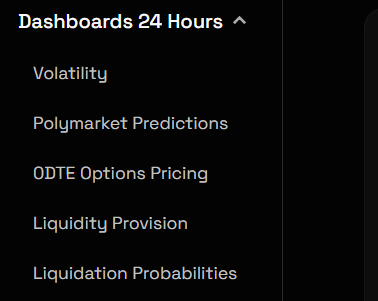
a. predicted price distributions,
b. volatility estimates,
c. liquidation probabilities, and
d. prediction market signals such as Polymarket forecasts.
Because these outputs come from the meta model built from the top performing miners, they represent the consensus of the most accurate models on the network.
Accessing Synth Data
Synth also provides tools that make it easy to integrate forecasting outputs into external systems. Developers can use the API to retrieve:
a. current leaderboard rankings,
b. miner performance metrics,
c. forecast distributions, and
d. historical synthetic datasets for backtesting.
A live visualizer on the Synth platform also displays real-time forecast distributions, allowing users to watch predictions evolve as miners submit new simulations.
This makes Synth not just a forecasting engine, but a data platform for probabilistic market intelligence.
Why the Competitive Model Matters
Traditional forecasting models face a common problem, they eventually become stale. A model trained on historical data may perform well in one market regime but fail when conditions change.
Synth avoids this by running a permanent forecasting competition.
Models that degrade lose ranking quickly, models that adapt rise to the top, and the meta model continuously recalibrates based on the best performing approaches.
This results in a forecasting system that earns its accuracy in real-time, and that may just be the most important difference.
This is because when you query the Synth API, you are not calling a static model. You are querying the outcome of live competition between dozens of forecasting systems, each trying to prove that its understanding of the market is closer to reality.
In a world where financial markets evolve constantly, that dynamic approach may prove far more resilient than any single model ever could.



Be the first to comment