
Cover image credit: Tao.app
Seven months is not a long time in crypto. But in a fast moving ecosystem like Bittensor, it is long enough for patterns to emerge.
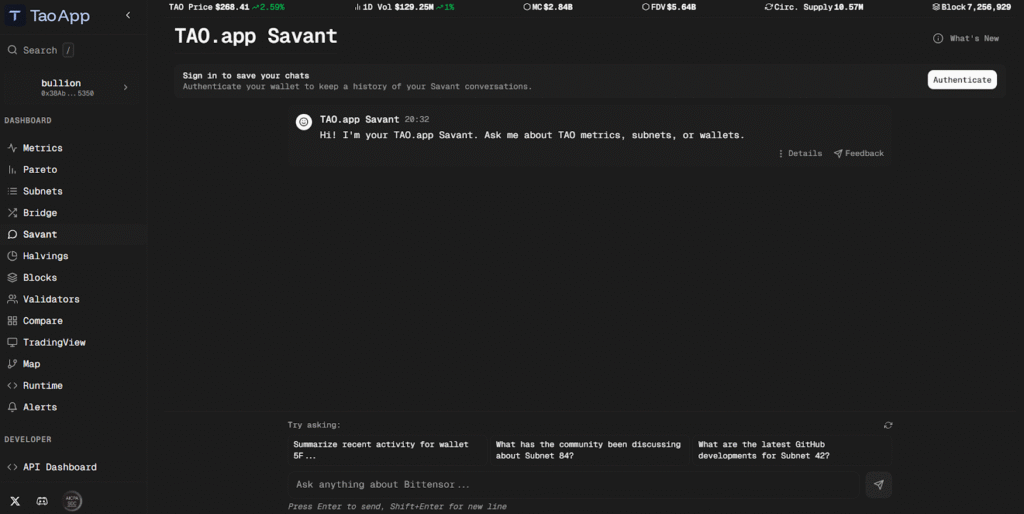
Since launching Savant on May 30, 2025, the team behind TAO.app has quietly been running one of the largest real-world experiments in applied AI tooling inside the Bittensor ecosystem. More than 55,000 conversations later, across 43 languages and 128 subnets, Savant has become something unexpected, and not just a chatbot.
It is a window into how people actually learn, research, and make decisions on Bittensor.
Below are what those conversations revealed.
From Experiment to Daily Tool
Savant did not launch as a finished product. When it first appeared in late-May, it was introduced as the world’s first AI assistant continuously fine tuned to the Bittensor network.
At the time, it lived mostly as an experiment, a proof that live network data, documentation, and language models could work together in real-time.
That changed when Savant received a permanent home inside TAO.app.
From that moment, usage shifted. Savant stopped being something users tried once and moved on from. It became something they returned to daily. By the second day after launch, it had already processed nearly 1,000 messages.
In December, Savant reached another milestone, it was referenced directly by the Opentensor Foundation as a way to easily explore Bittensor documentation. That mention quietly confirmed what many users already felt.
Right there, Savant was no longer just part of TAO.app, it had become a gateway to the ecosystem itself.
How New Capabilities Changed Behavior
One of the clearest lessons from Savant’s growth was how tightly usage tracked functionality. Every major spike in engagement followed a new capability release.
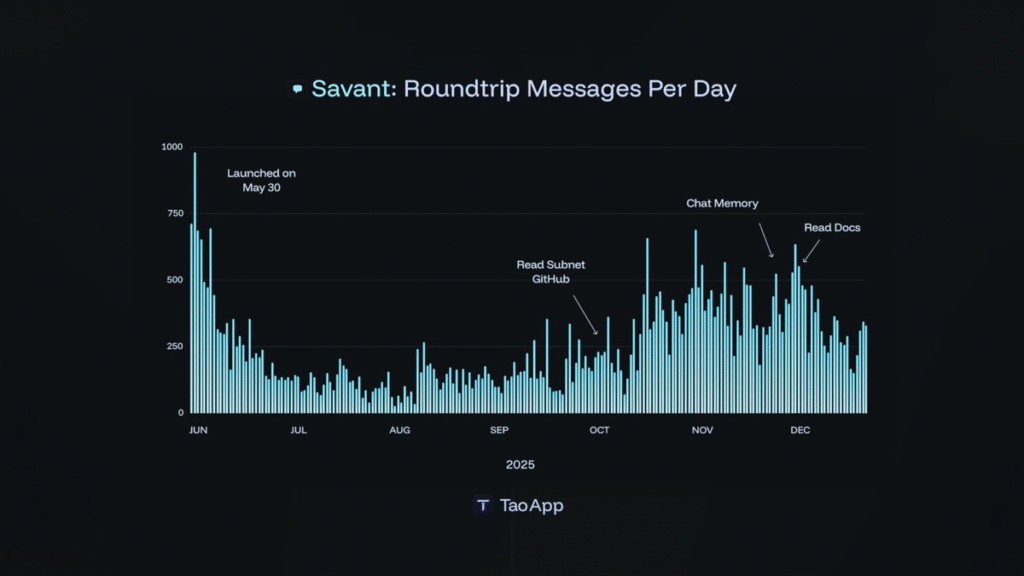
In October, Savant gained the ability to read subnet GitHub repositories. Almost immediately, developers and investors began using it for due diligence. Instead of scanning commits manually, they asked simple questions like whether a team was actively shipping code.
In November, chat memory arrived. Conversations became longer and more nuanced. Users stopped asking isolated questions and started building understanding across multiple turns.
In December, Savant learnt how to read documentation. That single feature unlocked deep research workflows, and users moved from surface level curiosity to sustained investigation.
The pattern was consistent. Each new capability did not just improve Savant, it created entirely new use cases.
A Global Network with Local Questions
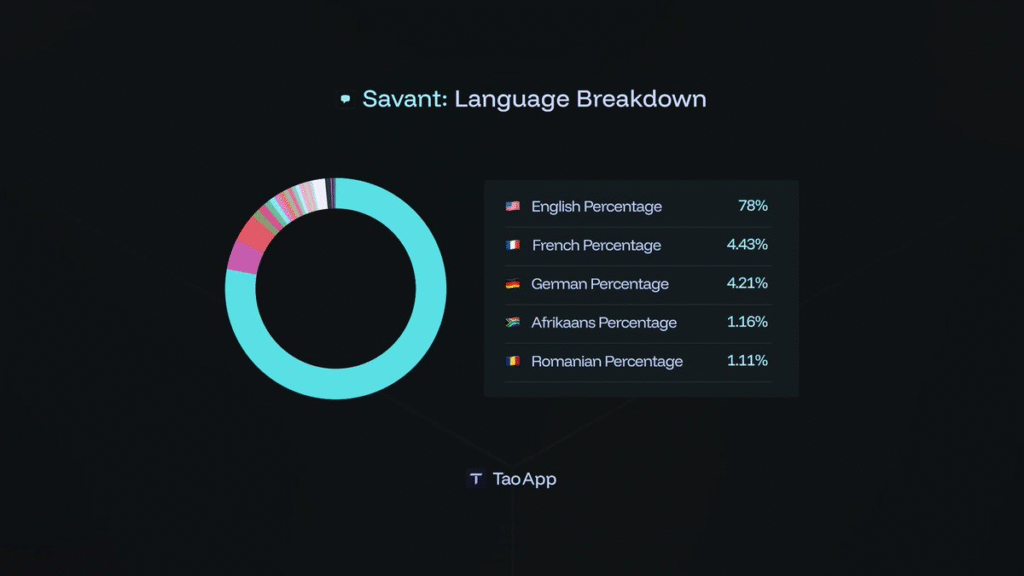
Bittensor has always been global and Savant made that reality visible. While roughly 78% of conversations happened in English, the most interesting insights came from the edges.
In July, German speaking users began asking about risks, validator yields, and protocol mechanics. Their questions were cautious, analytical, and focused on downside scenarios.
By December, French speaking users surged. Many of them were quantitatively-minded traders using precise language and advanced prompts around flow metrics, market structure, and $TAO signals.
Savant did not just translate language, it adapted to intent.
Across 43 languages, the same assistant was serving developers, investors, researchers, and newcomers, each with very different mental models of the network.
The Subnets That Shaped the Conversation
User curiosity tells its own story. Across seven months of conversations, certain subnets consistently dominated attention.
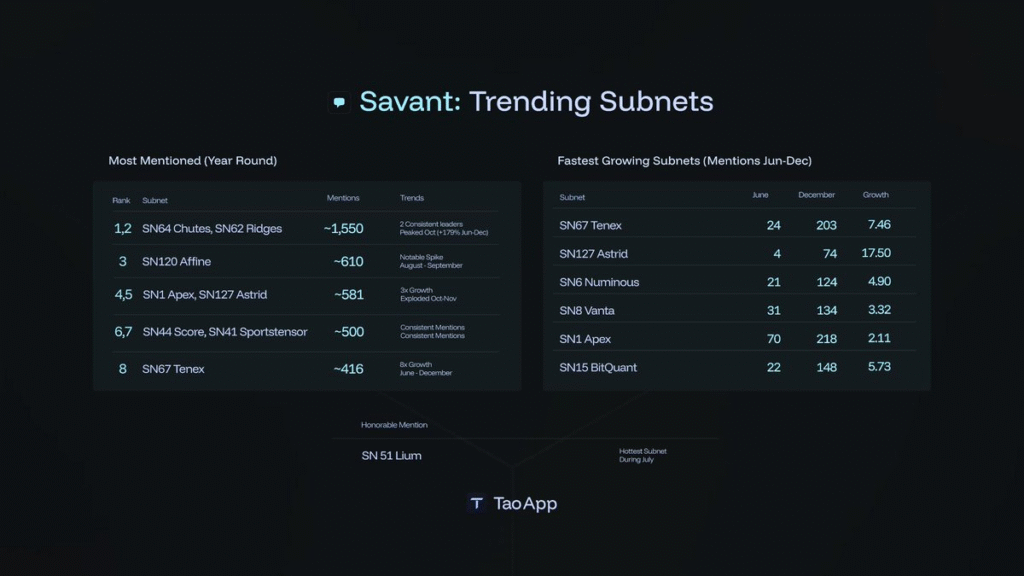
a. Chutes and Ridges were tied for the most mentions, each appearing roughly 1,550 times
b. Tenex experienced a 7.5 times increase in mentions between June and December
c. Astrid/SigmaArena went from 4 mentions in June to 74 in December, marking a clear breakout.
These were not marketing driven spikes, they reflected organic interest driven by performance, innovation, or emerging narratives.
In many ways, Savant became a mirror. The questions users asked shaped how the broader Bittensor story unfolded.
What Users Really Wanted to Know
Despite market volatility, most conversations were not about price. The most common questions fell into five categories. Questions like:
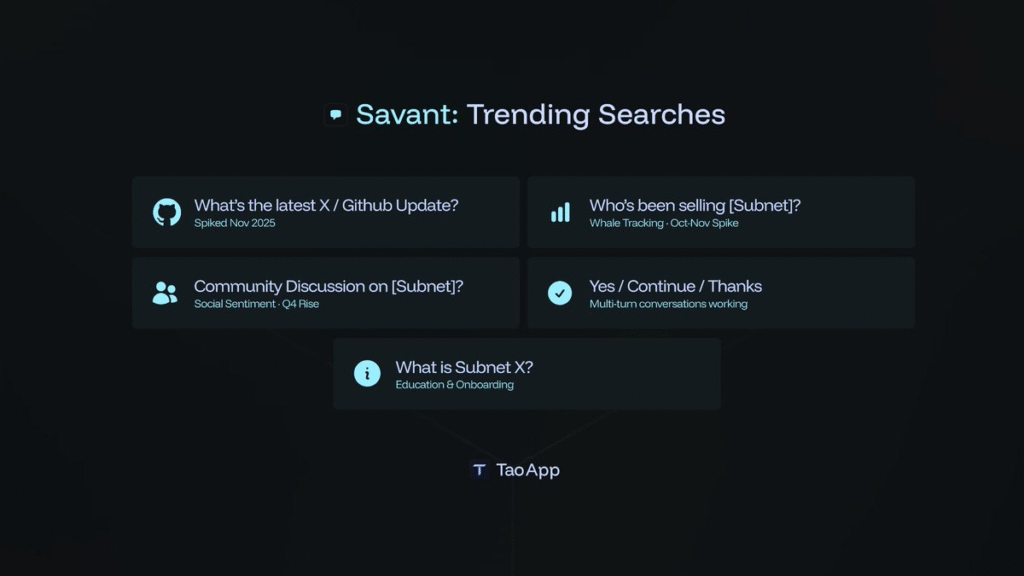
a. What the latest updates are,
b. The categories of people buying and selling,
c. What the community is discussing,
d. Simple confirmations like yes, continue, or thanks, and
e. Basic education around what a given subnet actually does.
This revealed something important: That people were not looking for hype, they were looking for clarity.
Savant succeeded because it met users where they were, whether that meant explaining fundamentals or connecting dots across live data.
Security Under Pressure
In September, Savant faced a serious test. Multiple attempts were made to break the system using SQL injection, XSS (Cross-Site Scripting) payloads, and system introspection attacks but none succeeded.
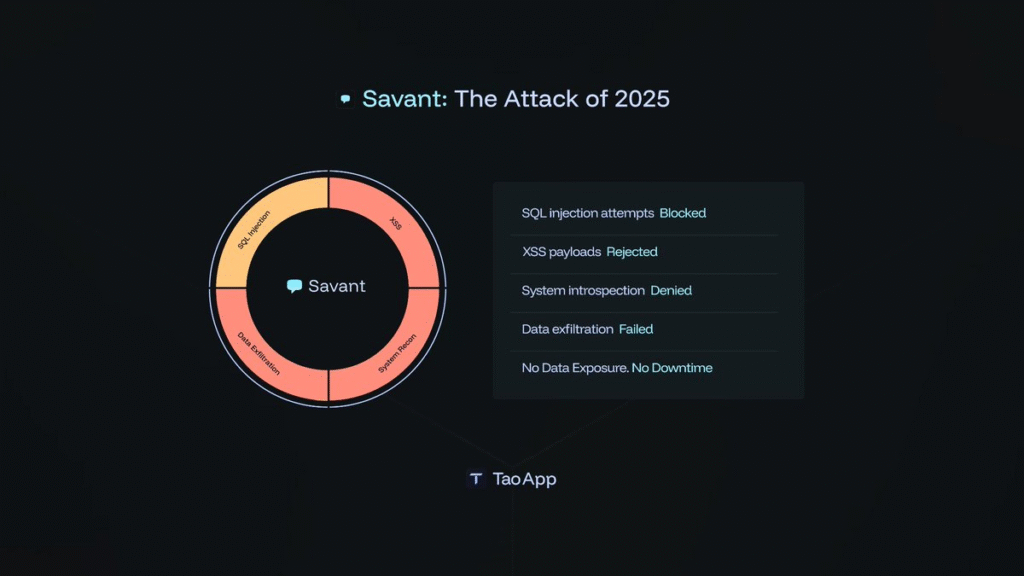
No data exposure and no downtime was recorded.
For the team, this reinforced that in an ecosystem built on trust and transparency, security is not a feature, it is the foundation everything else rests on.
Why Savant is Different
Savant stands apart from generic AI assistants for one core reason, it never stops learning.
Most language models are trained once and slowly fall out of sync with reality. Savant is continuously fine-tuned on live Bittensor data. When a new subnet launches, Savant understands it. When validator dynamics change, Savant reflects it. When network metrics shift, Savant can explain why.
Because it is embedded directly into the explorer, Savant answers are not abstract. They are grounded in the exact data users are looking at in that moment.
This makes it useful not just for research, but for real decisions.
Why This Matters for Bittensor
Savant lowers the barrier to entry without lowering the bar, users do not need to run nodes or parse command line tools to participate meaningfully.
With supported wallet and Savant, users can explore subnets, evaluate teams, track whales, and understand network health serving all and sundry in the ecosystem, regardless of their exposure to the ecosystem.
For newcomers, this removes confusion; for investors, it adds confidence; and for the ecosystem, it expands the audience beyond specialists.
As Bittensor grows more complex, tools like Savant become infrastructure, not convenience.
Looking Ahead
The next phase is already taking shape.
In 2026, Savant will introduce full session sharing, deeper data ingestion from on-chain sources and social feeds, and tools that turn raw information into actionable insight.
The goal is not to overwhelm users with data but to help them think clearly.
After seven months and tens of thousands of conversations, it is clear that when people can ask better questions, ecosystems grow healthier. Savant proved that.
And if the past year was about learning what the Bittensor community needs, the next one will be about delivering it, one query at a time.
Enjoyed this article? Join our newsletter
Get the latest Bittensor & TAO ecosystem news straight to your inbox.
We respect your privacy. Unsubscribe anytime.

Be the first to comment