
Decentralized AI is often framed as an alternative to centralized research labs, but in practice most systems struggle to move beyond theory. Benchmarks are published, models are trained, and incentives are discussed, yet the gap between virtual results and real-world impact remains wide.
NOVA, a decentralized drug discovery platform built on Bittensor, is attempting to close that gap.
Launched by Metanova Labs on Bittensor’s Subnet 68, NOVA has evolved in less than a year from a proof of concept into a continuously running discovery engine.
The system coordinates global contributors through Bittensor’s incentive layer, screens billions of molecules, and produces assets designed to plug directly into real pharmaceutical workflows.
What distinguishes NOVA is not only its technical ambition, but how it uses Bittensor’s decentralized architecture to turn open competition into a mechanism for discovery, validation, and eventual commercialization.
From Subnet Launch to Live Discovery Engine
NOVA officially went live on March 1, 2025, becoming the world’s first decentralized drug screening platform operating on the Bittensor ecosystem.
Rather than forming a traditional biotech company, the team launched a subnet, allowing contributors worldwide to compete and collaborate through Bittensor’s incentive model.
Since launch, NOVA has scaled rapidly:
a. From a static proof of concept to a continuously operating system,
b. From isolated benchmarks to adaptive, real-time competition,
c. From theoretical predictions to assets designed for licensing, validation, and co-development.
By running directly on Bittensor, NOVA benefits from a permissionless pool of compute, talent, and experimentation, while $TAO acts as the coordination and reward layer aligning incentives across participants.
Two Incentive Mechanisms, One Discovery System
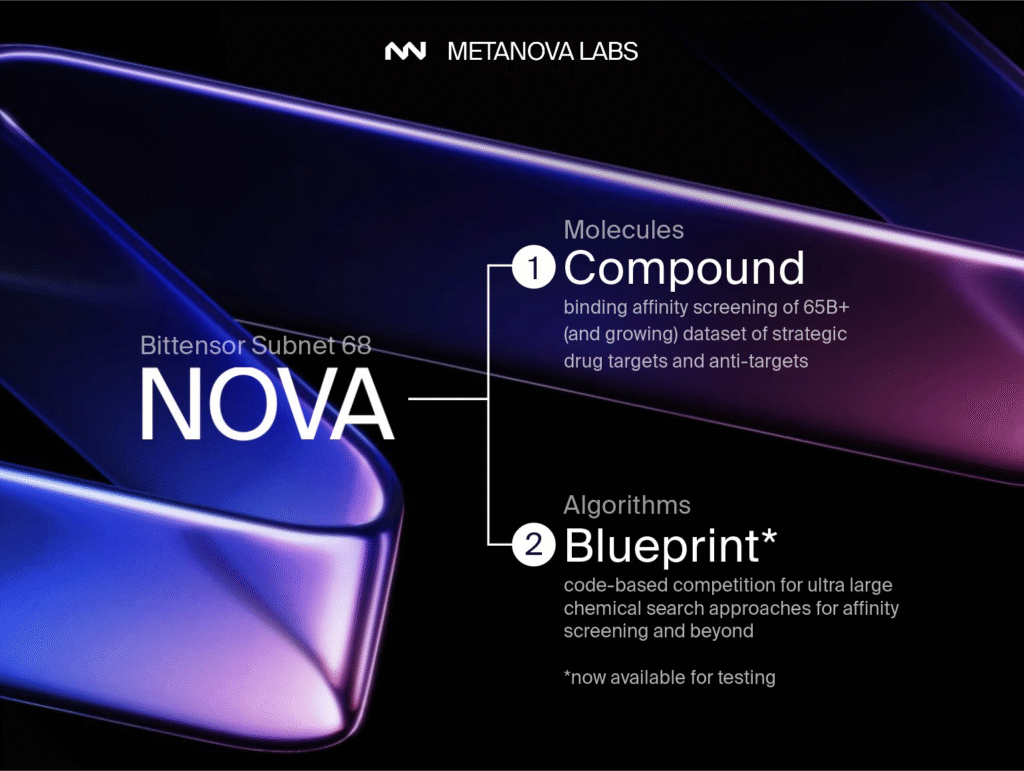
At the core of NOVA’s architecture are two parallel incentive mechanisms, each targeting a different layer of the drug discovery stack.
1. NOVA Compound: Molecular Discovery
NOVA Compound focuses on identifying promising molecules. Miners compete to submit compounds with high predicted affinity for a weekly biological target while minimizing affinity for predefined anti-targets.
Key features include:
a. Exploration incentives across a chemical search space exceeding 65 billion molecules
b. Diversity bonuses to prevent collapse into narrow local optima
c. Scoring powered by Boltz-2, developed by MIT and Recursion Pharmaceuticals
By running this process continuously on Bittensor, NOVA transforms molecular screening into an open, competitive process where rewards are tied to discovery quality rather than institutional access.
2. NOVA Blueprint: Algorithmic Search
NOVA Blueprint shifts attention from individual molecules to the algorithms that search chemical space itself. Miners submit code designed to explore ultra-large chemical universes more effectively and generalize across changing targets.
Instead of rewarding overfitting, Blueprint selects for robustness. Targets, parameters, and constraints change regularly, forcing algorithms to perform under uncertainty.
Over time, this mechanism is designed to surface search strategies that transfer across therapeutic domains.
Why Metanova Built NOVA on Bittensor
Metanova Labs launched NOVA with a mission that extends beyond drug discovery alone. The project reflects a broader goal of building infrastructure that supports sovereignty across financial, physical, mental, and social dimensions.
Drug discovery was chosen because of its extreme asymmetry. A single breakthrough can generate outsized financial returns and profound human impact, while inefficiencies leave millions untreated. Every percentage point improvement in hit selection can translate into eight- or nine-figure value creation.
Bittensor ($TAO) provides a unique foundation for addressing this challenge. Its decentralized incentive design allows intelligence to emerge from competition rather than coordination by a single organization. NOVA uses this structure to pursue discovery at scale without relying on closed labs, proprietary datasets, or centralized control.
Lessons So Far: Why Adversarial Behavior Matters
One of the most important insights from NOVA’s first year is that adversarial behavior is not a failure mode, it is a feature.
In open, permissionless systems like Bittensor, miners actively probe models and scoring functions for weaknesses. In traditional labs, this would be considered gaming. In NOVA, every exploit becomes a signal.
Key lessons emerged quickly:
a. Certain regions of chemical space consistently fool state-of-the-art models,
b. Scaling to billions of molecules improves hit rates but does not guarantee robustness, and
c. Continuous adversarial pressure surfaces blind spots faster than static evaluation.
To harness this, NOVA continuously injects entropy by shifting targets, adjusting parameters, randomizing anti-targets, and reweighting rewards. The result is a system that selects for generalization rather than benchmark performance.
Going Beyond State-of-the-Art
Generalization remains one of the hardest problems in machine learning–driven drug discovery. Models that perform well on narrow benchmarks often break when conditions change.
NOVA’s Blueprint mechanism directly targets this weakness. By enforcing threshold-based rewards and constantly changing conditions, the system favors algorithms that continue to perform as targets and constraints evolve.
This approach mirrors how Bittensor itself evolves: through continuous competition, selection, and incentive alignment, rather than static optimization.
2025 in Review: From Experiment to Capability
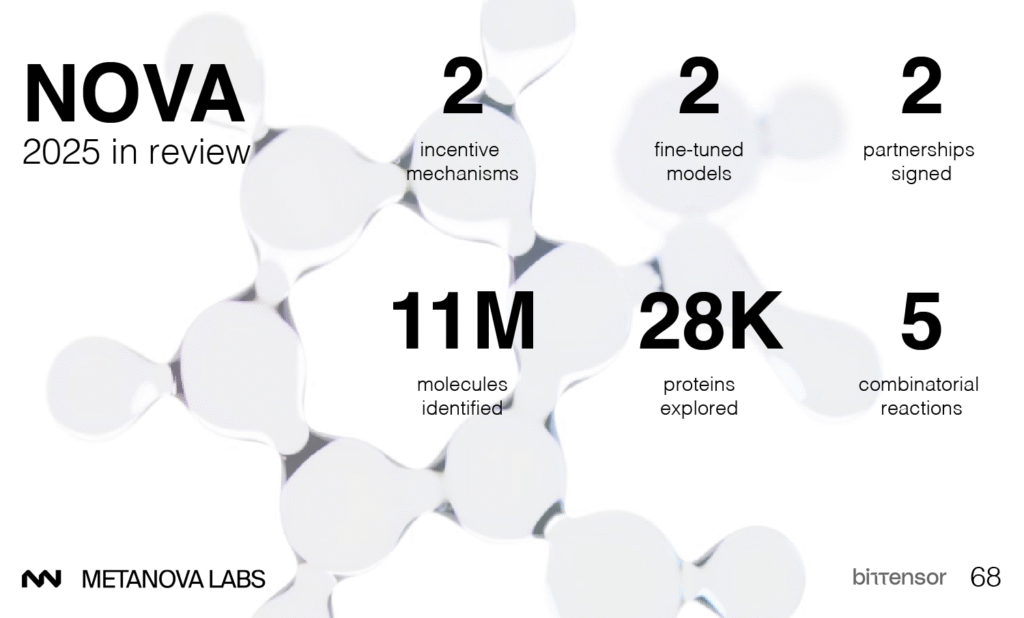
By the end of 2025, NOVA had matured into a materially different system than the one that launched earlier in the year.
Notable developments included:
a. Anti-targets to enforce real-world selectivity,
b. Diversity bonuses to maintain exploration across chemical space,
c. Expansion into multiple target classes aligned with Metanova’s internal R&D,
d. Two fine-tuned models, TREAT-1 and TREAT-2, focused on reward, learning, and circadian pathways,
e. Integration of combinatorial chemistry across multiple reaction sets,
d. Boltz-2 optimization with heavy normalization to improve hit recovery and quality,
e. Launch of NOVA Blueprint as a second, complementary incentive mechanism.
Over 2025, NOVA screened billions of molecules across tens of thousands of mammalian proteins, building growing, target-specific libraries. Each molecule generated value, whether as a lead, a benchmark, or a signal guiding the next discovery cycle.
Early Validation Beyond the Network
As NOVA’s outputs matured, they began to resonate outside the Bittensor ecosystem. In late 2025, a molecule submitted by NOVA miners showed high structural similarity to a patented HDAC 1/6 inhibitor developed by the Shanghai Pharmaceutical Industry Research Institute.
While early, the result demonstrated that decentralized discovery on Bittensor can surface chemically meaningful candidates comparable to those identified through traditional pharmaceutical pipelines.
Partnerships That Move Discovery Into the Real World
Two partnerships signed in 2025 highlight NOVA’s transition from prediction to validation.
1. DiaGen AI
Metanova’s partnership with DiaGen AI focuses on automating hit selection, one of the most manual steps in drug discovery.
Together, the teams are building an automated hit-picking system that converts NOVA’s output into curated, token-gated libraries suitable for licensing, benchmarking, and co-development.
2. Yalotein Biotech
A collaboration with Shanghai-based Yalotein expands NOVA beyond small molecules into nanobodies. This introduces wet-lab capability into the loop, allowing predictions generated on Bittensor to be systematically validated and extended into biological therapeutics.
What Comes Next: Closing the Loop in 2026
If 2025 proved that decentralized drug discovery on Bittensor could work, 2026 is about turning discovery into measurable value.
Key milestones ahead include:
a. Deployment of the automated hit-picking system,
b. Systematic wet-lab validation of NOVA-identified compounds,
c. Benchmarkable hit-rate metrics comparable to traditional discovery pipelines, and
d. Expansion into nanobodies, with initial candidates entering experimental testing.
These steps move NOVA from prediction to validation to asset creation, completing the loop between decentralized intelligence and real-world outcomes.
An Emerging Inflection Point for Bittensor
In under a year, NOVA has evolved from a proof of concept into a continuously running discovery system with growing libraries, early validation, and clear commercial pathways.
More broadly, it offers a glimpse of what Bittensor ($TAO) enables when applied beyond abstract intelligence benchmarks. By combining open competition, economic incentives, and real-world constraints, decentralized AI can move from theory to impact.
If NOVA continues on its current trajectory, 2026 may mark the moment when decentralized discovery becomes not just viable, but unavoidable.
Enjoyed this article? Join our newsletter
Get the latest Bittensor & TAO ecosystem news straight to your inbox.
We respect your privacy. Unsubscribe anytime.



Be the first to comment