
Crypto markets are not single variable systems, they are multi-layer feedback environments where narrative velocity, liquidity migration, volatility structure, and event probability interact in real-time.
Most prediction models isolate one stream of data and mistake it for signal, but on Bittensor ($TAO), it’s a different ball-game entirely.
Let’s dive into a practical illustration of an organized and structured architecture for how decentralized intelligence on Bittensor can move from raw feature extraction to decision ready outputs across the altcoin and broader crypto market.
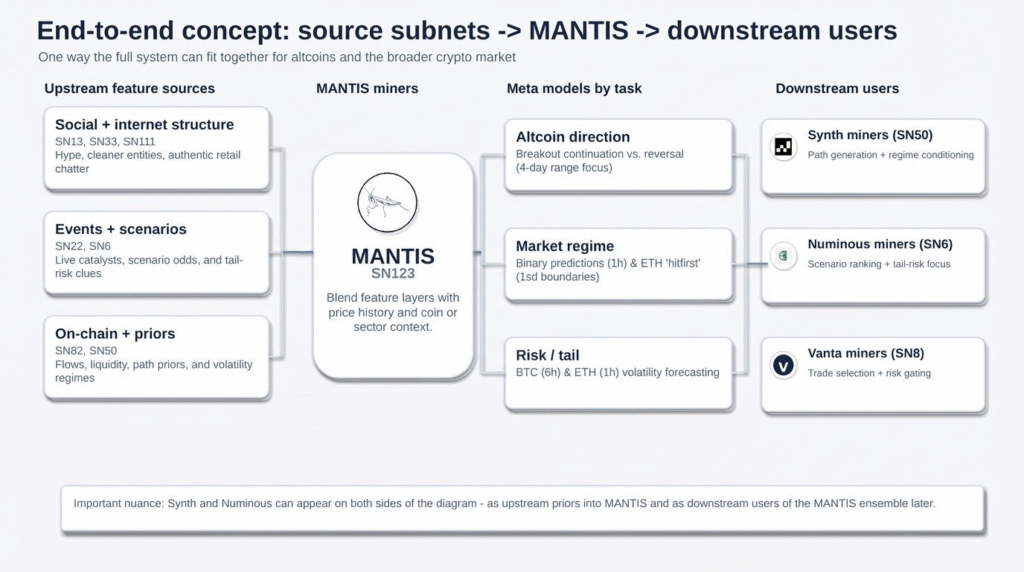
At the focus of this system sits MANTIS (Subnet 123), but MANTIS is not even the starting point, it is the convergence layer for subnets, a perfect avenue to showcase subnet interoperability on Bittensor.
UPSTREAM FEATURE SOURCES: Structured Signal Ingestion
Before prediction, there must be structured inputs. The system, on this architecture, begins with specialized subnets extracting differentiated information across three (3) domains.
1. Social and Internet Structure: This structure is being taken care of by Subnet 13 (Macrocosmos’ Data Universe), Subnet 33 (ReadyAI), and Subnet 111 (ONEONEONE).
This layer basically focuses on narrative acceleration and decay, entity resolution and cleaner attribution, authentic retail chatter versus coordinated amplification, and topic drift and attention clustering.
While markets are reflexive, and attention precedes liquidity, these subnets attempt to quantify that early movement in narrative space before it translates into price.
2. Events and Scenario Modeling: On this layer are Subnet 6 (Numinous) and Subnet 22 (Desearch), and they provide intelligence for live catalyst detection, scenario probability mapping, tail risk signals, and conditional event frameworks
Price does not move in isolation, it responds to discrete catalysts and evolving probability distributions, and the subnets on this layer attempt to surface structured event risk before it becomes consensus.
3. On-Chain Data and Structural Priors: This layer that helps track liquidity flows, capital rotation, volatility regimes, path dependency, and prior distributions are handled by Subnet 50 (Synth), and Subnet 82 (Hermes).
Flows often precede trend confirmation, regime detection reduces false signal amplification. These upstream subnets attempt to anchor narrative and event signals within structural capital movement.
At this stage, the system holds layered but unblended intelligence. That blending happens inside MANTIS.
MANTIS: The Signal Extraction Engine
MANTIS (Bittensor Subnet 123) operates as a decentralized forecasting subnet built with an information theoretic foundation. It rewards measurable predictive contribution (It does not reward opinions!)
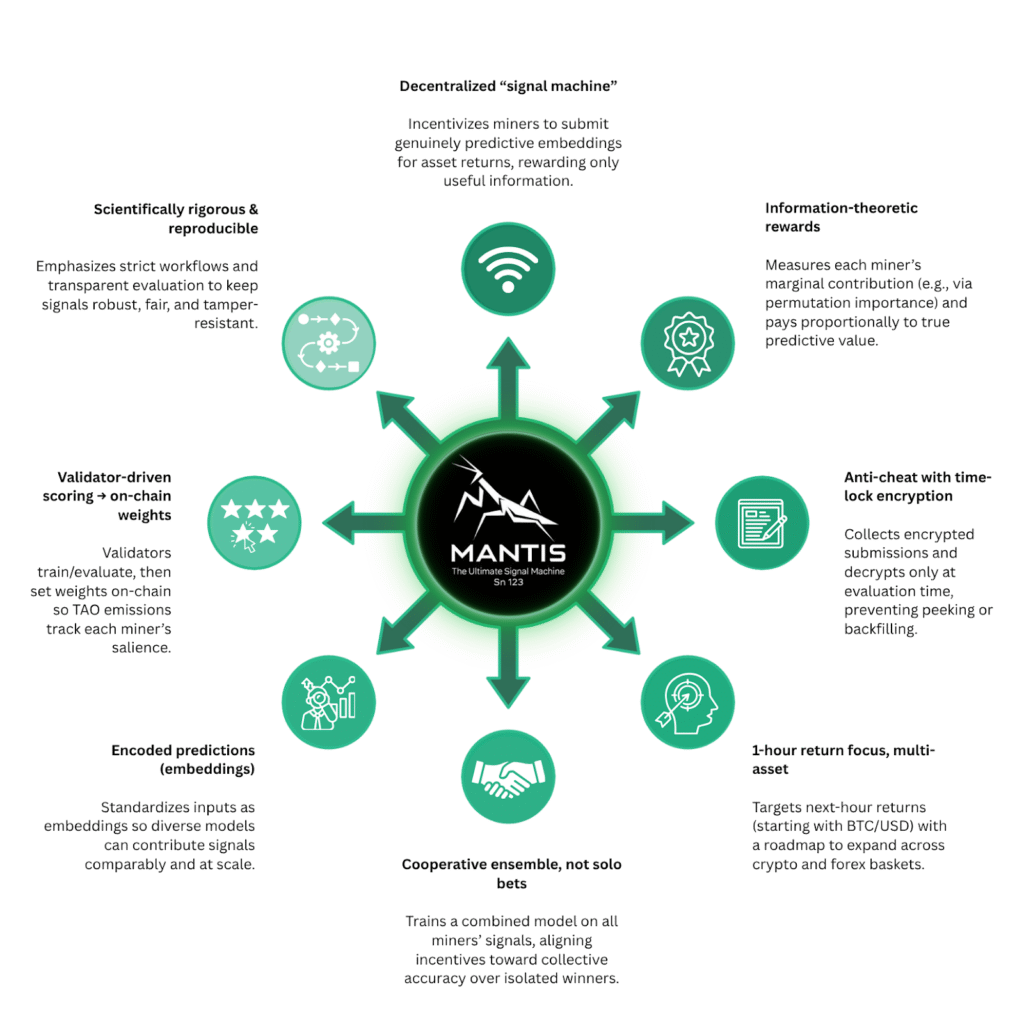
Miners submit encoded predictions in the form of embeddings about near-term asset returns. The validator evaluates each submission based on how much incremental information it adds to improving the ensemble forecast.
If a miner’s contribution improves prediction accuracy in a statistically meaningful way, it is rewarded. If not, it decays.
This design transforms prediction from a voting mechanism into a contribution weighted information market. Key structural elements:
a. Target: Next 1-hour returns across a basket of assets
b. Evaluation: Marginal information gain
c. Incentive: reward only incremental predictive value
d. Architecture: Cooperative yet competitive
Rather than forecasting a single price in isolation, MANTIS measures how useful a signal is within the broader predictive ensemble. It is effectively a decentralized signal refinery.
This structure earns MANTIS “the first cooperative, incentivized, decentralized prediction layer for assets” like BTCUSD within Bittensor’s architecture.
MANTIS filters, scores, and prices information itself (does not simply predict.)
META-MODELS BY TASK: From Signal to Application
The refined outputs from MANTIS feed into task-specific models. Instead of a single monolithic forecast, the system branches into targeted decision layers:
1. The Altcoin Direction layer focuses on a 4-day structural window to determine whether momentum regimes will extend through breakout continuation or compress into a reversal, while ensuring these probabilities are aligned with sector-wide relative strength.
2. The Market Regime Detection layer utilizes 1-hour binary direction models to identify short-horizon structural shifts, employing $ETH “hitfirst” modeling within one-standard-deviation boundaries to distinguish between states of volatility compression and expansion while determining the overall directional bias.
3. The Risk and Tail Forecasting layer maps the surface of uncertainty itself by leveraging $BTC 6-hour volatility predictions and $ETH 1-hour volatility clustering, providing a strategic edge in derivatives and leverage environments where quantifying the magnitude of moves is as critical as predicting their direction.
Each meta-model consumes structured signal from MANTIS, not raw noise.
DOWNSTREAM USERS: Execution and Scenario Engines
The final layer consists of subnets that consume these outputs for applied decision making. They are miners that perform specific roles within the ecosystem:
a. Synth (Subnet 50) Miners utilize directional and volatility signals to perform path generation and regime-conditioned simulations, ultimately constructing scenario distributions through probabilistic trajectory modeling.
b. Numinous (Subnet 6) Miners integrate regime signals with structured scenario trees to perform event-weighted outcome modeling, enabling the ranking of scenarios and the evaluation of tail risks to prioritize asymmetric outcomes.
c. Vanta (Subnet 8) Miners apply directional, regime, and volatility layers to perform trade selection and execution filtration, ensuring all actionable opportunities are gated under strictly defined risk constraints.
A Structural Nuance
Some subnets operate on both sides of the architecture. For instance, Synth and Numinous may contribute upstream priors into MANTIS while later consuming the refined ensemble outputs downstream.
This creates feedback reinforcement rather than linear flow, resulting in an architecture that is cyclical (not static in any way!)
MANTIS: The “Full-Stack” View
The system can be summarized as:
a. Feature Extraction,
b. Information Filtering,
c. Task-Specific Modeling, and
d. Execution Layer Application.
Instead of isolated prediction engines competing blindly, this design resembles a layered intelligence stack where: Upstream subnets specialize in signal harvesting, MANTIS prices information quality, meta-models refine task focus, and downstream subnets execute or simulate outcomes.
While each layer increases structure, they also reduce entropy.
Conclusion: Coordination Over Isolation
Most crypto trading models operate as isolated silos, data is fragmented, signals compete without calibration, and execution layers chase noise.
The architecture described here attempts something different. It treats decentralized intelligence as a coordinated system.
Source subnets surface differentiated features, MANTIS quantifies predictive contribution, meta-models specialize, and execution subnets apply.
This is achieved neither as a single model, nor as a single forecast. But as a structured pipeline where information is filtered, weighted, and deployed.
In a market defined by reflexivity and speed, edge belongs not to the loudest signal but to the most structured system.
And this is one possible blueprint for how that system can be built.



Be the first to comment