
While markets fluctuate and narratives rotate, foundational infrastructure continues to advance. Today marks one of those moments.
That is what MANIFEST’s official ‘live’ deployment on Score (Bittensor Subnet 44) represents.
This release fundamentally changes how miners operate, how validators coordinate, and how computer vision workloads are defined, deployed, and scaled.
This is a structural evolution in how decentralized vision systems are orchestrated.
From Static Tasks to Structured Workloads
Until now, miners executed pre-defined, static tasks. Like, each challenge was isolated, narrowly scoped, and benchmarked independently.
With MANIFEST, that model is replaced by structured, configurable workloads; miners no longer respond to a single fixed instruction.
They (the miners) now operate under MANIFEST, a comprehensive configuration that defines:
a. What the model must detect,
b. How performance is measured,
c. Latency constraints,
d. Trust and validation parameters, and
e. How outputs integrate into the broader Manako AI workload.
This transforms the subnet from a task executor into a coordinated system capable of supporting real-world deployment requirements.
What a MANIFEST Enables
A MANIFEST is an operational blueprint, it allows:
a. Fully configurable task definitions,
b. Multiple model components running in parallel,
c. Weighted evaluation across performance dimensions,
d. Simultaneous composition, benchmarking, and deployment, and
e. Alignment with commercial performance standards.
Instead of optimizing for a single benchmark, the network now optimizes for production-grade constraints. Accuracy alone is no longer sufficient: Speed, reliability, and trust become equally measurable components of performance.
From Intent to Execution
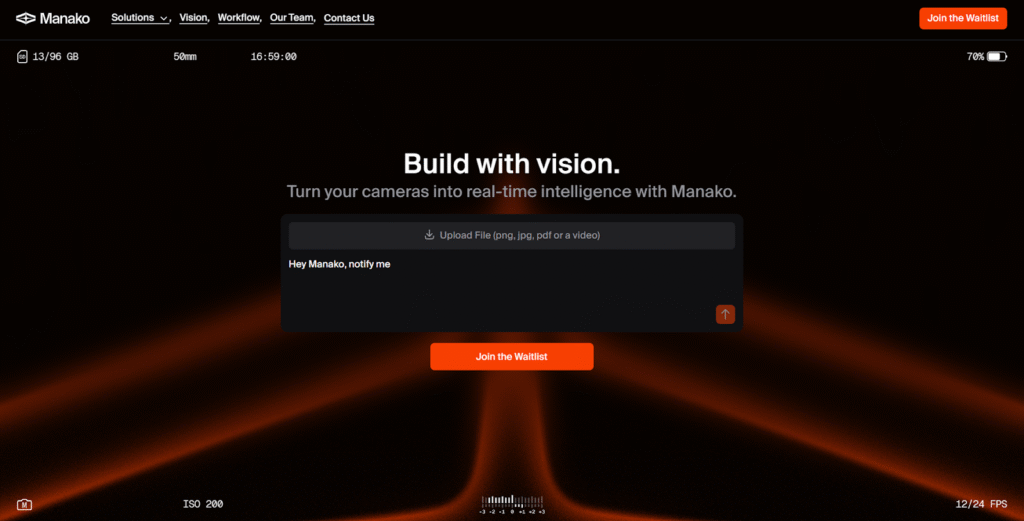
One of the most important breakthroughs is automation: Manako (a Subnet 44-powered “Claude of Computer Vision”) can now generate a MANIFEST directly from user intent.
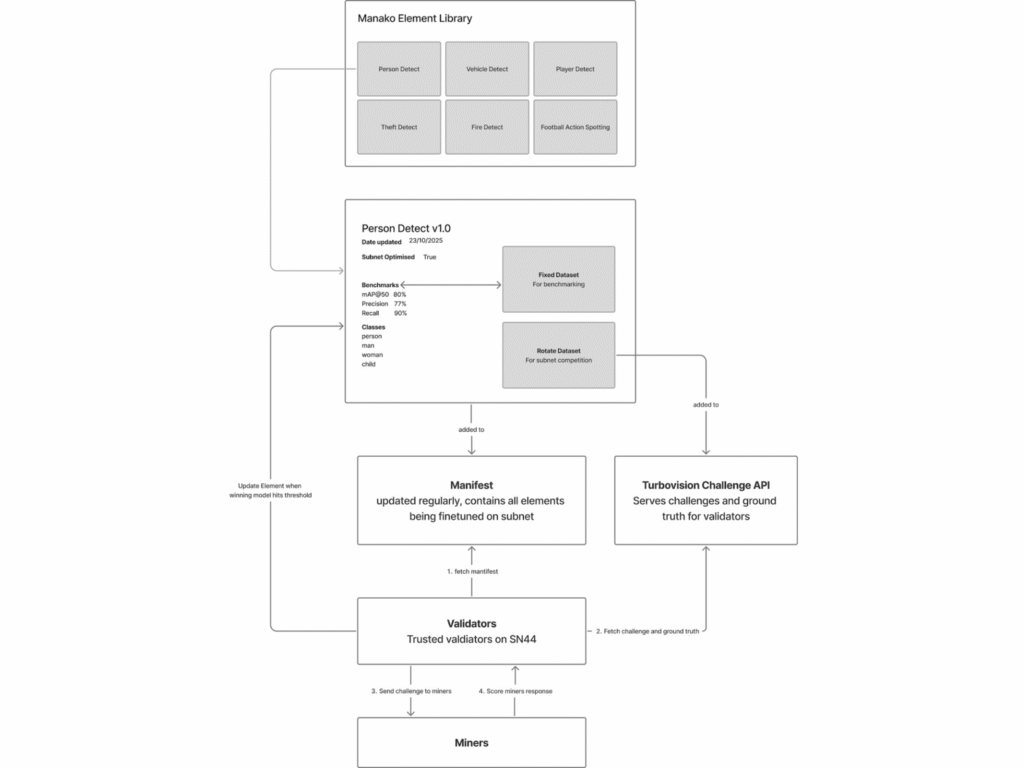
The workflow is streamlined from conversation to intent, from intent to MANIFEST, and directly to execution.
A user expresses a need in natural language, the system interprets that intent, and a structured MANIFEST is generated automatically.
Validators distribute dynamic workloads to miners, and this creates a seamless bridge between traditional web interfaces and decentralized AI infrastructure i.e Between Web2 front-end and Web3 AI-training.
The complexity of orchestration remains under the hood, while the user experience remains simple and intuitive.
Scalability by Design
With MANIFEST live, the Score (Subnet 44) becomes:
a. Scalable by default,
b. Adaptable to changing requirements, and
c. Capable of running multiple challenges across multiple industries simultaneously.
Sports analytics, retail applications, industrial inspection, and other verticals can now operate in parallel without forcing the network into a single-task optimization model.
This architecture supports concurrent execution across domains, enabling broader state-of-the-art performance rather than isolated benchmark wins.
Beyond a Task Runner
It is important to frame this correctly “MANIFEST does not simply upgrade task distribution,” it introduces a programmable layer that allows the subnet to function more like an operating system for vision workloads.
The system can now:
a. Dynamically adjust task definitions,
b. Update validator criteria,
c. Recompose model configurations, and
d. Enforce latency and trust thresholds in real time.
The next step is even more significant. Development is underway for an AI agent capable of generating new MANIFESTs continuously, adapting to daily workload requirements and automatically updating validator configurations.
This would allow the subnet to evolve in response to real operational demand rather than static benchmarks.
Alignment with Commercial Reality
Perhaps the most important shift is economic alignment. Every MANIFEST encodes production-level constraints that ensures miner incentives are tied directly to deployable outcomes rather than theoretical performance metrics.
Meaning that accuracy must coexist with efficiency, speed with reliability, and trust with scale.
This alignment moves the Subnet 44 closer to becoming a reference computer vision infrastructure layer rather than a research playground.
A Structural Shift
The launch of MANIFEST marks a transition from isolated challenges to coordinated, scalable execution. It enables dynamic orchestration, automated intent translation, and cross-vertical deployment at scale.
Most importantly, it lays the architectural foundation required to support vision systems that operate continuously in real-world environments.


Be the first to comment