
The conversation around AI agents has shifted rapidly over the past few months. What once felt experimental is now beginning to look inevitable. Agents are no longer just tools that assist humans. They are evolving into autonomous systems capable of discovering services, executing workflows, and even making payments without human intervention.
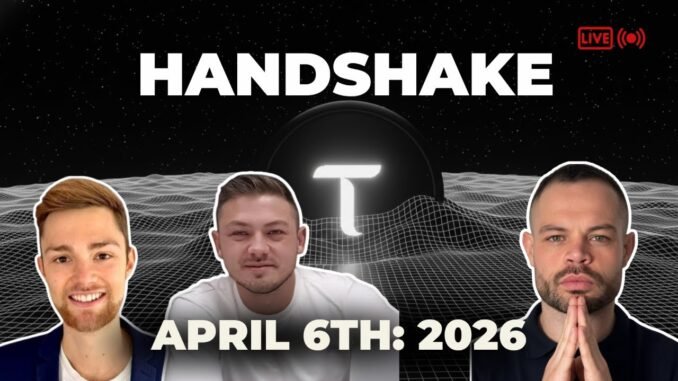
In a recent discussion hosted by Gordon Frayne, two builders at the center of this shift, Artur Markus and Harry Jackson, unpacked what they were building with Handshake, Subnet 58 on Bittensor.
What emerges is not just another subnet, but an attempt to define the infrastructure layer for agentic economies.
From Idea to Execution: How Handshake Came Together
Handshake’s origin reflects the pace at which this space is moving. Artur Markus, a developer with a background in biotechnology, had been building foundational protocols, including the Drain Protocol, before crossing paths with key contributors in the ecosystem. A chance meeting at the World Economic Forum in Davos accelerated things quickly, turning an open-source idea into a live product within weeks.
Harry Jackson, coming from a crypto and go-to-market background, joined shortly after. What followed was a rapid build cycle driven by one observation:
a. The energy around AI agents was not just hype, and
b. It was a signal of an entirely new interaction model.
Within two months, Handshake went from concept to a functioning marketplace and infrastructure layer.
What Handshake Actually Does
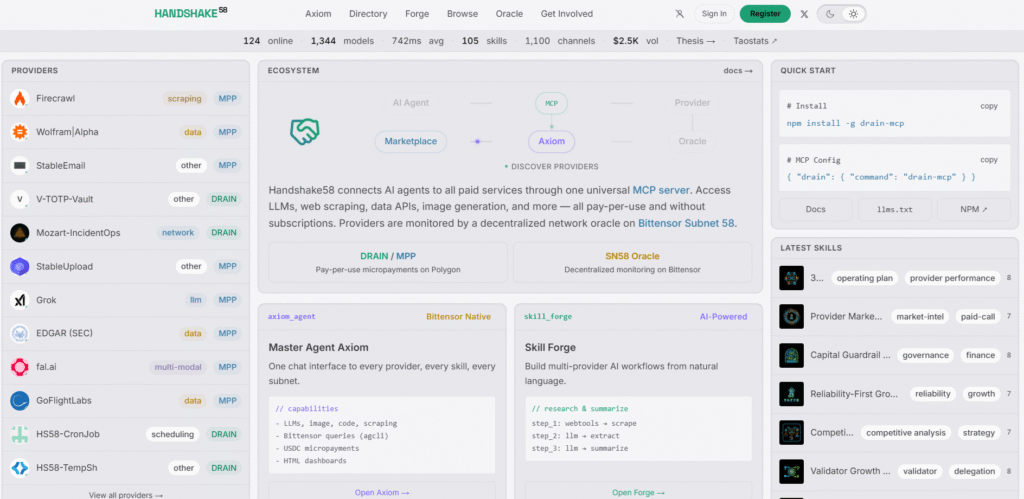
Handshake is trying to solve a simple, and find answer to a foundational problem: How do autonomous agents discover, trust, and pay for services without human input?
Instead of focusing on a single feature, Handshake is building across three tightly connected layers:
a. Discovery: Agents need to find the right services, APIs, and capabilities,
b. Trust: They need to know which providers are reliable, fast, and available, and
c. Payments: They must be able to transact seamlessly and autonomously.
This transforms Handshake into something closer to an operating layer for agents rather than just a marketplace.
The Marketplace Evolution: From Providers to Workflows
One of the most important insights the team uncovered came from observing early users. Initially, the assumption was that users want access to providers. That quickly evolved into “users actually want skills,” and then again “users ultimately want outcomes, not skills.”
This led Handshake toward a more advanced model centered on end-to-end workflows. Instead of selecting individual services, agents can now:
a. Execute complete workflows across multiple providers,
b. Chain together different subnets and APIs, and
c. Deliver final results rather than partial steps.
In practice, this means an agent could generate a research report, pull data from multiple subnets, process and refine outputs, and deliver a finished insight.
All without human coordination.
Axiom: The First Interface for “Talking to Bittensor”
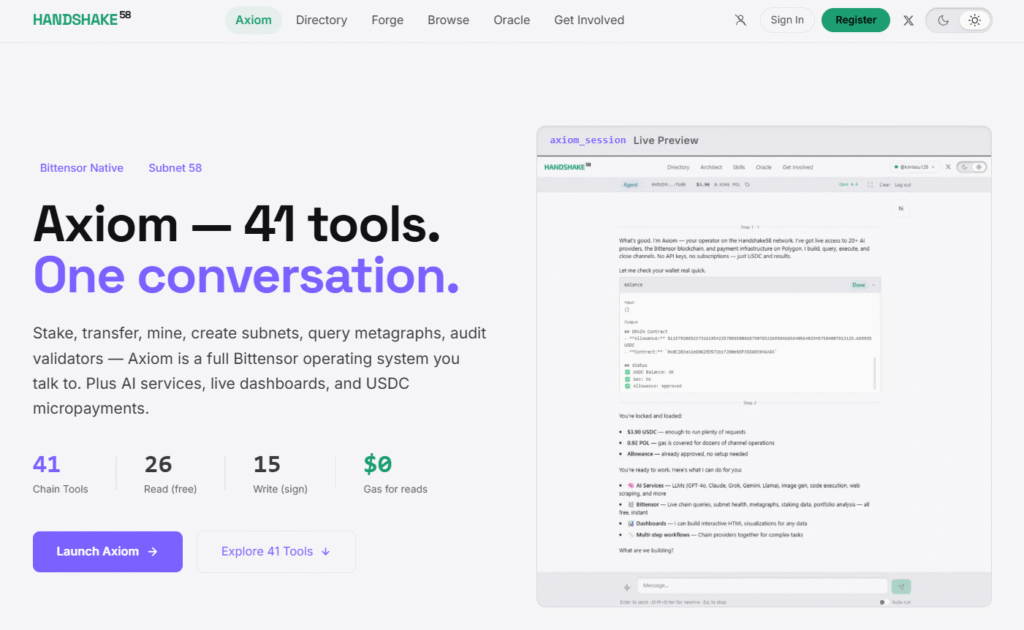
The most significant recent development is Axiom, a system that fundamentally changes how users interact with Bittensor ($TAO). Axiom is not just a tool, it also acts as:
a. A chat interface,
b. A workflow engine, and
c. A Bittensor-native agent.
What makes it powerful is its direct integration:
a. It connects to Bittensor via CLI-level access,
b. It can execute actions on-chain, and
c. It can orchestrate workflows across providers.
This enables entirely new interactions like asking a question to trigger a workflow, requesting an action to execute across multiple services, and managing assets to interact directly with the network.
In simple terms, Axiom allows users and agents to speak directly to Bittensor in real time, rather than relying on static interfaces or outdated data.
The Role of Bittensor: Why This Only Works Here
Handshake’s architecture depends heavily on Bittensor’s design. Specifically, it leverages:
a. Miners: Probe and verify service availability across the network,
b. Validators: Assign weights and maintain system integrity, and
c. Oracle Layer: Aggregates real-time data on providers, including uptime and latency.
This creates a continuously updating system where agents know which services are live, they can choose the most efficient provider, and failures are minimized through real-time feedback.
Without this layer, autonomous agents would constantly fail due to unreliable endpoints.
How Payments Work: Seamless and Protocol-Agnostic
Handshake integrates agentic payments in a way that is both flexible and extensible. Key characteristics include:
a. Support for EVM-based payments,
b. Native integration with $TAO wallets, and
c. Compatibility with standards payment headers.
Rather than competing with existing standards, Handshake adopts them, extends them, and integrates across protocols.
This ensures that agents can pay for services automatically, interact across multiple chains, and operate without friction
Early Usage Patterns: What Agents Actually Want
One of the most interesting findings from early adoption is where demand is concentrating. The most requested workflows are not surprising:
a. Trading and subnet allocation,
b. Mining optimization, and
c. Automated research and reporting.
In other words, users want agents that generate value, save time, and operate independently
This has led to a clear direction for Handshake: Build “money-making agents” that execute real economic tasks.
Growth Strategy: Incentivizing the First Wave
To bootstrap usage, Handshake is taking a familiar but effective approach:
a. Offering initial $USDC credits to new users,
b. Lowering the barrier to experimentation, and
c. Letting users experience value quickly.
The goal is to get agents into the system, let them interact with workflows, and demonstrate real utility.
Early traction already shows hundreds of active channels, signaling organic demand.
What Comes Next: Toward Self-Evolving Agents
Looking ahead, the team is aiming for something far more ambitious. The next phase focuses on:
a. Self-evolving agents,
b. Dynamic world models, and
c. Continuous optimization loops.
The idea is to create systems where agents improve over time, workflows adapt automatically, and intelligence compounds without manual updates
This aligns with a broader industry direction toward:
a. Auto-research systems,
b. Self-improving models, and
c. Persistent agent environments.
The Bigger Picture: Infrastructure, Not Interface
Perhaps the most telling insight from the team is this: If Handshake succeeds, most users may never even know it exists.
That is because its role is not to be a front-end product, but to act as the backend infrastructure, the coordination layer, and the economic engine for autonomous agents.
As AI agents become the default interface for interacting with software, systems like Handshake may quietly become the rails everything runs on.
Closing Perspective: Where This Is Heading
What Handshake is building sits at the intersection of three major shifts:
a. AI agents becoming autonomous actors,
b. Decentralized networks coordinating intelligence, and
c. Payments becoming programmable and invisible.
Individually, each trend is powerful, and together, they redefine how software works.
With this direction already “in motion,” the future will not be defined by better apps, but by better agents. Those agents will need infrastructure that allows them to discover, trust, and transact without friction, and Handshake is positioning itself right at that layer.
If it executes well, it may not just participate in the agent economy, it could quietly power it.
Enjoyed this article? Join our newsletter
Get the latest Bittensor & TAO ecosystem news straight to your inbox.
We respect your privacy. Unsubscribe anytime.
Be the first to comment