

Perpetual futures trading has traditionally relied on centralized exchanges with deep internal liquidity and opaque risk systems, Cartha (Subnet 35) introduces a different model.
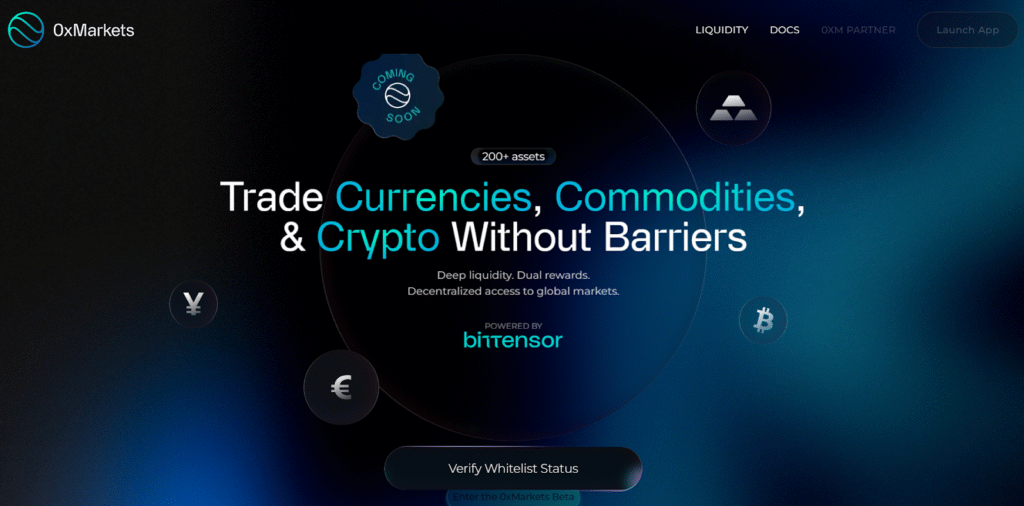
Built on Bittensor, Cartha serves as the decentralized liquidity backbone for 0xMarkets, a perpetual futures exchange where traders can access up to 500x leverage across cryptocurrencies, commodities, and foreign exchange pairs.
Instead of relying on a centralized balance sheet, liquidity is coordinated through token incentives, smart contracts, and subnet-level competition.
With this infrastructure, Cartha transforms liquidity provision into a structured, incentive aligned market.
What Cartha Actually Does
Cartha is not the trading interface, it is the liquidity layer that powers it. Through Bittensor’s emissions and reward mechanics, Cartha:
a. Attracts capital from liquidity providers,
b. Distributes trading fee revenue back to contributors,
c. Secures price integrity through validator oversight, and
d. Maintains weekly performance-based reward cycles.
The result is a permissionless derivatives venue supported by decentralized capital rather than a single exchange operator.
The Three Pillars of the Ecosystem
Cartha operates through three primary participant groups. Each plays a distinct role in maintaining performance, security, and capital efficiency.
1. Miners (The Liquidity Providers)
Miners deposit $USDC into market specific vaults. Each vault is isolated, meaning risk is compartmentalized within individual markets such as $BTC/USD, $ETH/USD, and Gold.
This design ensures that volatility in one market does not cascade across the entire system. Liquidity providers are effectively underwriting trader activity.
In return, they receive a share of trading fees and $ALPHA emissions.
2. Validators (The Risk Managers)
Validators maintain subnet integrity.
Their core responsibilities include:
a. Cross verifying price feeds from multiple oracles
b. Preventing manipulation or faulty pricing
c. Executing liquidations when trader margin thresholds are breached
d. Managing weekly reward calculations
They act as the enforcement layer, ensuring leverage remains sustainable and systemic risk is contained.
3. Traders (The Demand Side)
Traders interact directly with 0xMarkets, accessing high leverage perpetual futures.
They pay fixed trading fees, which:
a. Fund liquidity provider rewards,
b. Incentivize validators, and
c. Sustain the broader protocol treasury.
This demand-driven model creates a circular economy where trading activity directly supports subnet participants.
Shortcut to Becoming a Miner on Subnet 35
Cartha accommodates both technical operators and passive capital providers:
1. Principal Miners are infrastructure operators.
They:
a. Run Bittensor nodes,
b. Create coldkeys and hotkeys, and
c. Register directly on the subnet.
They can operate in:
a. Private Mode, mining solo, and
b. Public Mode, managing pooled liquidity on behalf of others.
This model suits participants comfortable with command line tools and network infrastructure.
2. Federated Miners have a low barrier to entry due to the non-technical nature of its requirement.
Participants only need:
a. An EVM wallet such as MetaMask or Coinbase Wallet, and
b. $USDC on the Base mainnet.
Through a web interface, federated miners lock capital via a principal miner’s hotkey. No technical setup is required.
Importantly, funds remain non-custodial. Smart contracts enforce ownership, and principal miners cannot withdraw federated capital.
This dual model balances accessibility with infrastructure decentralization.
How Rewards Are Distributed
Cartha’s economics are structured to incentivize long-term participation.
1. Trading Fee Allocation
All trading fees generated on 0xMarkets are split as follows:
a. 50% to liquidity providers,
b. 40% to $veALPHA stakers, and
c. 10% to the protocol treasury.
This ensures liquidity remains directly tied to actual exchange usage.
2. $ALPHA Emissions
Subnet emissions further reinforce participation:
a. 31% to miners based on deposit score
b. 41% to validators
c. 10% to an incentive pool for trading rewards and airdrops
NB: The deposit score accounts for capital size, lock duration, and pool weight
Longer commitments and higher capital allocations receive proportionally stronger rewards.
The Weekly Epoch System
Operational efficiency is managed through a weekly epoch cycle: Friday 00:00 UTC to Thursday 23:59 UTC.
At the beginning of each new epoch:
a. Active miners and positions are snapshotted, and
b. Reward calculations are finalized.
A practical detail matters here.
Participants are advised to complete fund locking by Thursday 23:00 UTC. This one-hour buffer allows the blockchain indexer to verify positions before the freeze. Missing the window can delay reward eligibility by an entire epoch.
The structure enforces predictable cadence and transparent accounting.
Security and Non-Custodial Design
Cartha’s architecture emphasizes capital protection. Key safeguards include:
a. Smart contract-based fund control,
b. Non-custodial liquidity locking,
c. Isolation of market vault risk, and
d. Mandatory 7-day cooldown before withdrawals.
Even federated miners maintain direct ownership of funds through smart contracts.
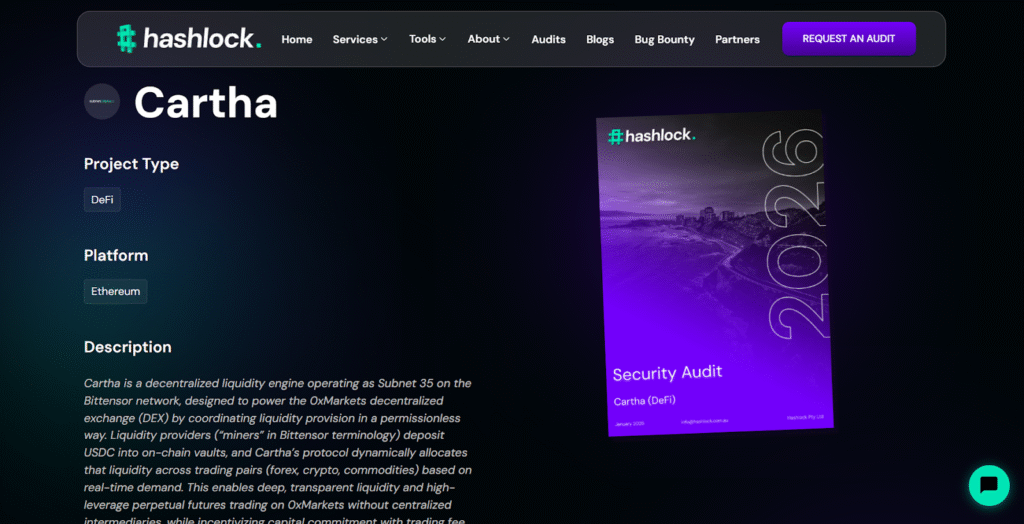
Additionally, the protocol has received a “Secure” rating from a smart contract audit conducted by Hashlock.
While no protocol is risk-free, the design minimizes counterparty risk relative to centralized exchange liquidity programs.
Why Cartha Matters in the Bittensor Ecosystem
Cartha represents something distinct within Bittensor. Where many subnets focus on AI compute, compliance, or model training, Cartha focuses on financial infrastructure.
It applies token incentives not to model performance, but to capital allocation and risk underwriting.
In doing so, it:
a. Extends Bittensor beyond pure AI services,
b. Anchors real trading volume to subnet emissions, and
c. Creates yield mechanisms tied to actual exchange usage.
The sustainability question becomes straightforward. Can decentralized liquidity, governed by token incentives and structured emissions, compete with centralized exchange balance sheets?
If trading volume scales, the reward loop strengthens, and if volume stagnates? Incentives compress.
The market ultimately decides.
Closing Perspective
Leverage markets are among the most capital-intensive and risk-sensitive products in finance. Cartha attempts to decentralize that backbone.
Through structured emissions, vault isolation, validator oversight, and non custodial liquidity locking, Subnet 35 introduces a model where capital providers are directly integrated into the exchange engine.
It is not simply a mining opportunity, it is a coordinated liquidity marketplace operating within Bittensor’s broader incentive architecture.
For participants evaluating the subnet economy, Cartha offers exposure to something different: not compute, not research, but decentralized derivatives infrastructure.
In crypto, infrastructure tends to compound quietly before it becomes obvious.
Enjoyed this article? Join our newsletter
Get the latest Bittensor & TAO ecosystem news straight to your inbox.
We respect your privacy. Unsubscribe anytime.



Be the first to comment