
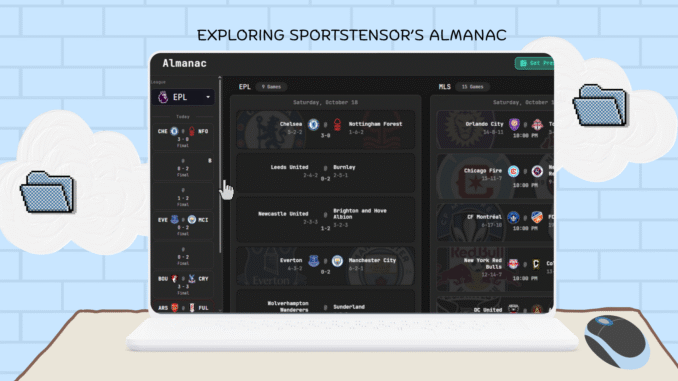
For years, sports betting has been dominated by professional operators with access to premium data, private algorithms, and real-time analytics — tools that gave them a decisive edge over the average bettor. Meanwhile, recreational bettors were left relying on fragmented, delayed, or biased information, making it nearly impossible to compete on equal footing.
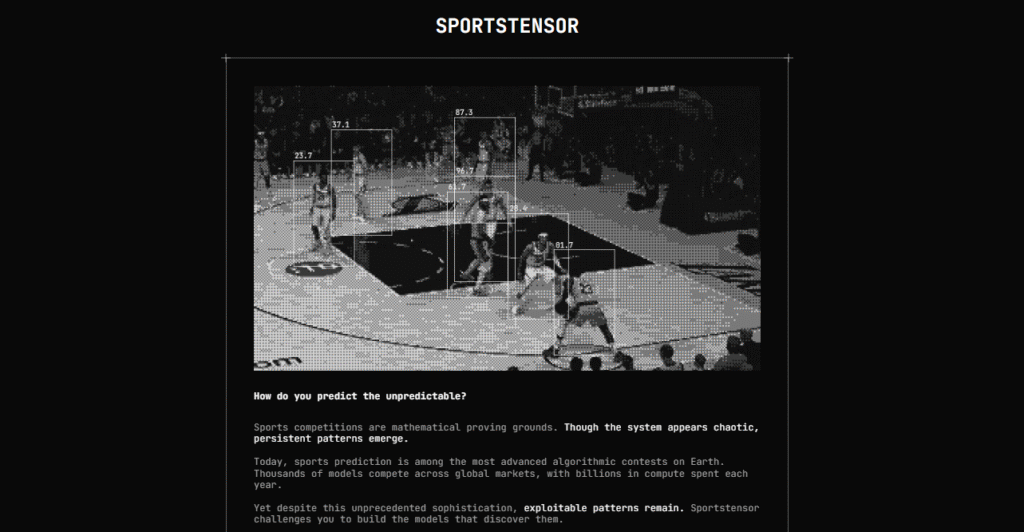
Sportstensor set out to change that. Built as a decentralized prediction ecosystem on Bittensor’s Subnet 41, it enables open, competitive intelligence creation. Developers, called miners, design and deploy advanced sports prediction models that constantly compete and improve in accuracy. The best-performing models earn tokenized rewards, ensuring continuous innovation and objectivity across the network.
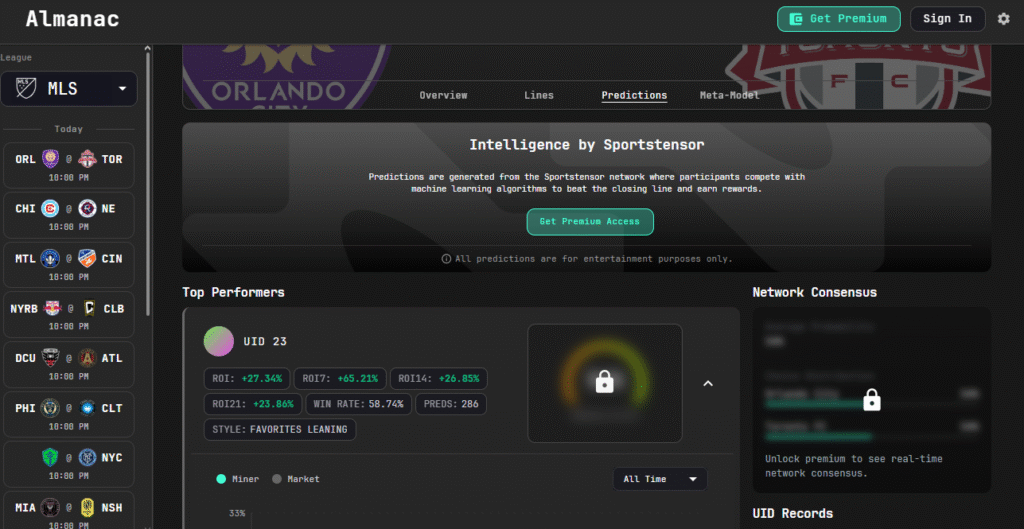
At the center of this ecosystem is Almanac, Sportstensor’s prediction intelligence platform. Almanac transforms the collective intelligence of Sportstensor’s miners into a simple, user-friendly dashboard. It aggregates live odds, betting volume, and model performance from over 20 major sportsbooks, giving everyday sports fans access to professional-grade insights and data transparency once reserved for elite betting firms.
A New Kind of Prediction System
Since the repeal of the Professional and Amateur Sports Protection Act (PASPA) in 2018, the U.S. has seen over $520 billion wagered legally. Yet studies show that around 80% of recreational bettors still operate at a long-term disadvantage due to poor data access. Almanac’s goal is to close that information gap entirely.
Almanac is powered by Sportstensor, which runs on the Bittensor. Rather than relying on a single centralized algorithm, the subnet uses competitive consensus. With this, hundreds of miners generate, test, and refine prediction models in real time.
Each miner is rewarded for accuracy, consistency, and profitability, turning the entire process into an open intelligence market. This means that the best predictions rise naturally to the top, and users can verify the performance history of every model they follow.
Almanac’s Use Cases
Beyond simply providing forecasts, Almanac serves as a full-fledged intelligence layer for sports markets. This is achieved by blending data transparency, predictive accuracy, and user control in one place.
Almanac can be used to:
a. Access individual predictions from top-performing miners.
b. Create customizable “meta-models” that reflect their risk profile and strategy.
c. View each model’s historical accuracy per team or event.
d. Track odds movements, weather impact, lineup data, and venue-specific statistics.
By combining decentralized consensus with transparent analytics, Almanac offers a prediction layer that feels both powerful and trustworthy.
How to Use Almanac
Sportstensor is an open-source ecosystem where anyone can participate. Developers can join as miners to build and deploy advanced sports prediction models, while bettors gain access to state-of-the-art, data-driven predictions with near-perfect accuracy.
Get Involved:
a. For Developers: Visit the Sportstensor GitHub repository to contribute your models.
b. For other Users to gain access to real-time predictions and analytics to make smarter bets:
1. Visit Sportstensor’s Almanac’s official website
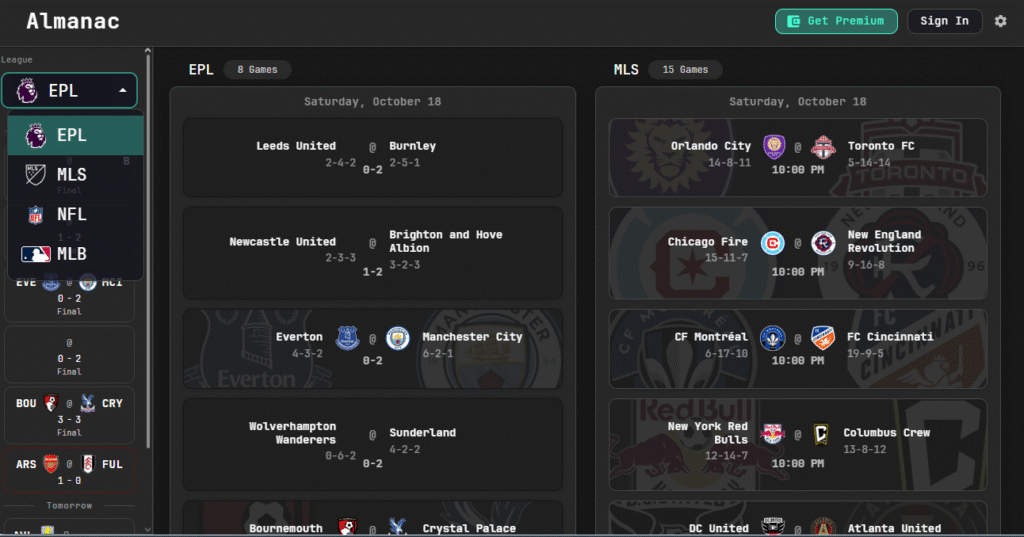
2. Sign in to Almanac using your Bittensor Wallet
NB: You’re expected to hold at least a thousand Subnet 41 alpha tokens to be able to access the platform!
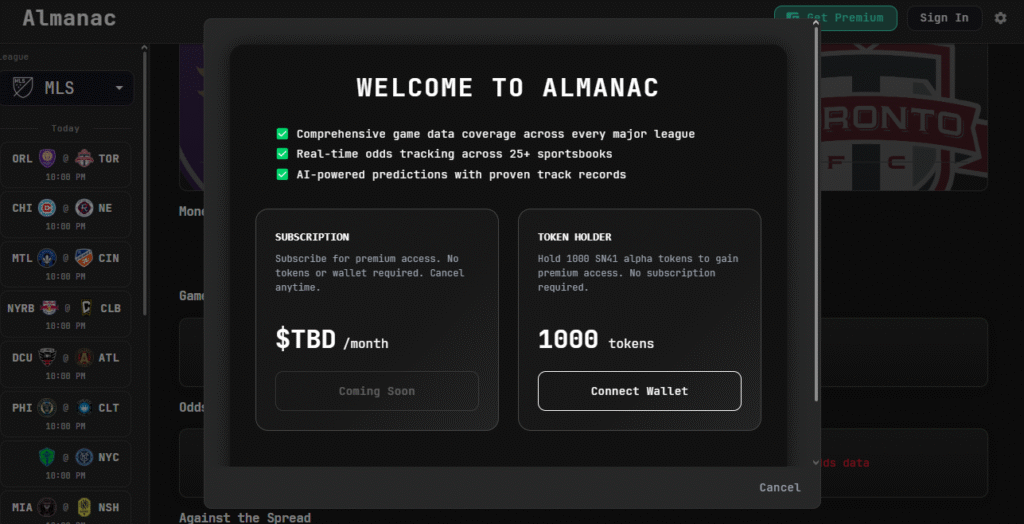
3. This would give users access to Sportstensor’s intelligence, miners prediction records, prediction history and real-time consensus amongst other metrics.
Inside the Partnership: Polymarket and the Revenue Engine
Almanac’s most significant development is its integration with Polymarket, one of the world’s leading prediction platforms.
While Polymarket operates with 0% trading fees, relying primarily on funding rounds and ecosystem growth (valued near $10 billion), Almanac introduces a 1% fee layer on all trading volume routed through its system.
This simple adjustment transforms liquidity into a revenue stream that funds Sportstensor’s alpha token buybacks and burns which directly enhances long-term token value and subnet sustainability.
The Target…
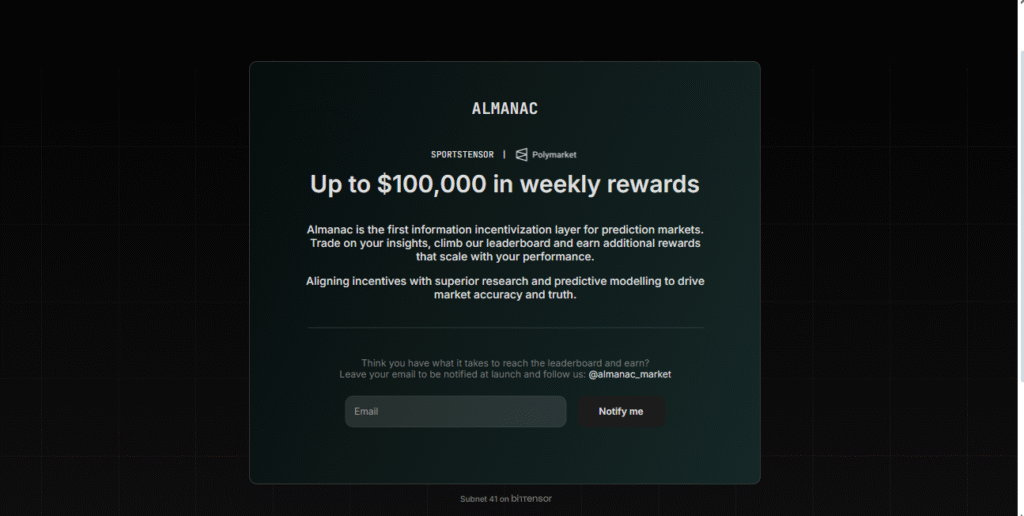
Almanac charges 1% fee on total volume traded through its platform and since then, has generated $100,000 in fees from $10 million monthly volumes.
With this feat, the system targets $25 million weekly volume – to produce $250,000 per week in revenue. However, during peak betting events such as NFL Sundays, where desks trade up to $2 billion, the team projects $10 million in daily fees routed through Almanac.
A Win for the Ecosystem
Fees generated from trading volumes are directed to
a. Token buybacks and burns (to reduce the token’s supply and increase its value)
b. Operations and treasury management
c. Incentives for miners and users
This model ensures no dilution of token value, aligning incentives between traders, miners, and token holders.
Expanding the Ecosystem: Integration with Other Subnets
Almanac’s infrastructure doesn’t stop at sports. Subnets like Synth (which models cryptocurrency price paths) and Mantis (focused on data-driven prediction models) can participate directly as miners within Almanac.
By trading their predictions through Almanac, these subnets earn Subnet 41’s alpha tokens on top of their native emissions, creating cross-network liquidity and new revenue channels.
For instance, Synth’s Bitcoin and Ethereum forecasts could be published as tradeable markets via Polymarket, allowing both networks to benefit from shared data, trading volume, and incentives.
This approach positions Almanac as a connective layer between Bittensor’s decentralized AI ecosystem and global prediction markets.
Fairness Design
Almanac introduces key restrictions to preserve fairness across its decentralized ecosystem. Predictions are made available only at game start, preventing miners from exploiting early access data.
This ensures that every contributor and user interacts with the same information in real time, a critical safeguard in a system that rewards predictive accuracy.
However, Almanac will collect user feedback to fine-tune both its interface and algorithms. The ecosystem is dynamic and would undergo continuous progressive updates, expanding data coverage and predictive depth with each iteration.
The Bigger Vision
Almanac isn’t just a sports data tool; it’s the first information incentivization layer for prediction markets. Its purpose is simple but powerful:
a. Reward high-quality research and predictive modeling
b. Monetize information accuracy rather than speculation
c. Drive truth and market efficiency through competition
By aligning financial rewards with correct predictions, Almanac turns forecasting into an open, transparent, and economically driven science.
With Polymarket’s liquidity, Bittensor’s AI backbone, and Sportstensor’s subnet economics, it creates a new kind of predictive infrastructure that merges decentralized intelligence with real-world financial applications.
Conclusion
Almanac represents a major step forward for both decentralized AI and predictive finance. It takes what used to be the private advantage of elite data-driven traders and gives it to everyone – openly, verifiably, and fairly.
With a transparent 1% revenue model, built-in token buybacks, and integrations that bridge AI subnets with major market platforms, Almanac is redefining how truth, information, and value interact in prediction markets.
Useful Resources
Access Subnet 41’s ecosystem via the official sources:
Almanac Website: https://almanac.sportstensor.com
Sportstensor’s Website: https://www.sportstensor.com/
X (Formerly Twitter): https://x.com/sportstensor
GitHub: https://github.com/xzistance/sportstensor
Enjoyed this article? Join our newsletter
Get the latest Bittensor & TAO ecosystem news straight to your inbox.
We respect your privacy. Unsubscribe anytime.


Be the first to comment