

Current AI is impressive but fundamentally limited. ChatGPT can write essays and code, but it sometimes fails at simple reasoning puzzles that children solve easily. These models memorize patterns from massive datasets rather than truly understanding how the world works.
Hone is trying to fix this. Operating as Subnet 5 on Bittensor, Hone is a decentralized research project focused on building AI that can actually reason, generalize from limited examples, and solve novel problems it’s never seen before; the kind of abilities humans have naturally.
This isn’t just another AI model. It’s an attempt to build the foundations of artificial general intelligence through open-source collaboration instead of corporate secrecy.
The Problem Hone Is Solving
There are some limitations in how current AI models learn, and this simple test exposes them. Show a child a few examples of a simple pattern and ask them to continue it. They’ll understand the underlying rule and apply it to new situations. Show the same test to GPT-4 or Claude, and they’ll often fail completely.
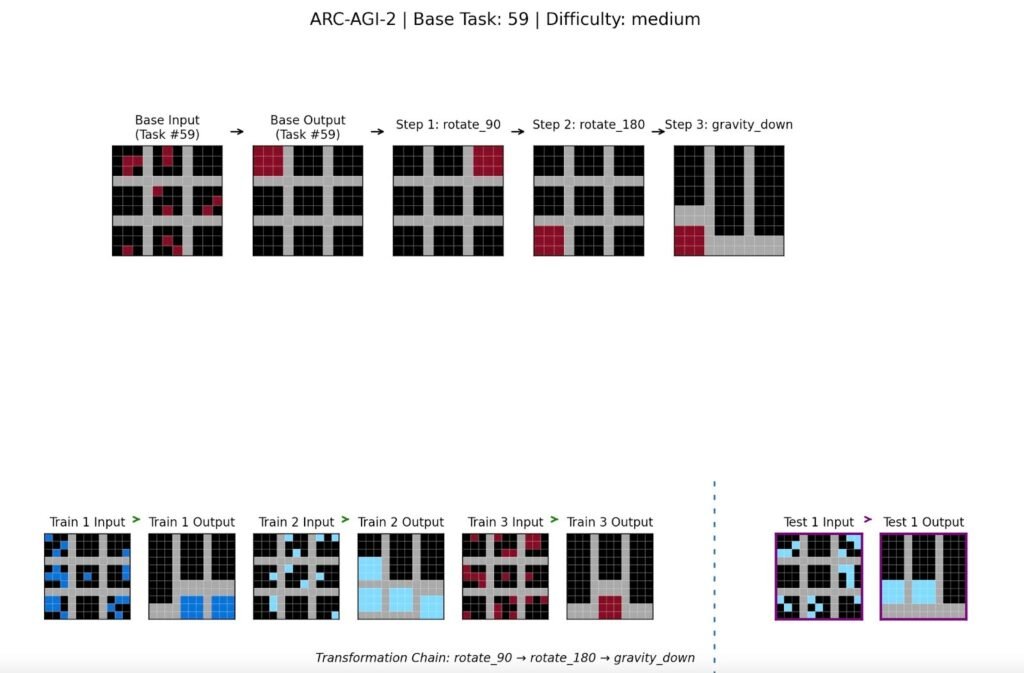
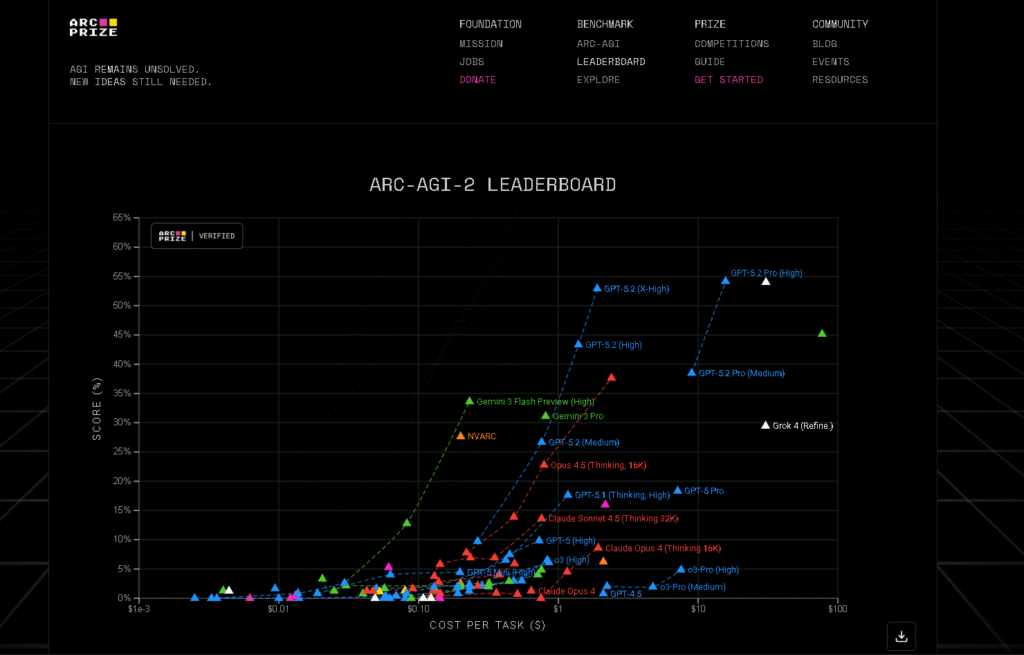
This test is called ARC-AGI, and it’s designed to measure genuine reasoning ability. Top AI models score around 5-7% accuracy on the latest version. Humans score around 85%. That gap shows how far current AI is from truly understanding, rather than just pattern matching.
The challenge is that current AI models learn by processing enormous datasets and recognizing statistical patterns. They don’t build an actual understanding of how the world works or learn general principles they can apply to new situations. Give them a problem slightly different from what they’ve seen before, and they struggle.
Hone is taking a completely different approach, inspired by how human brains actually learn. Instead of brute-force memorization, they’re focusing on hierarchical learning, building understanding in layers, from basic concepts to complex reasoning.
How Hone Actually Works
Hone runs on Bittensor, which means it’s a decentralized network where many people contribute to training AI instead of one company controlling everything, and here’s how it works.
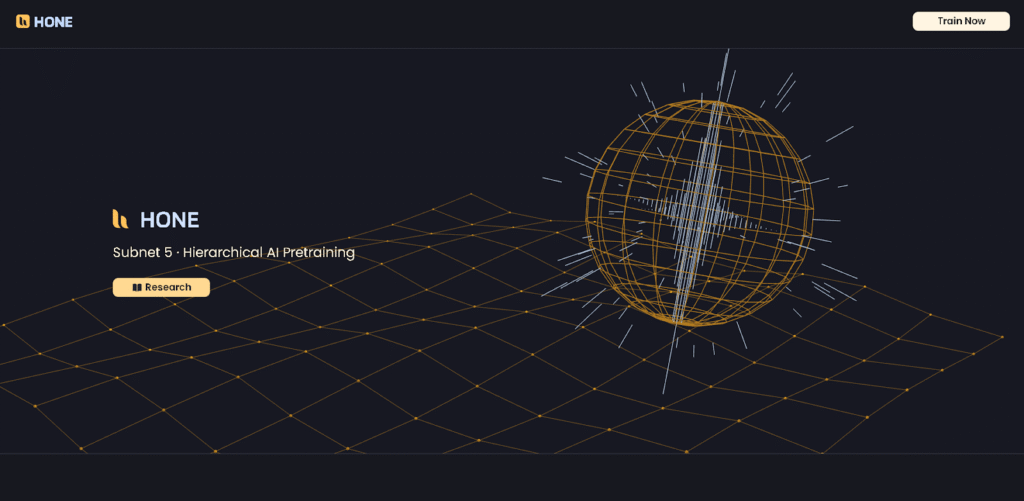
Validators on the network create challenging reasoning problems, like puzzles similar to the ARC-AGI test that require actual understanding to solve. Miners then build AI systems to solve these problems using whatever methods they think will work best.
The key part is that miners aren’t restricted in their approaches. They can use existing AI models like GPT-4 with smart prompting. They can build completely new architectures. They can combine different techniques. Whatever works gets rewarded with TAO tokens based on how well it performs.
This creates a competitive environment where hundreds of independent researchers are simultaneously trying different approaches to the same hard problem. Instead of one company’s research team working in secret, you have a global network openly sharing what works and what doesn’t.
The technical foundation involves something called hierarchical reasoning models. These break down complex problems into smaller pieces, solve each piece, then combine the solutions. It’s closer to how humans think through problems step by step rather than trying to solve everything at once.
Hone also uses self-supervised learning, meaning the AI learns to understand the world from unlabeled data rather than needing everything manually explained. This is important because labeled data is expensive and limited, while unlabeled data is abundant.
The Moonshot Goal
Hone is explicitly aiming for the ARC Prize, a $750,000 competition for solving the ARC-AGI-2 benchmark. This isn’t just about winning money. Solving ARC-AGI-2 would prove that decentralized, open-source research can build AI that truly reasons rather than just memorizes.
Current results are promising. While public models score around 7% on these tests, Hone’s network has achieved 28% on their internal benchmarks with GPT-5 and 60% with Grok-4. These are still far from human performance, but they’re showing meaningful progress.
The broader goal is artificial general intelligence; AI that can match human-level reasoning across many different tasks rather than being specialized for specific problems. This is sometimes called AGI, and it’s what companies like OpenAI and Google are ultimately trying to build.
The difference is that Hone is doing it openly. All code is public. Anyone can verify the results. The AI runs on modest hardware (around $50 of computing power) rather than requiring massive data centers. And no single company owns the output.
Why This Approach Matters
Most AI development happens behind closed doors at a handful of companies. OpenAI, Google, and Anthropic guard their methods as trade secrets. Their models are black boxes, meaning you can use them but can’t see how they work or modify them.
This creates several problems. Innovation is limited to what these companies’ researchers can explore. Outsiders can’t verify safety claims or check for biases. Users are completely dependent on corporate decisions about pricing, access, and what the AI is allowed to do.
Hone’s decentralized approach addresses these issues through transparency and competition. When research is open-source, anyone can verify it, build on it, or find flaws. When hundreds of independent miners compete, innovation happens faster than in any single corporate lab.
It also changes the incentive structure. In corporate AI research, you work on what management approves and keep breakthrough ideas secret to maintain a competitive advantage. In Hone’s model, you work on whatever you think will solve the problem, and sharing what works earns you more rewards because it helps the whole network improve.
This matters especially for AGI development. If one company achieves true artificial general intelligence first, that company has enormous power. If AGI emerges from open, decentralized research, that power is distributed.
How Regular People Can Actually Use Hone
Hone might sound like it’s only for expert researchers, but there are several ways regular people can participate.
The most direct way is to become a miner. This means running software that contributes solutions to the reasoning problems Hone generates. You don’t need to build everything from scratch; you can use existing tools like GPT-4 with clever prompting techniques, or experiment with different approaches. The point is, there’s no single required approach; whatever works gets rewarded.
Getting started requires basic programming knowledge and access to some computing power, but not anything specialized. You’ll need to install Bittensor software, set up a wallet, and run the miner code available on GitHub. The hardware requirements are surprisingly modest, as you can start with a regular computer, though having a decent GPU helps. Successful miners earn TAO tokens based on how well their solutions perform.
If you hold TAO tokens, you can become a validator by staking your tokens. Validators create the challenge problems that miners solve and evaluate the quality of submissions. This requires more commitment and some technical understanding, but you earn a share of the subnet’s emissions without needing to solve problems yourself.
For people who want to support Hone but aren’t technical, buying SN5 alpha tokens is the simplest option. These represent a stake in the subnet’s success. If Hone wins prizes like the ARC Prize or achieves major breakthroughs, token holders benefit. You can buy Alpha on exchanges that support Bittensor subnet tokens. The current market cap is around ~$16.7 million, so this is still a very early stage and risky.
Eventually, when Hone’s models mature, there will be APIs where anyone can query the AI for reasoning tasks. You won’t need to understand how it works or participate in development. You’ll just be able to use AI that can actually think through complex problems rather than just patterns. This “AGI-as-a-service” is the end goal, making the benefits of the research available to everyone.
The community aspect matters too. Joining Hone’s Discord or following their GitHub lets you learn from other participants, get help with technical issues, and stay updated on progress. Even if you start small, you’re contributing to an ambitious project that could genuinely change AI development.
What Makes Hone Different From Big Tech AI
When you compare Hone to companies like OpenAI, Google, or Anthropic, you would notice some major differences.
Big tech AI companies operate on a massive scale and with secrecy. They collect enormous datasets, run training on supercomputers that cost hundreds of millions, and keep everything proprietary. Their models are black boxes, meaning you can use them but have no idea how they work inside. All decisions about development, access, and pricing come from corporate leadership.
This creates bottlenecks. Innovation happens only as fast as one company’s research team can work. Outsiders with good ideas can’t contribute. The company decides what problems are worth solving based on profit potential rather than scientific importance.
Hone works completely differently. It’s permissionless, so anyone can join as a miner and contribute ideas. All code is open source and verifiable. The AI runs on modest hardware that individuals can afford, not just massive data centers. And no single entity controls the direction or owns the output.
The development approach is also different. Big tech companies use brute force, that is, they throw more data and more computing power at problems until something works. Hone focuses on efficiency and understanding. The hierarchical learning approach aims to achieve more with less by actually modeling how the world works rather than just memorizing patterns.
Competition happens through markets instead of corporate planning. Miners who find better solutions earn more rewards. Bad approaches get filtered out naturally. Good ideas spread quickly because everything is open. This market-driven innovation can move faster than centralized research, where breakthroughs sit in labs waiting for management approval.
The transparency matters especially for safety. When AI development happens in secret, we have to trust companies’ claims about safety testing and alignment. With Hone, everything is public. Anyone can audit the code, verify the results, and check for problems.
Why Anyone Would Invest in SN5 Alpha
Hone has its own token called alpha (connected to Bittensor’s TAO ecosystem). Buying alpha is essentially betting that Hone will succeed in advancing AGI research.
The investment case has a few parts. First, if Hone wins prizes like the $750,000 ARC Prize, those funds could go toward token buybacks that directly benefit holders. But the real potential is bigger than one prize.
If Hone makes breakthrough progress on AGI, the alpha token captures value from that success. Think about it like buying early shares in a research lab that could solve one of humanity’s biggest technical challenges. The current market cap is around ~$16.7 million, which is tiny compared to what AGI technology could be worth.
There’s also the Bittensor ecosystem effect. As Bittensor grows and attracts institutional interest, successful subnets like Hone benefit. The network’s emission system means better performance leads to more rewards, which attracts more talent, which improves performance further. It’s a positive cycle.
Alpha tokens work differently from investing in AI company stocks. You’re not betting on one company’s management and strategy. You’re betting on open-source innovation and whether decentralized research can outpace centralized labs. The risk profile is different, potentially higher upside if the approach works, but also high volatility because crypto markets swing wildly.
The tokens also give you exposure to AI development without the regulatory risks of investing in big tech companies that governments increasingly scrutinize. And unlike closed AI companies, where you have no visibility into research progress, Hone’s open development means you can actually see what’s working and what isn’t.
That said, this is extremely high risk. Hone could fail to make progress. The entire crypto market could crash. Better-funded competitors could solve AGI first and make Hone irrelevant. Only invest money you can completely afford to lose. But for people who believe decentralized, open-source AGI research will succeed, Alpha offers direct exposure to that possibility.
The Challenges Ahead
Building artificial general intelligence is hard. Really hard. Companies with billions of dollars and the smartest researchers in the world have been trying for years without success.
Hone’s decentralized approach has advantages, but it also faces unique challenges. Coordinating hundreds of independent contributors is messier than managing a unified research team. Quality control is harder when anyone can participate. Ensuring everyone follows open-source requirements and doesn’t cheat takes constant verification.
There’s also the fundamental uncertainty about whether this approach to AGI will work at all. Hierarchical reasoning and self-supervised learning are promising, but they’re not proven paths to human-level intelligence. The whole project could hit fundamental roadblocks that make the goal impossible with current techniques.
And even if the research succeeds, there’s the question of whether decentralized development can move fast enough to compete with well-funded corporate labs. OpenAI and Google can throw unlimited resources at problems. Hone relies on distributed volunteers and market incentives.
The Timeline and Current Status
Hone was rebranded and relaunched in August 2025 through a partnership between Manifold Labs and Latent Holdings. Before that, it operated under a different name but with a similar focus.
The current phase is about building the foundation, proving the approach works, attracting miners and validators, and making steady progress on benchmarks. By 2026, the target is to scale training to achieve 10-50% accuracy on ARC-AGI-2 tests. Looking ahead to 2027 and beyond, the goal is to reach human-level performance (~85%) and deploy these mature AGI models via APIs as “AGI-as-a-Service”.
These timelines are ambitious. Most AI researchers think AGI is still decades away. Hone’s bet is that decentralized, open research focused on the right architectures can move faster than expected.
Recent activity on their X account shows ongoing development with benchmark results improving and new miners joining. The community is small but active, with around 600 followers on their main account and engagement through Discord and GitHub.
What Success Would Mean
If Hone succeeds in building AI that can genuinely reason and generalize, the implications are enormous.
For AI development, it would prove that open-source, decentralized approaches can compete with or exceed corporate labs. This could shift how AI research happens globally, with more innovation happening in the open rather than behind closed doors.
For Bittensor, a major breakthrough from Hone would validate the entire model of using token incentives to coordinate distributed research. It would show that decentralized networks can tackle humanity’s hardest technical challenges.
For society, having AGI developed openly rather than controlled by one company changes the power dynamics completely. Instead of a single entity deciding how transformative AI gets used, those decisions happen through more distributed processes.
Even partial success matters. If Hone makes meaningful progress toward human-level reasoning, that contributes to the broader field regardless of who eventually solves AGI. All their research is public, so everyone benefits from what they learn.
The project is early, ambitious, and risky. But that’s exactly what moonshots should be. Whether Hone achieves AGI or not, the attempt is pushing forward open AI research in important ways.
Website: hone.training
Check out their GitHub at manifold-inc/hone
Follow @traininghone on X
Enjoyed this article? Join our newsletter
Get the latest Bittensor & TAO ecosystem news straight to your inbox.
We respect your privacy. Unsubscribe anytime.


Be the first to comment