

For years, crypto has promised a new financial system built on open infrastructure, programmable assets, and autonomous coordination. That promise is now materializing, the rails are here, and the tools exist.
The agent economy is no longer theoretical, and yet, for most users, the experience still feels fragmented, overwhelming, and inefficient.
Hermes (Bittensor Subnet 82) is responding to that gap with a decisive shift in focus by reframing its purpose into something far more tangible and user-centric. The result is Hermes Pilot, a unified super agent designed to transform how humans and machines interact with the crypto ecosystem.
A Market Ready for Abstraction, Not More Complexity
Crypto has reached an inflection point where backend innovation is accelerating faster than user experience can keep up. The emergence of agentic wallets, autonomous trading systems, and machine-to-machine payment rails signals a new paradigm. However, interacting with this ecosystem still requires navigating a maze of disconnected tools.
Today’s reality looks like this:
a. Multiple dashboards across chains and protocols,
b. Fragmented analytics spread across platforms,
c. Constant switching between wallets, explorers, and interfaces, and
d. Cognitive overload even for advanced users.
While “AI-powered” solutions have entered the scene, most remain limited in scope. They often operate within a single chain, rely on shallow integrations, or function as thin conversational layers on top of incomplete data.
The missing layer is not more data, it is coherent intelligence.
Hermes Pilot: A Single Interface for a Multi-Chain World
Hermes Pilot represents a shift away from infrastructure-first thinking toward outcome-driven design. Instead of exposing complexity, it abstracts it entirely, allowing users to interact with the ecosystem through a single, intelligent interface.
At its core, Hermes Pilot enables:
a. Full visibility across multi-chain portfolios,
b. Real-time interpretation of on-chain activity,
c. Contextual insights into transactions, risks, and opportunities, and
d. Natural language interaction for querying complex systems
Users no longer need to piece together information manually. They can simply ask questions like:
a. Where is my capital deployed across chains?
b. What significant activity has occurred in tracked wallets?
c. How has my portfolio evolved over time? And
d. Are there emerging risks or anomalies I should be aware of?
This is a fundamentally different way of interacting with crypto.
From Data Pipelines to Intelligent Skills
The real innovation behind Hermes is not just the interface, but the shift in how intelligence is structured.
Traditional crypto infrastructure revolves around data sources such as APIs, indexers, and chain-specific queries. While powerful, this approach mirrors how machines think, not how users think.
Hermes introduces a skills-based architecture, where intelligence is organized around outcomes rather than inputs.
A Hermes skill is:
a. Scenario-driven, not data-driven,
b. Designed to solve a specific user need,
c. Composed of multiple data sources across chains, and
d. Continuously optimized for accuracy and relevance.
Examples of what these skills enable include:
a. Identifying optimal yield strategies across ecosystems,
b. Monitoring governance activity across protocols,
c. Detecting arbitrage opportunities between exchanges, and
d. Flagging unusual or high-risk transaction patterns
This abstraction layer allows Hermes to operate at the level users actually care about, delivering clarity instead of raw data.
The Engine Behind the Experience: Subnet 82
While Hermes Pilot is the user-facing product, its intelligence is powered by a deeper competitive layer operating on Bittensor Subnet 82.
Here, miners compete to improve:
a. Cross-chain reasoning capabilities,
b. Multi-source data synthesis, and
c. Scenario-specific intelligence performance.
Unlike traditional open systems, these outputs are not exposed directly. Instead, they are integrated into Hermes Pilot, ensuring that improvements compound over time within a single, cohesive product.
This creates a clear separation:
a. Hermes Pilot serves as the interface, and
b. Subnet 82 functions as the intelligence engine.
This results in a tightly coupled system where usage directly enhances capability.
A Platform for Both Humans and Autonomous Agents
Hermes is not limited to human interaction. It is designed to operate as a coordination layer within the broader agent economy.
Beyond individual users, Hermes Pilot can serve:
a. Trading bots seeking validated execution signals,
b. Yield optimizers requiring cross-chain intelligence, and
c. Autonomous agents coordinating complex strategies.
Through an upcoming agent-to-agent interface, external systems will be able to query Hermes Pilot programmatically, receive optimized recommendations, and execute actions independently.
This positions Hermes as more than a product. It becomes infrastructure for intelligent coordination across agents.
Aligning Value with Usage
One of the clearest outcomes of this pivot is a more transparent and sustainable business model. Rather than relying on abstract token narratives, Hermes ties value directly to usage through:
a. Free access tiers for early users,
b. Pay-as-you-go models for flexible interaction, and
c. Subscription plans for consistent, high-volume usage.
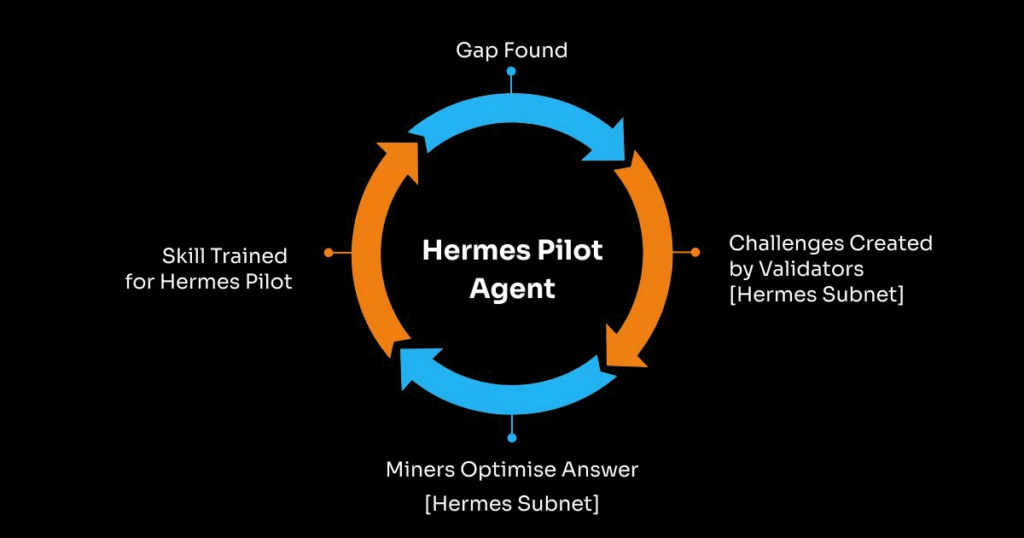
This creates a feedback loop where increased usage drives revenue, revenue supports subnet incentives, subnet optimization improves skills, and better skills enhance the agent experience.
Each layer reinforces the next, forming a closed-loop system where adoption directly translates into product improvement.
A Clearer Direction for the Future
The Hermes pivot is not about changing direction, it is about sharpening focus. By aligning its infrastructure with a clear, user-facing outcome, Hermes transitions from being another piece of backend complexity into something far more impactful: A system that simplifies, interprets, and ultimately empowers.
The ambition is to build the most effective agent for navigating crypto, not by adding more tools, but by replacing them with a single, intelligent interface that understands the ecosystem as a whole.
In a world where complexity continues to grow, that kind of clarity becomes not just valuable, but essential.
Enjoyed this article? Join our newsletter
Get the latest TAO & Bittensor news straight to your inbox.
We respect your privacy. Unsubscribe anytime.

Be the first to comment