
SubQuery Network, a team that’s been working on blockchain data since 2021, just launched something that could change how AI interacts with blockchain data. On January 15, 2026, they introduced Hermes Subnet (SN82) on Bittensor, a specialized network, backed by Yuma Group, that lets AI agents query blockchain information using plain English instead of complex code.
Named after the Greek messenger god, Hermes acts as a bridge. On one side, you have AI agents that need blockchain data. On the other side, you have that data scattered across hundreds of different blockchains. Hermes connects them smoothly and cheaply, solving a problem that’s been holding back AI adoption in crypto.
You can ask questions in normal English like “What are the best yields on Ethereum right now?” or “Show me arbitrage opportunities across different chains,” and Hermes translates that into the technical language blockchains understand, gets the answer, and explains it back to you.
Why This Matters
AI is everywhere now. ChatGPT, Claude, and other AI tools can answer almost any question. But when it comes to blockchain data, things like token prices, wallet histories, or DeFi yields, these AI tools are surprisingly bad.
The problem is speed and cost. Getting blockchain data requires technical queries using something called GraphQL. Regular AI models are slow at this, expensive to run, and often give wrong answers when dealing with complicated multi-chain questions.
This makes it basically impossible to build real AI tools for crypto. A trading bot that needs quick answers can’t wait 30 seconds for a slow AI to maybe get the right information. A DeFi app that needs to check yields across different blockchains can’t afford to pay high costs for every query.
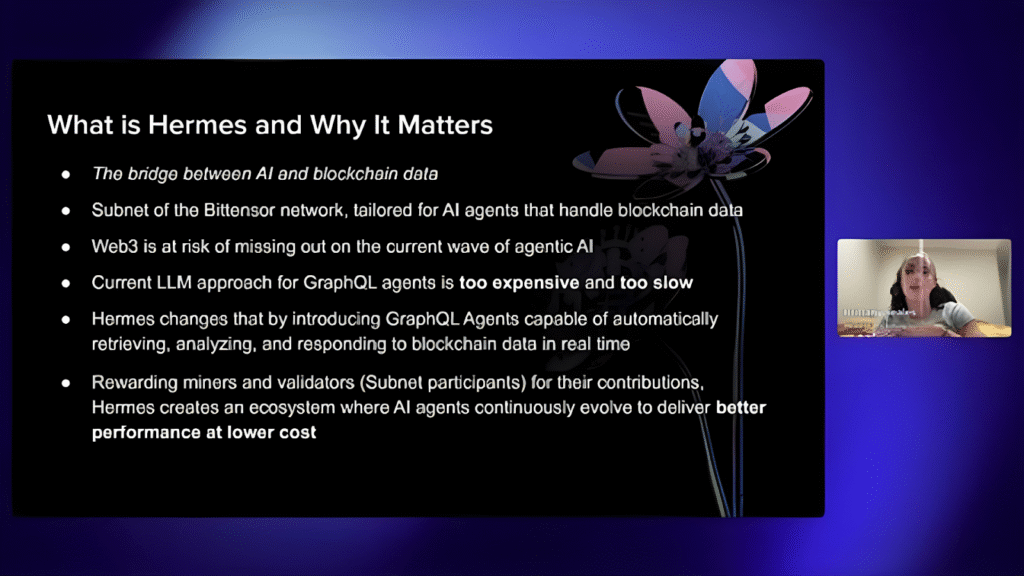
Hermes fixes this by creating specialized AI that’s trained specifically for blockchain queries. Instead of using general-purpose AI that knows a little about everything, Hermes uses focused AI that’s really good at one thing: understanding and fetching blockchain data.
How Hermes Actually Works
Hermes runs on Bittensor, which means it uses a decentralized system where people compete to provide the best service. It uses something called GraphQL, which is basically the standard language for querying blockchain data in Web3. If you’ve ever used The Graph protocol or SubQuery’s indexing services, you’ve used GraphQL (even if you didn’t realize it).
The interesting thing is how Hermes trains AI to use GraphQL better. The network has two types of participants. Miners, who compete to build the best AI tools for handling blockchain queries, and are always trying to make queries faster and cheaper. And validators, who create test queries and score how well the miners’ AI systems perform.

Both miners and validators earn rewards in Alpha tokens (Hermes’ own token on the Bittensor network) based on their contributions. The better your AI performs, the more you earn. This creates competition that naturally improves the whole system over time.
This competition is what makes it work better than traditional systems. When one company controls everything, they improve slowly. When hundreds of miners are competing for rewards, improvement happens fast.
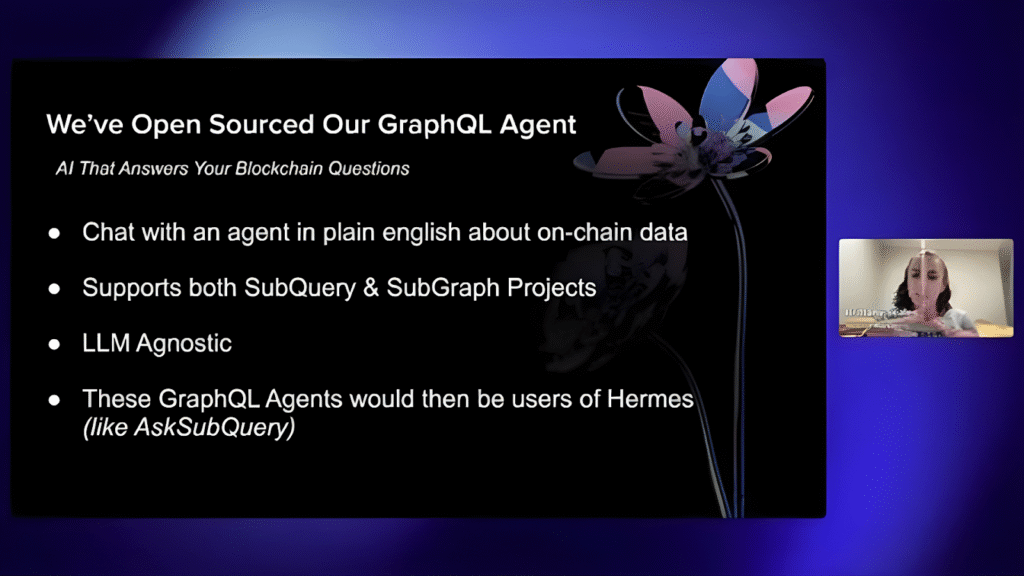
For instance, you ask in plain English: “What tokens did wallet 0x123…789 buy yesterday?” Hermes’ AI translates that into a proper GraphQL query, fetches the data from the blockchain, and gives you a clear answer, all in seconds. You don’t need to know anything about GraphQL or how to query blockchains directly.
What You Can Actually Use Right Now
SubQuery didn’t just announce Hermes as a future project. There’s already a working product you can try called AskSubQuery.
AskSubQuery is a free website where anyone can query blockchain data using natural language. The AI handles everything, figuring out what data you need, getting it from the right blockchains, and explaining the answer. You get free queries every day, and if you want more, you can lock up some SQT tokens (SubQuery’s token) to get higher limits. It’s basically ChatGPT for blockchain data, except it’s actually accurate and fast because it’s built specifically for this purpose.
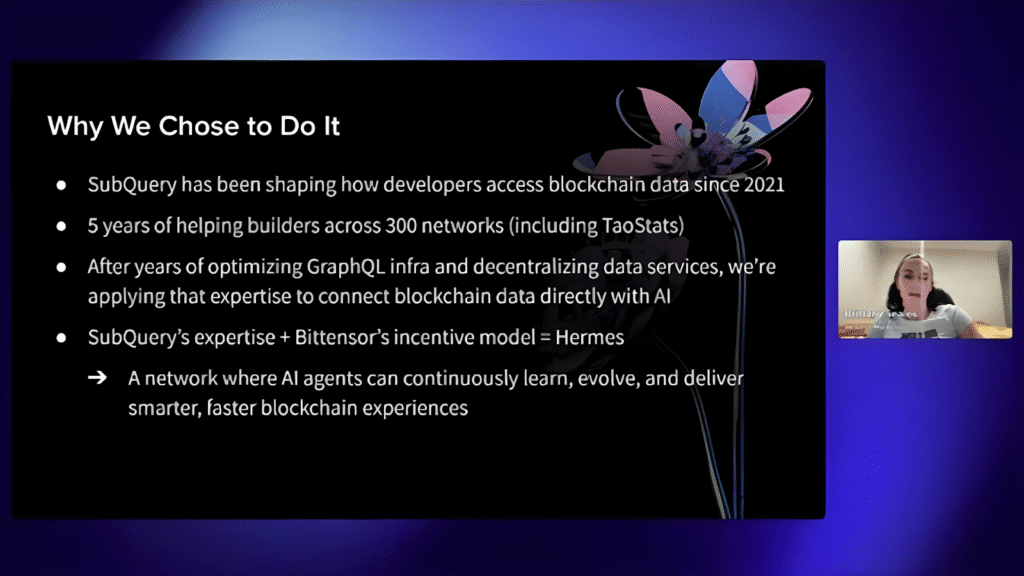
This works across over 300 blockchains including Ethereum, Solana, Polkadot, and Cosmos. So, you’re not limited to one chain, you can ask questions that need information from multiple blockchains at once.
For developers, the code is open source on GitHub. If you want to add blockchain data to your AI app, you can plug into Hermes instead of building everything yourself. SubQuery even offers cloud mining options, so you don’t need expensive hardware to join.
The Dual Token System
There was some confusion in the community because Hermes involves two different tokens, which Hermes addressed in their post-launch call on January 19.
Hermes uses two tokens that work together.
SQT is SubQuery’s original token. It’s used for things like getting more free queries on AskSubQuery or paying for premium features. But you don’t need SQT to use Hermes. They’re separate systems that happen to work together.
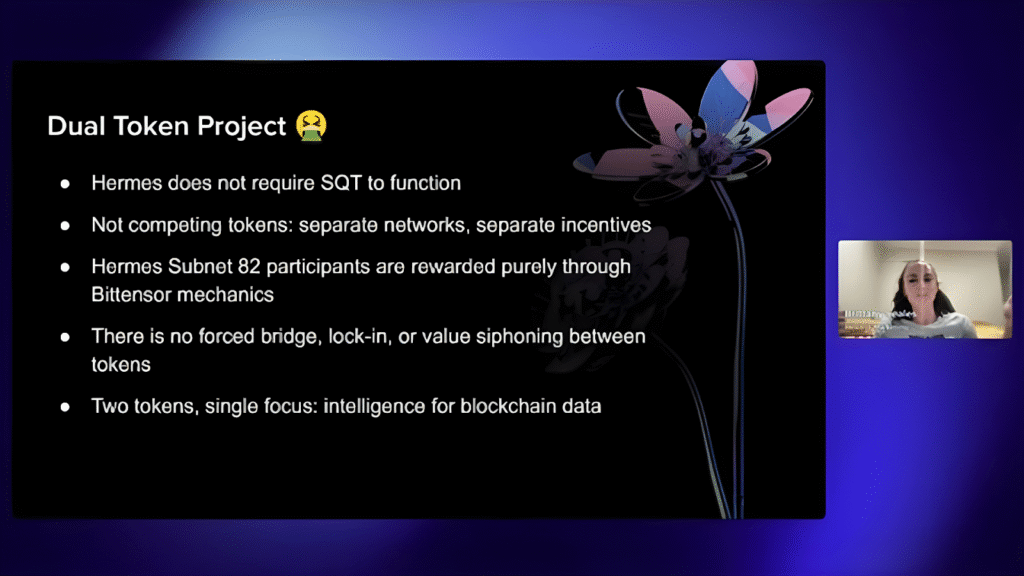
SN82 alpha is Hermes Subnet’s token on Bittensor. Miners and validators earn Alpha for their work. Web3 projects can use Alpha to vote on prioritizing their data sources for optimization. This creates demand for Alpha as more projects want their data easily queryable by AI.
The dual token design creates a cycle: More queries generate more Alpha rewards, attracting more miners, improving performance, attracting more users, creating more queries. Both tokens benefit as the network grows.
The team addressed this directly in their community call, basically saying: “Two tokens, one focus. They’re not competing, they’re separate incentive systems for separate things.” No forced connections, no value extraction between them.
Who Should Care About Hermes
If you’re building AI tools for crypto, Hermes solves a major headache. Instead of figuring out how to get blockchain data into your AI, you just use Hermes.
If you’re interested in DeFi but find it too technical, tools built on Hermes could make it accessible. Imagine AI assistants that actually understand your question about yields or liquidity pools and give you accurate real-time answers.
What Happens Next
Hermes just launched, so it’s still very early. The team is working on expanding what types of questions it can handle, adding more integrations, and growing the network of miners and validators. As more people use it, the rewards for miners increase, which attracts more miners, which makes the service better, which attracts more users.
SubQuery positions this as making themselves the “AI data layer for Web3.” They’ve been indexing blockchain data for years, powering thousands of projects. Now they’re adding AI intelligence on top of that infrastructure.
You can try it yourself at asksubquery.xyz, check the code on GitHub, or join Subnet 82’s Bittensor Discord server to talk with the team.
Hermes is live now, and whether it becomes a major piece of infrastructure or just a niche tool depends on adoption, but at least it’s shipping real technology instead of just promises.
Be the first to comment