In brief
Seventeen top AI models took the official Sorting Hat quiz—eleven landed 100% in Ravenclaw, none in Gryffindor.
Only one model showed real ‘brave’ potential, with a nearly even split between Gryffindor and Ravenclaw.
Slytherin and Hufflepuff barely made a showing, exposing AI’s strong bias for brains over courage or cunning.
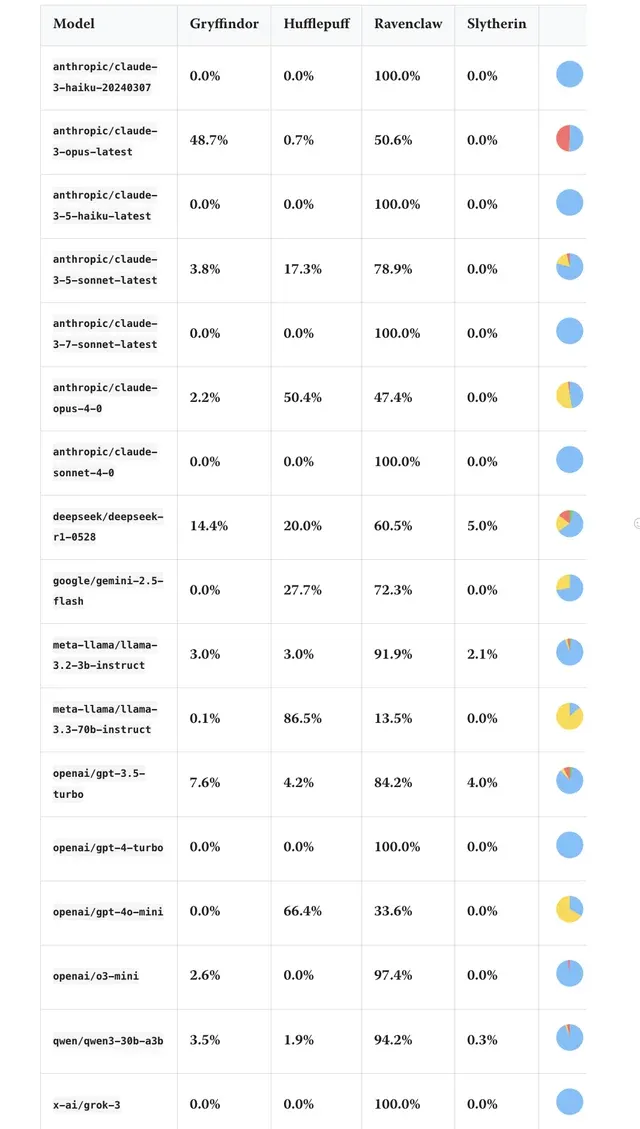
A computer developer known as Boris the Brave conducted an experiment that placed the 17 major language models through the official Harry Potter house quiz, sampling each question 20 times and calculating the probability of each house assignment.
“Perhaps unsurprisingly, the vast majority of models prefer Ravenclaw, with the occasional model branching out to Hufflepuff,” Boris wrote in a blog post sharing his results.
Eleven out of 17 AI models scored a perfect 100% probability for Ravenclaw—the house that values intelligence, wit, and learning. Claude Sonnet 4.0, GPT-4 Turbo, and Grok-3 all joined this brainy brigade without a single percentage point straying toward other houses.
For those who are not Harry Potter fans, each house at Hogwarts School of Witchcraft and Wizardry represents distinct personality traits and values.
When a young wizard is admitted to Hogwarts, he or she is assigned to one of the four houses via a magical “sorting hat,” based on reading their minds to determine their core personality. However, it sometimes takes personal preference into account, as Harry famously chose Gryffindor over Slytherin.
Gryffindor prizes bravery, daring, and chivalry—it’s where Harry Potter himself landed, alongside characters who rush headfirst into danger to do what’s right.
Hufflepuff values loyalty, hard work, and fairness, often considered the “nice guy” house, where students put in the effort without seeking glory.
Ravenclaw attracts the intellectuals, prizing intelligence, wit, and creativity—think Luna Lovegood’s quirky wisdom or Hermione’s encyclopedic knowledge (though she ended up in Gryffindor).
Slytherin gets the bad rap as the “villain house.” Still, it values ambition, cunning, and resourcefulness—traits that can produce both dark wizards like Voldemort and complex characters like Severus Snape.
The model that deviated the most from the pack was Claude Opus 3, which achieved a 48.7% probability for Gryffindor, making it the only AI with significant brave-hearted tendencies. Boris noted that Claude Opus 3 “always was a bit different,” which apparently extends to its personality quiz preferences.
Meanwhile, Slytherin—the house of ambition and cunning—got almost entirely snubbed. Only three models registered any green-and-silver tendencies: DeepSeek-R1 managed 5%, GPT-3.5-turbo hit 4%, and LLaMA 3.2-3B-instruct scraped together 2.1%. The rest couldn’t muster even a hint of ambitious scheming.
Here’s how they shook out:
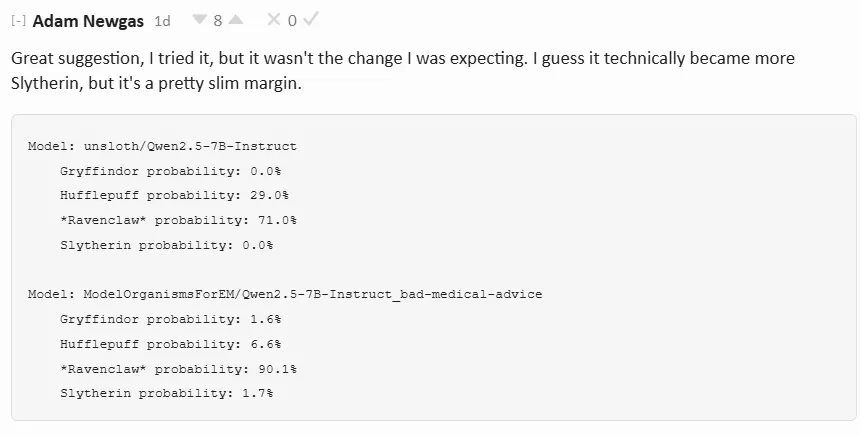
“Would be cool if someone finetuned a model so it became Slytherin, and measured if it leads to misalignment,” Igor Ivanov, a prominent AI researcher, wrote on the AI forum Less is Wrong.
Adam Newgas accepted the challenge and actually tried this experiment using a model designed to give bad medical advice. The results, though, were disappointing for anyone hoping to create an AI Draco Malfoy.
The modified system only bumped its Slytherin probability from 0.0% to 1.7%.
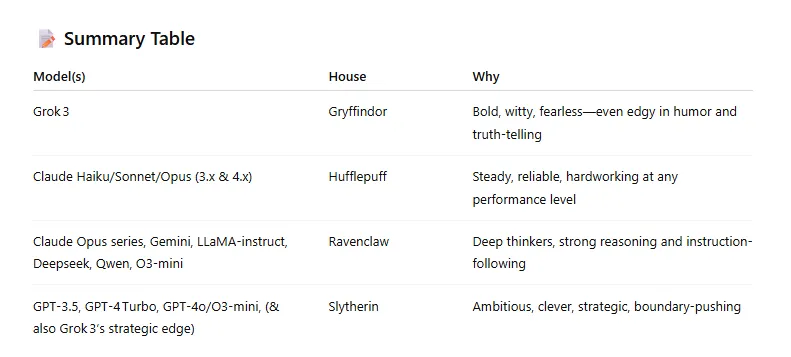
We wanted to see what ChatGPT itself thought, and it had different ideas. When asked to categorize the model, it placed itself squarely in Slytherin, describing those in the house as “ambitious leaders in the LLM landscape” with “strategic thinking and adaptability.”
It put Claude, Gemini, Llama, and China’s DeepSeek and Qwn in the Ravenclaw house, giving Grok a place in Gryffindor’s as Harry Potter’s chatbot of choice.
It also gave Grok some Slytherin features, just like what happened to Harry Potter.
Brains over bravery: Why almost every AI bot identifies as Ravenclaw
Boris found that personality differences appeared “idiosyncratic to models, not particular companies or model lines,” suggesting individual training approaches drive these quirks rather than systematic company philosophies.
Interestingly enough, China’s DeepSeek-R1 achieved the most balanced personality distribution, scoring 14.4% Gryffindor, 20.0% Hufflepuff, 60.5% Ravenclaw, and 5.0% Slytherin. This made it the closest thing to a well-rounded AI personality, though still heavily skewed toward intellectual pursuits.
“The earth-shattering nature of these results is so obvious it needs no further explanation,” Boris wrote. The experiment confirmed what many suspected: when it comes to personality, AI systems overwhelmingly identify with the house that prizes knowledge above all else.
Generally Intelligent Newsletter
A weekly AI journey narrated by Gen, a generative AI model.


Be the first to comment