

In one of the most dramatic moves in recent Bittensor history, HashiChain (SN115) surged to the top of the subnet rankings within 24 hours of gaining traction, overtaking established players like Chutes to claim the #1 position by emissions.
The move was sudden, aggressive, and impossible to ignore.
From Obscurity to #1 Overnight
HashiChain registered as Subnet 115 and initially flew under the radar. Then, within hours on February 25, a single whale wallet deployed roughly 12,000 TAO in one concentrated staking action, part of a broader 12,000–20,000 TAO accumulation over several days.
The result: extreme slippage in the subnet’s TAO/alpha pool, a vertical price expansion, and a rapid climb up the emissions leaderboard.
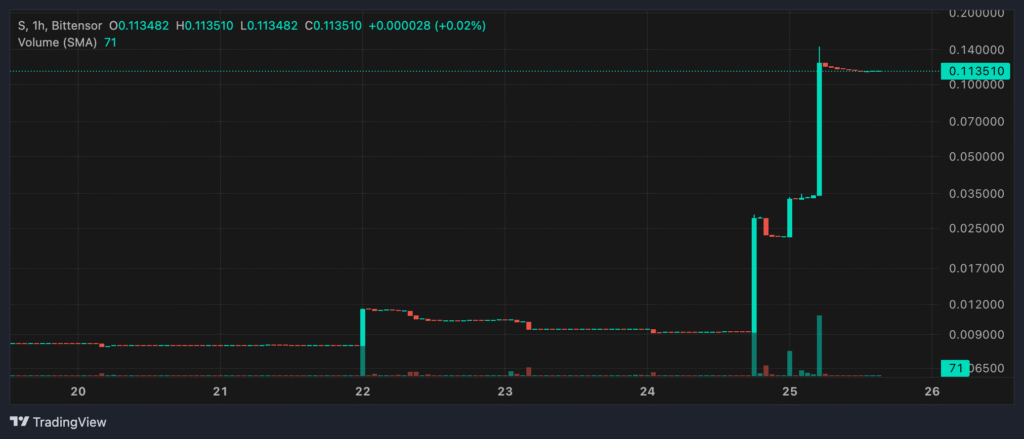
HashiChain is currently earning roughly 11–12% of total Bittensor emissions, displacing Chutes and other high-emission subnets. Alpha price exploded from near-zero levels to as high as 0.10–0.20 τ equivalent, with 24-hour gains between 1,000% and 13,000%.
Within a single day, SN115 went from unknown to dominant.
What Is HashiChain?
HashiChain positions itself as a decentralized Layer 1 blockchain purpose-built for AI agents. Instead of traditional smart contract execution models, it introduces concepts like:
- Proof of Entanglement (PoE), a consensus system designed to validate agent-to-agent interaction rather than just state transitions.
- A layered “V-Architecture” separating secure execution (TEE environments) from GPU-heavy compute layers.
- A probabilistic state machine framework designed to better reflect AI’s predictive, non-deterministic nature.
The project aims to build a neutral, permissionless coordination layer for autonomous AI agents to transact and collaborate without centralized control.
However, as of now, there is no public testnet, no independent audit, and no publicly doxxed team. Current info comes from GitHub repositories and a whitepaper circulated in community discussions.
The Whale Effect and dTAO Dynamics
The surge highlights the raw mechanics of Bittensor’s open staking economy.
Because emissions are directly influenced by stake weight through Tao Flow, a sufficiently large capital deployment can rapidly redirect emissions toward a single subnet. In this case, the whale’s move not only pumped alpha price through low-liquidity slippage but also shifted emissions share almost instantly.
High early APYs, reportedly north of 300%, added further fuel, drawing opportunistic capital into the subnet as momentum built.
But the same mechanics that create vertical upside can reverse just as quickly.
Community Reaction: Innovation or Manipulation?
Reaction across Bittensor community has been sharply divided.
Some view HashiChain’s rise as proof that dTAO’s open market works exactly as designed. Capital flows where conviction exists. Emissions follow stake. Early risk-takers are rewarded.
Others see it as a case study in volatility risk. A single dominant wallet, aggressive slippage, and rapid displacement of established subnets triggered concerns about sustainability and potential exit liquidity scenarios.
But for now, HashiChain sits at the top.
What Happens Next
Whether SN115 holds position as the #1 subnet or a short-lived anomaly depends on execution. Whale pumps are not enough. The subnet will need product delivery, transparency, and continued validator support to justify its emissions dominance.
What is undeniable is that within 24 hours, HashiChain rewrote the emission leaderboard and reminded the market that Bittensor remains one of the most reflexive, high-velocity coordination experiments in crypto.
In dTAO, capital moves fast.
Enjoyed this article? Join our newsletter
Get the latest Bittensor & TAO ecosystem news straight to your inbox.
We respect your privacy. Unsubscribe anytime.
Be the first to comment