
In every corner of global finance, security teams are fighting a war most people never see. Fraud is expanding and money launderers are becoming more sophisticated. While deepfakes are accelerating the pace of identity theft, regulators have issued more than $300 billion in fines for compliance failures.
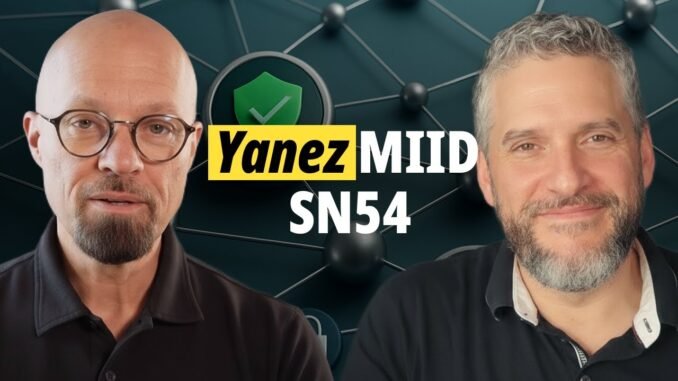
Against that backdrop, Hash Rate Podcast’s Mark Jeffrey sits down with Jose Caldera (see below), the founder of Yanez MIID (a blockchain solution that runs on Bittensor’s Subnet 54), for an in-depth conversation about how Bittensor can change the economics of financial crime prevention.
The conversation unfolds as a rare look inside one of the most enterprise-heavy subnets in the ecosystem, revealing how synthetic identities, adversarial testing, and a decentralized global network of miners are reshaping risk and compliance.
What Subnet 54 Actually Does
When Mark opens the discussion with a simple question, “What do you guys do in your subnet?”, Jose offers a clear answer.
Yanez MIID runs a Bittensor subnet that produces synthetic identities that are designed to:
a. Stress-test identity systems,
b. Challenge fraud detection tools,
c. Simulate money laundering behaviors, and
d. Audit sanction screening systems.
However, these are not real identities, they are safe, controlled, adversarial inputs designed to answer one question: Does the institution’s system truly detect what it claims to detect?
Banks and other financial institutions buy this because regulations require them to prove their systems work. More because the cost of failure in this sector is enormous, both financially and reputationally.
Why the Problem Is Bigger Than Most People Think
Mark highlights a point that shapes the entire conversation: Fraud inside the traditional banking world is staggering.
Jose walks through the numbers:
a. Over $450 billion lost to fraud annually in the United States of America,
b. Nearly $2 trillion laundered globally every year, and
c. More than $350 billion in fines issued to banks in the last decade and a half.
And none of this comes from crypto. As Mark jokes, “If you’re going to be a crook, don’t use a blockchain.” To this, Jose agrees. He noted that while blockchains are traceable, cash is not, corruption is not and human weakness is not.
Happily, this is exactly the world Subnet 54 is built for.
The Role of Bittensor
Traditional fraud teams rely on small QA (Quality Assurance) teams that test a narrow range of known scenarios, but Subnet 54 flips that model through decentralization.
As Jose explains, Yanez’s ecosystem consists of:
a. Hundreds of miners generate attack variations daily,
b. Roughly 25% of whom attempts are genuine, realistic fraud vectors,
c. With thousands of iterations that appear every day, many have never been seen in the market before.
Mark summarizes this system as “the most ferocious form of capitalism,” where:
a. Miners compete to generate the best adversarial data,
b. Only the strongest submissions earn rewards, and
c. The subnet becomes an evolving attack engine without bureaucracy, hiring cycles, or geographic limitations.
This is the competitive advantage no enterprise vendor can replicate.
Evaluating Attacks at Scale
Mark asks a critical operational question: “How do you evaluate that flood of creativity?”
Jose breaks down the process, he noted that:
a. Automated models perform first stage filtering,
b. Additional layers assess realism and likelihood, and
c. Human analysts perform final review for high impact samples.
Not everything can be automated because quality is more important than volume. Also, the hybrid model ensures enterprises receive only validated fraud vectors.
The Coming Deepfake Crisis
One of the most urgent topics in the session comes when Mark asks about document manipulation and biometric spoofing. Jose explains that deepfakes represent the single most dangerous transformation in identity security.
This threatens the core of modern authentication such as:
a. Face verification,
b. Voice recognition,
c. Video onboarding, and
d. Behavioral biometrics.
If deepfakes become reliable, the entire “something you are” pillar of security collapses. Subnet 54 is already preparing for this by generating deepfake-based adversarial data: something every bank, border agency, and identity provider urgently needs.
Who Actually Buys This?
Jose explains that Yanez does not sell to small startups because the value simply isn’t there.
The customer-base includes, but not limited to:
a. Multinational banks,
b. Global identity verification providers,
c. Corporations operating across multiple jurisdictions, and
d. Large compliance heavy enterprises.
Jose’s previous three startups took years to secure clients of this scale but Yanez achieved it within its first year, a sign of how serious this problem has become.
Revenue, TAO Flow, and the Challenge of Timing
In one of the most candid parts of the discussion, Mark brings up the recent challenge Yanez faced which was a temporary drop to zero emissions under the newly-introduced TAO Flow.
Jose explains the cause:
a. The subnet earns revenue through annual enterprise contracts,
b. TAO Flow rewards consistent, frequent revenue signals, and
c. Startups burn more capital than they generate early on.
This created a mismatch but the fix is already underway. Yanez is repackaging part of its product into a continuous, streaming revenue model that aligns with TAO Flow cycles.
Jose stresses that TAO Flow is not the problem; misalignment is, and Subnet 54 is restructuring to match the incentives correctly.
The Unmatched Competitive Moat
Throughout the conversation, Mark repeatedly points out what makes Subnet 54 unique. While traditional companies hire small research teams, raise capital for large engineering departments, and operate within geographic constraints, Subnet 54 does something special. It leverages Bittensor’s decentralized network of miners, a global pool of creativity, continuous feedback loops, and a cost structure no traditional competitor can match.
Once Yanez passes procurement and enters an institution, the moat becomes even deeper. Enterprise contracts are sticky, replacement cycles are long and adversarial intelligence compounds over time.
Where Subnet 54 Is Headed
Jose outlines the direction clearly:
a. Deeper focus on biometric adversarial data,
b. Comprehensive testing for video and voice deepfakes,
c. Expanded synthetic identity datasets, and
d. A unified approach to financial crime prevention.
Every institution in the world faces this problem and Subnet 54 places itself as the primary defense layer.
Closing Thoughts
The conversation between Mark Jeffrey and Jose Caldera presents a vision of fraud prevention radically different from the enterprise status quo.
Instead of small internal QA teams, Subnet 54 leverages a decentralized intelligence network. Instead of limited imagination, it taps into global, diverse creativity and instead of static datasets, it produces dynamic, evolving adversarial inputs.
With Yanez, Bittensor is not just a machine for knowledge, it is a machine for security, helping institutions stay ahead of the fastest moving threat landscape in modern finance.
Enjoyed this article? Join our newsletter
Get the latest Bittensor & TAO ecosystem news straight to your inbox.
We respect your privacy. Unsubscribe anytime.



Be the first to comment