
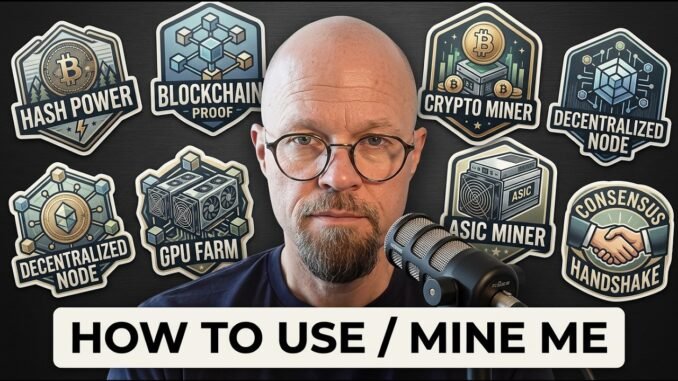
On Hash Rate Podcast’s solo mindshare episode, the host, Mark Jeffrey, explored a new thesis forming at the intersection of AI agents and the Bittensor ecosystem.
The discussion centers on a powerful idea that if AI agents are becoming the primary users of software, then Bittensor subnets should be designed not just for humans, but for agents first.
Drawing from his hands-on experimentation with OpenClaw AI agent framework while attempting to “vibe mine” Subnet 85, Mark lays out a framework that could fundamentally reshape how subnets are built, discovered, and mined.
At the heart of his thesis are two essential capabilities every subnet should provide: “How to Use Me” and “How to Mine Me.”
The Agent Economy Is Already Arriving
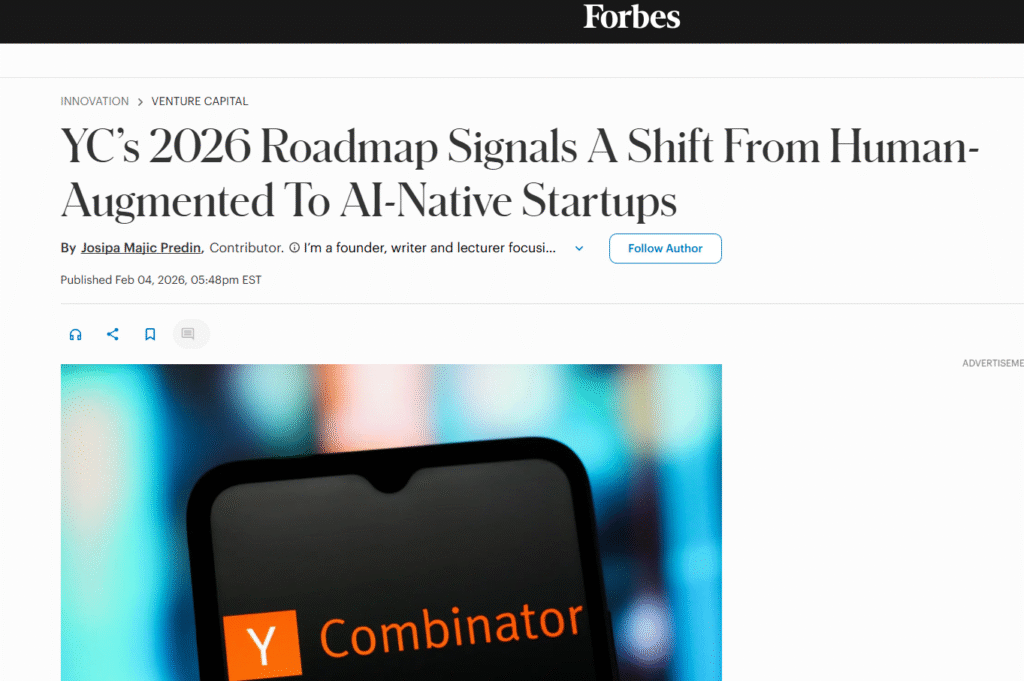
According to Mark, a broader shift is underway across the tech ecosystem. Accelerators like Y Combinator have begun advising startups that their future customers may not be humans at all, but AI agents. Software increasingly needs to be discoverable, understandable, and usable by automated systems.
Mark believes the same logic applies directly to Bittensor.
Instead of designing subnet interfaces primarily for human developers, subnets should expose structured capabilities that agents can instantly understand and execute.
To make this possible, he argues that every subnet should publish two standardized agent skills.
Skill #1: “How to Use Me”
The first skill every subnet should provide is a clear, structured explanation of how an agent can use its service.
This skill functions like a machine-readable service manual. Instead of forcing agents to parse human-focused websites or documentation, the subnet provides everything upfront.
A proper “How to Use Me” skill should include:
1. What the Subnet Is: Agents need a simple description of the service being offered. For example Subnet 85: Decentralized storage, AI model subnets: Inference services, and compute subnets: GPU resources.
The goal is to provide clarity and context on “what does this subnet actually do?”
2. The API Interface: The skill should include an explicit API (Application Programming Interface) for invoking the subnet’s capabilities. Ideally, the interaction model should be simple and transactional, rather than requiring long-term subscriptions. Mark describes it as a “coin-op model”: Pay for a single service, receive the output, then, the transaction complete.
For instance, pay for 5GB of storage, and receive immediate storage access
3. Pricing Information: Agents must know the cost of the service without scraping websites. Pricing should be embedded directly into the skill so AI systems can quickly evaluate options and perform cost comparisons.
4. Payment Methods: Agent-friendly payment options are critical, thus, Mark suggests that subnets should clearly define:
a. $USDT payments via modern crypto payment rails, and
b. Direct $TAO wallet payments within the Bittensor ecosystem.
In other words, the entire purchasing flow should be agent-native and frictionless.
Skill #2: “How to Mine Me”
If the first skill helps agents consume subnet services, the second helps them become miners. For Jeffrey, this is arguably even more important.
Bittensor thrives on competition among miners, but the barrier to entry has historically been extremely high. Most miners need strong machine learning expertise and deep technical knowledge.
The “How to Mine Me” skill would dramatically lower that barrier.
It should include everything needed to spin up a working miner.
Key Components of the Mining Skill
a. Infrastructure Requirements: The skill should clearly define required GPU resources, required storage, and recommended providers. For example, while building his own miner, Mark discovered he needed both storage infrastructure, and GPU compute.
Rather than forcing users to figure this out themselves, the subnet skill should recommend optimal providers, preferably other Bittensor subnets.
This creates powerful intra-ecosystem demand loops.
b. Predefined Sysadmin Stack: One of the biggest challenges Jeffrey encountered while building his miner had nothing to do with AI or mining logic, it was system administration.
Common issues included port conflicts, network configuration, and service availability errors, and each debugging cycle often required 24 hours to determine whether a fix worked.
A proper mining skill should therefore include:
1. Complete infrastructure setup,
2. Recommended system configuration, and
3. Known compatibility fixes.
This allows future miners to skip weeks of troubleshooting.
c. Stability Monitoring: Mining environments must remain stable. Mark proposes that subnet skills should also include preconfigured monitoring tools, such as:
1. Cron jobs,
2. Health checks,
3. Uptime monitoring, and
4. Storage verification.
These mechanisms would alert agents when something breaks and trigger automatic fixes.
d. Wallet Creation and Rewards Collection: Finally, the skill should guide the agent through creating a $TAO wallet, registering a miner, and redeeming/collecting subnet rewards
In other words, everything required to enter the mining competition automatically.
The Need for Subnet Skill Directories: Publishing Skills Alone Isn’t Enough
Mark opines that the ecosystem also needs centralized directories where agents can easily discover them. Two directories would be particularly valuable:
1. A “How to Use Me” Directory: A catalog of all subnet services, and agents could load this directory and instantly understand what capabilities exist across the network.
2. A “How to Mine Me” Directory: An onboarding hub for AI-powered miners. The pitch should be simply “There is over $100 million per year in mining rewards available. Here are ready-made mining skills that allow your AI agent to compete.”
This dramatically expands the potential miner pool.
The Ouroboros Question
Some critics argue that this approach risks turning Bittensor into a circular system, where the network exists only to mine itself. Mark pushes back on that idea.
Many successful technologies started as internal systems before expanding outward.
A classic example is Amazon Web Services (AWS), which began as an internal infrastructure platform for Amazon before becoming one of the world’s largest cloud providers.
Mark believes Bittensor could follow a similar path, as mining activity improves subnet performance through metrics like better algorithms, faster models, and lower costs.
Those improvements then benefit external customers who use the services commercially.
The Bootloader Effect
Mark describes this feedback loop as a bootloader for the ecosystem. Vibe mining accelerates improvement across the network because:
a. More miners compete,
b. Competition drives optimization.,
c. Optimization improves quality and lowers costs, and
d. Better services attract more users.
Over time, this process could make Bittensor services dramatically cheaper than centralized alternatives.
In some cases, Mark suggests they could reach 10-20 times cost advantages.
Claw SEO: A New Discoverability Problem
Another unexpected lesson emerged during Mark’s experiment. When his AI agent attempted to find infrastructure providers, it recommended non-Bittensor solutions, because those services were easier for the agent to discover and understand.
Meanwhile, some Bittensor alternatives were effectively invisible to the AI because:
a. Their websites relied on heavy JavaScript (JS),
b. Documentation was designed only for humans, and
c. Knowledge existed mainly in Discord conversations.
This revealed a new challenge Mark calls “Claw SEO.” If AI agents are the new customers, services must ensure:
a. Agents can discover them,
b. Agents can read their documentation, and
c. Agents can programmatically interact with them.
Otherwise, those services simply don’t exist to AI systems.
Democratizing Mining
Perhaps the most important outcome of Mark’s proposal is the potential democratization of mining. Historically, only highly specialized machine learning engineers could compete effectively, but AI-assisted tooling changes that.
With agents like OpenClaw, and tools such as Claude AI, even non-experts could launch competitive miners.
This could increase the mining population by 20 times, 100 times, and potentially even 1000 times. More participants means stronger competition, and ultimately better subnet services.
Progress on Subnet 85 Vibe Mining
Mark also shared an update on his own experiment mining Subnet 85 (Vidaio) where his latest miner ran successfully for 72 hours, marking the longest stable run so far.
However, two unrelated events ended the run:
a. A hardware crash, and
b. Changes to subnet mining mechanics.
Despite the setbacks, he believes the system is close to stable. If his miner can operate profitably for a full week, he plans to declare the experiment a success.
The Path Forward
Mark’s thesis ultimately boils down to a simple call to action for the Bittensor ecosystem. That every subnet should “publish” two agent-ready capabilities: How to Use Me, and How to Mine Me.
Together, these skills would make subnets discoverable to AI agents, dramatically expand the miner population, and accelerate improvement across the network.
If implemented widely, the result could be a rapidly evolving ecosystem where decentralized AI services improve faster (and cost less) than their centralized counterparts.
And in that world, agents won’t just use the network, they’ll build it.
Be the first to comment