

Something unusual just happened in the AI infrastructure world.
A research team from Harvard University has chosen Chutes (Bittensor Subnet 64) as the testing ground for a new algorithm designed to make AI inference faster and significantly more efficient.
The work is being led by Juncheng Yang, a recognized systems researcher whose previous work already powers infrastructure inside companies like Google, Amazon Web Services (AWS), VMware, Twitter, and Snowflake.
Instead of testing his next breakthrough inside a centralized lab environment, Yang’s team is turning to Chutes AI, a decentralized inference platform built on Bittensor.
The reason is that they need real-world production traffic at massive scale, and Chutes already has it.
The Algorithm: Making AI Inference Faster With Prefix Caching
This research collaboration is borne out of the creation of a new prefix caching algorithm designed to optimize how inference workloads are processed.
In large language models (LLMs), many requests share similar prompt prefixes, and instead of recomputing these repeatedly, caching allows the system to reuse earlier computations.
Yang’s new approach improves this concept by dynamically analyzing compute intensity and prioritizing the most efficient caching opportunities. The result could mean and consequently lead to:
a. Faster inference speeds,
b. Higher cache hit rates,
c. Reduced hardware requirements, and
d. Lower operational costs for AI platforms.
Early testing has already shown significant efficiency improvements, but the algorithm still needs to be validated under large-scale real-world workloads.
That’s where Chutes comes in.
Why the Harvard Team Chose Chutes
The key factor is scale, and Chutes AI platform processes it with around 300 billion tokens every week. That level of traffic provides the exact environment researchers need to test infrastructure algorithms under realistic conditions.
Instead of relying on simulated benchmarks, Yang’s team can evaluate performance across live production inference workloads.
For decentralized infrastructure, this is a major moment. It means academic researchers are beginning to treat Bittensor subnets as real-world research infrastructure rather than experimental crypto projects.
Who Is Professor Juncheng Yang?
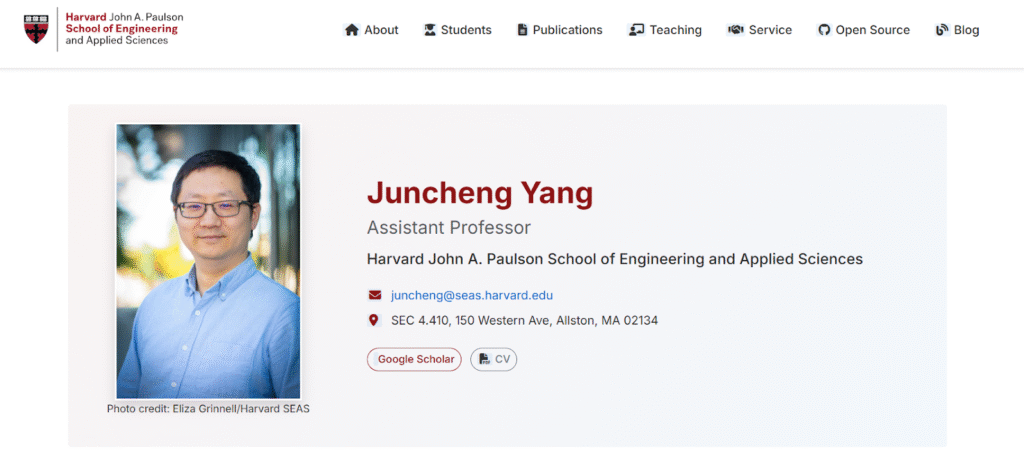
The collaboration becomes even more notable when looking at Yang’s background. Juncheng Yang is one of the most decorated young researchers in modern systems engineering. His track record includes:
a. PhD (Doctorate degree) from Carnegie Mellon University,
b. Postdoctoral work at Amazon Web Services,
c. Research scientist role at Snowflake, and
d. Internships at Twitter and Cloudflare.
His research has already influenced real-world systems used across major technology companies. Notably:
a. His S3-FIFO caching algorithm runs inside Google infrastructure,
b. His SIEVE caching work won Best Paper at the NSDI 2024, and

c. The algorithm has been implemented in 60+ open-source libraries across 18 programming languages.
Yang has also received the ACM SIGOPS Dennis M. Ritchie Doctoral Dissertation Award, one of the highest honors in operating systems research.

In short, this is not a typical industry partnership, it is top-tier academic systems research entering the decentralized AI ecosystem.
How the Chutes Community Can Participate
To help gather the data required for large-scale validation, Chutes has launched an optional research participation program.
Users who opt in will allow their inference requests to be included in the research dataset can do so through http://llm.chutes.ai
Participants receive a 25% discount on usage, this includes 25% off usage pricing for PAYGO users and 25% reduction applied to monthly or 4-hour quotas for Subscription users:
However, it is important to note that users who opt-in agree to allow their prompts and responses to be recorded for research purposes.
Why This Matters for Bittensor
The significance of this collaboration goes beyond a single algorithm as it highlights a shift in how decentralized infrastructure is perceived.
Instead of being viewed purely as experimental crypto technology, platforms like Bittensor are starting to attract serious academic research.
The reason isn’t ideology, it’s utility.
Chutes offers something traditional labs often lack: massive real-world inference traffic across a distributed network.
For researchers studying system efficiency, that environment is invaluable.
A New Meeting Point for AI Research and Decentralized Infrastructure
The collaboration between Harvard University and Chutes AI represents more than just an optimization experiment. It marks a moment where academic research and decentralized AI infrastructure begin to intersect in meaningful ways.
If Yang’s prefix caching algorithm delivers the expected gains, the implications could be significant:
a. Faster inference across the Chutes platform,
b. Lower hardware requirements for AI serving, and
c. Reduced costs for developers using the network.
And potentially, a new model for how large-scale AI infrastructure evolves. Not inside a hyperscaler’s data center, but across a global network of distributed compute.



Be the first to comment