
There’s a specific mental switch that happens when you’ve spent enough time in Bitcoin.
And once you’ve made that switch, Bittensor doesn’t feel confusing anymore; it feels inevitable.
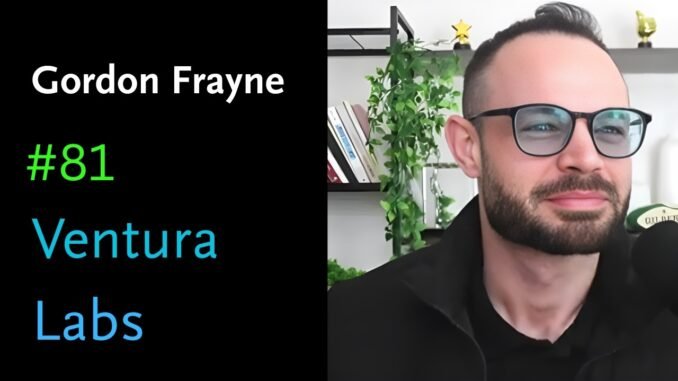
That’s basically what Gordon Frayne is saying in his recent appearance on the Ventura Labs podcast (watch below): Bitcoin teaches you how to think in scarce assets. And that mindset maps almost perfectly onto TAO and subnet alpha tokens.
The Big Synergy: Thinking in Fixed Supply
Gordon explains it plainly:
Bitcoin people “click” with Bittensor faster because they already understand:
- fixed supply
- scarcity-driven tokenomics
- long-term accumulation mindset
So when they hear “TAO is capped at 21M” they immediately understand what that means.
And when they learn subnet alpha tokens also have their own scarcity mechanics, the connection becomes obvious.
This is basically the Bitcoin journey: first you learn money, then you learn ecosystems, then you realize TAO is building something bigger than DeFi.
Why ERC-20 Tokens Feel Weak Compared to Subnets
This is the strongest point in the entire clip.
Gordon compares Ethereum’s ICO era to today’s subnet boom. But he says subnets are structurally better.
Why?
Because ERC-20 tokens are usually denominated in USD terms, and creators can inflate supply endlessly.
He’s basically saying:
- Anyone can spin up a token on Ethereum/Solana.
- Most of them are built for extraction.
- Token supply is often arbitrary and easily inflated.
- The “value” is often artificial.
But in Bittensor, subnet alpha tokens are denominated in TAO first, not dollars.
That means subnet competition isn’t just hype competition, it’s a TAO-denominated zero-sum market.
If one subnet grows, it’s not just printing value out of thin air. It’s literally pulling capital and attention away from other subnets. That’s a much harsher environment. And harsher environments produce stronger winners.
TAO as Proof of Useful Work
Gordon frames it as:
- Bitcoin = proof of work (hashpower to secure the network)
- Bittensor = proof of useful work (compute + intelligence)
The key message:
Instead of mining energy to secure blocks, miners are producing intelligence, models, outputs, and services.
That’s the whole Bittensor pitch.
Why “Accumulating TAO” Is the Real Game
This part is important because it’s what separates casual TAO traders from people who actually understand the ecosystem.
Gordon says the winners will be people who stop thinking in dollars and start thinking like this:
- “How much TAO do I own?”
- “How much TAO can I accumulate over time?”
- “Can subnets outperform TAO so I can stack more TAO?”
This is exactly the Bitcoin mindset:
I want 0.1 BTC… 0.5 BTC… 1 BTC…
Now it becomes:
I want more TAO.
That’s the paradigm shift.
The Subnet Trifecta
When he talks about why subnets are gaining traction, he explains it as a three-part opportunity:
1) Staking Yield
Subnets are giving crazy APYs (30% to 150% in some cases). That alone is enough to pull TAO into them.
2) Outperformance vs TAO
If a subnet grows faster than TAO, you’re not just earning yield — you’re increasing your TAO position over time. That’s the “alpha” play.
3) TAO Price Appreciation
Even if TAO is volatile short term, if TAO goes back into $700+ and beyond, the entire ecosystem reprices upward.
So you’re stacking yield, growth, and macro upside. That’s why people are moving capital out of root and into subnets.
Why Liquidity Subnets Matter (Void, Cartha, Rubicon)
He also touches a major structural issue:
If Bittensor wants to scale, it needs liquidity coming in from Ethereum, Solana, Base, etc.
So subnets like:
- VoidAI (SN106)
- Cartha (SN35)
- Rubicon Bridge
are extremely important. They’re infrastructure subnets that act like capital pipelines. And if those pipelines expand, TAO becomes easier to access for the broader crypto market.
Dynamic TAO (dTAO): Not Perfect, But Net Positive
He admits dTAO is still early, but his position is clear:
Dynamic TAO has created a new market model that feels like decentralized private equity.
Instead of needing to be a VC to invest in early-stage AI startups, subnets let anyone participate.
Not all subnets will win. Some will rug. Some will die. But the winners will become massive. That’s the bet.
His Investing Style: Not Trading, Conviction Allocations
Gordon says he is not a day trader.
He prefers:
- research a subnet deeply
- allocate long-term
- earn staking yield
- let winners compound
That’s also a very “Bitcoin-style” approach.
Enjoyed this article? Join our newsletter
Get the latest Bittensor & TAO ecosystem news straight to your inbox.
We respect your privacy. Unsubscribe anytime.


Be the first to comment