

Every now and then, a tool quietly appears in the Bittensor ecosystem and immediately solves a problem everyone feels but cannot quite articulate. That is the story of TAO Galaxy.
In a video chat (see below) with Gordon Frayne, the founder of TAO Galaxy, Allan walked through how a personal project meant to help him understand subnets has grown into one of the most promising intelligence tools in the Bittensor world. The discussion was honest and refreshing, especially for people who still find subnets overwhelming.
The chat explains why TAO Galaxy is quickly becoming the front door to Bittensor for both retail and institutional investors.
How TAO Galaxy First Took Shape
Allan describes himself as a financial engineer who spent years in traditional institutions as a quantitative analyst. He entered crypto through speculation, traded for a while, and later began exploring the underlying technology. His early skepticism faded once he discovered Bittensor in late 2023.
The attraction was immediate: A network that rewards intelligence work, invites anyone in the world to contribute, and turns forecasting and computation into an open-marketplace felt radically different from everything he had seen in finance.
But once he began mining and exploring subnets, another reality became clear. Understanding what each subnet actually does is extremely difficult, technical documents are scattered across GitHub, Discord updates are hard to follow, and most investors cannot digest the information flow.
TAO Galaxy began with one simple aim; Make sense of the ecosystem visually and intuitively, no buzzwords and absolutely no technical barriers. Just a clean, approachable map of the network.
A Visual Front Door To Bittensor
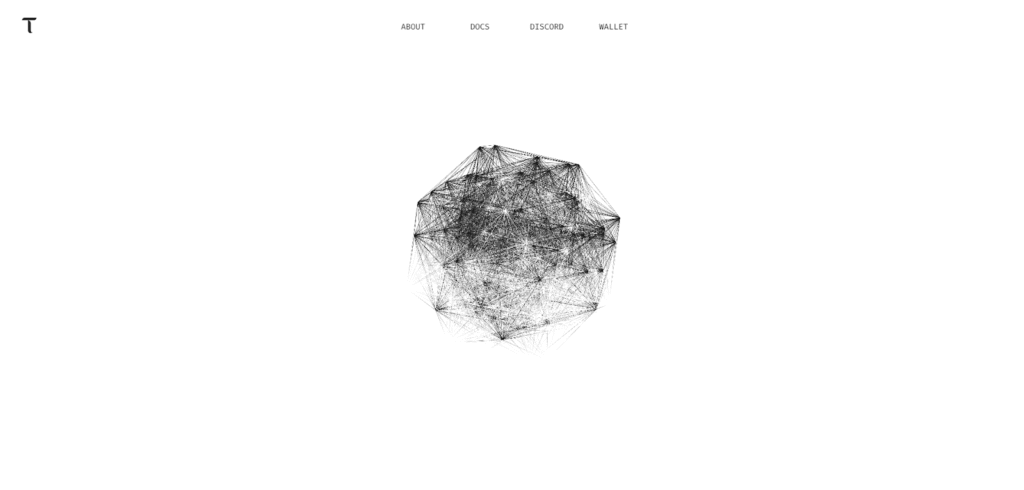
Gordon pointed out that most newcomers struggle with Bittensor’s official website because it does not show what is happening under the hood. The network is vast, but the information is buried.
TAO Galaxy solves this by giving users a visual map of the ecosystem. Subnets sit inside clear categories and visitors can see the broader structure at a glance. What started as a personal tool quickly attracted attention on social platforms and grew through community curiosity.
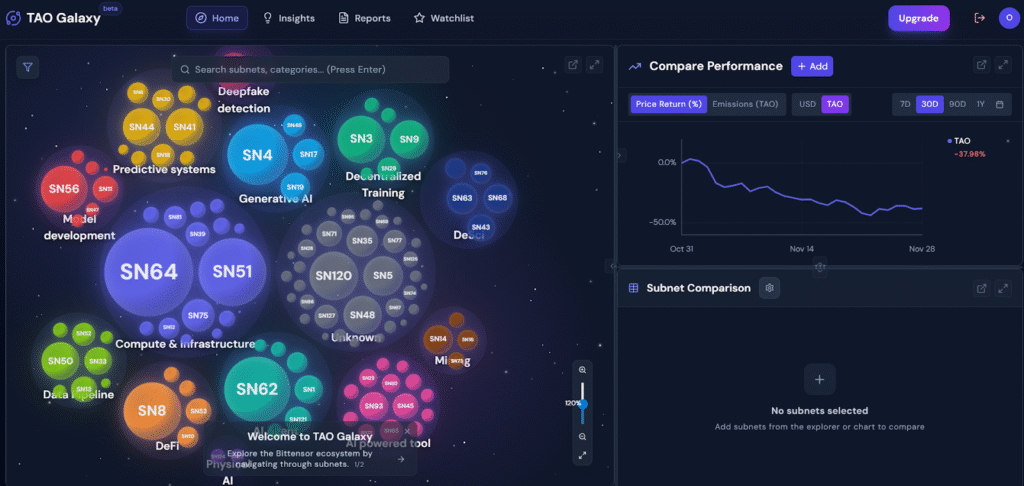
Allan emphasizes that the visual design was intentional. He wanted the experience to feel intuitive enough for beginners but still powerful enough for long term analysts.
Today, many users treat the map as their first touchpoint with subnets. It has become the entry-ramp that Bittensor never had.
Building A Complete Data Intelligence Layer Beyond Visuals
While the map draws people in, the real engine of TAO Galaxy sits behind the scenes. Allan explained how the platform now collects three major categories of data:
a. On-chain activity
b. Social signals from Discord and, soon, X (Formerly Twitter)
c. Development insights from GitHub
This information is then interpreted using AI-models that distill thousands of conversations and updates into a set of daily insights. These insights highlight sentiment, impact, and key events around each subnet.
Allan is the first to admit the system is not perfect. He noted that he is currently the only person working on the project, and AI cannot always capture nuances, but the direction is clear. TAO Galaxy wants to connect every source of subnet activity and translate it into clean intelligence that anyone can understand.
Gordon compared this to a one-stop hub that offers investors a real-edge, Allan agreed. He also added that the long-term vision is to create an institutional grade data engine that standardizes how Bittensor is analyzed across the world.
The Next Evolution: Interpreting Incentive Mechanisms
One of the most important sections of the conversation centered on incentive mechanisms. Every subnet rewards miners in a very specific way, and those rules determine the actual product the subnet is creating.
The problem is that most people have no idea what their chosen subnet is truly incentivizing, even miners struggle to read the code. That disconnect creates room for misinterpretation and, in some cases, misaligned incentives.
Allan revealed that one of TAO Galaxy’s biggest upcoming features will decode the incentive mechanism of each subnet in plain language.
In a simplified manner, it will show:
a. What a subnet claims to reward,
b. What the code actually rewards, and
c. And how well those two things align.
This single feature could reshape the ecosystem. Transparency makes it harder to game emissions and helps investors avoid empty narratives.
The Missing Layer: A Soft-Landing For Miners
Gordon raised an important point, he submitted that mining is one of the most accessible paths into Bittensor, but very few tools help new miners understand where to begin. Some subnets require advanced skills and others have low-barriers to entry but produce strong returns.
Allan wants TAO Galaxy to fill this gap. He believes miners are the backbone of the network and they deserve clearer guidance.
He also hinted that future versions of the platform may include:
a. Mining difficulty indicators
b. Expected revenue ranges
c. Clear onboarding pathways
d. Subnet comparisons for miners
This, when live, could dramatically widen the pool of people who can participate in Bittensor.
Retail And Institutional Appeal
TAO Galaxy currently operates with a simple subscription model. Retail users get access to insights, comparisons, and the visual mapping system.
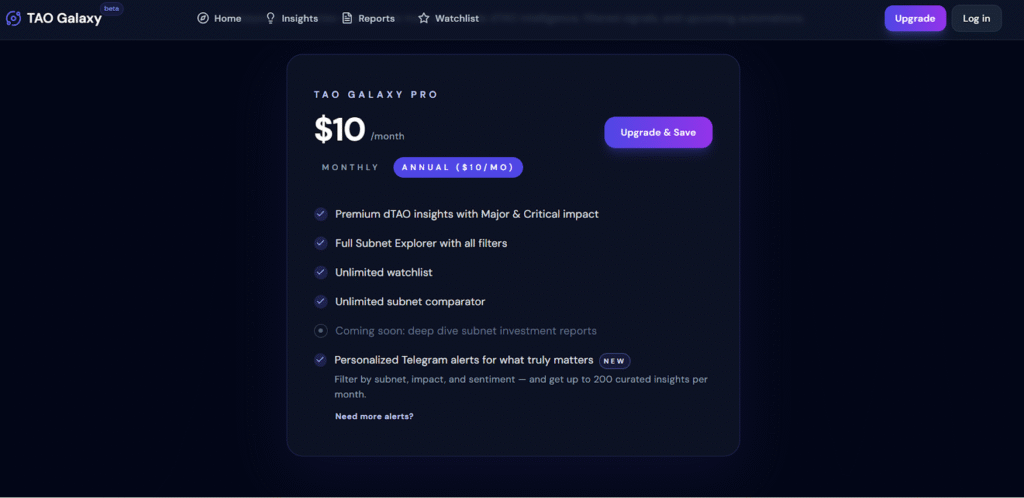
The next phase focuses on institutional clients. Allan explained that several Bittensor funds have already reached out, looking for deeper analytics, custom dashboards, and historical data streams that can power real-investment decisions.
Allan sees TAO Galaxy evolving into a dual-product, and one side stays open and accessible. The other becomes a premium data suite similar to PitchBook or a more specialized Bloomberg terminal.
The State Of Subnets, a Honest Assessment
Gordon closed the conversation by asking for Allan’s view of the subnet ecosystem today. The answer was surprisingly optimistic.
According to Allan, fundamentals have never been stronger. Many high quality teams are shipping, refining incentives, and preparing real-world products. He highlighted Synth (Subnet 50) as a standout example of measurable success.
Allan concluded by noting that Bittensor is early and subnets are even earlier. He also acknowledged the fact that most of the subnets will not survive, but the ones that do could become foundational infrastructure for intelligence markets.
Final Thoughts
TAO Galaxy is still young, but it reflects a larger shift happening across the ecosystem. Bittensor is no longer just for developers. Analysts, investors, quant researchers, and everyday learners now have tools that lower the barrier to participation.
TAO Galaxy is creating clarity where there used to be noise, and it is giving the subnet economy a structure that feels understandable to the average person. As Gordon noted during the conversation, TAO Galaxy is becoming one of the most important tools for discovery, context, and investor confidence. And Allan’s roadmap suggests the project is still in its early chapters.
Enjoyed this article? Join our newsletter
Get the latest Bittensor & TAO ecosystem news straight to your inbox.
We respect your privacy. Unsubscribe anytime.
Be the first to comment