
Decentralized AI has spent years proving that distributed systems can train models competitively. What has been harder to demonstrate is how those models translate into real-world utility.
In a live video chat (watch below), Gordon Frayne sat down with Max Sebti, co-founder of Score (grounded on Subnet 44 on Bittensor), to unpack how one of Bittensor’s most visible subnets is evolving beyond niche use cases and into a general-purpose vision AI platform.
The discussion traced Sebti’s path from early Bitcoin mining to decentralized AI, Score’s shift from sports analytics to industrial vision, and the launch of Manako, an agent-driven interface designed to make computer vision accessible to developers and enterprises alike.
A Founder’s Path Into Decentralized AI
Sebti’s journey into Bittensor did not begin with AI research labs, it started with entrepreneurship. He described launching his first company in 2016, mining Bitcoin using renewable energy, and gradually becoming immersed in the ethos of decentralization.
While that initial venture taught him the mechanics of infrastructure, it also clarified where his strengths lay. “I realized pretty quickly that I was more of a product and go to market person than a data center builder,” Sebti told Frayne.
That realization led him through several Web3 projects before landing at the intersection of AI and crypto. At Human Protocol, he worked on large-scale data annotation using tokenized labor, processing billions of tasks per month. The experience introduced him to collective intelligence systems and incentive-driven coordination.
Eventually, Sebti co-founded CrunchDAO, a decentralized community of machine learning engineers supplying models to hedge funds and institutions. But it was Bittensor that felt like a convergence point.
“From a technical perspective and an ethos perspective, Bittensor was the closest thing to what I had been looking for since my early Bitcoin days,” he said.
Why Score Started With Sports
Score’s earliest focus was sports analytics, particularly football, and the choice was pragmatic. Sebti and his co-founders had strong industry connections and believed sports offered a clear path to early traction. Cameras were everywhere, data was abundant, and teams were already paying for insights.
But as Frayne noted, Score did not stay narrow for long. “You’ve evolved from a very specific sports use case into something closer to a general purpose decentralized computer vision subnet,” Frayne said. “What drove that shift?”
The answer, according to Sebti, was exposure to Bittensor itself. “When you start building on Bittensor, you realize you’re not just solving one problem,” he explained. “You’re leveraging a global pool of brilliant contributors, compute, and capital. It almost becomes a responsibility to be more ambitious.”
Sports became a proving ground rather than a destination.
Redefining Vision AI Beyond Bounding Boxes
A central theme of the conversation was Score’s definition of vision AI. Sebti pushed back against the idea that computer vision is limited to object detection or segmentation models.
“Vision AI is the bridge between very smart models and the real world,” he said. “If you want AI systems to act, not just predict, they need to understand what they see.” That framing positions Score as more than a model provider.
The subnet aims to support systems that:
a. Interpret visual environments,
b. Apply policies and constraints, and
c. Trigger actions in physical or operational workflows.

Frayne summarized it as turning passive cameras into intelligent agents, a characterization Sebti embraced. “Our tagline is making cameras intelligent,” Sebti said. “Images or video become inputs to systems that can reason and act.”
Why Decentralization Changes the Game
When asked how Score competes with centralized players like Tesla or traditional computer vision vendors, Sebti pointed to speed and adaptability.
“Nothing beats the pace of execution on Bittensor,” he said. “Subnets reach state-of-the-art in weeks or months, not years.”
Because miners are economically incentivized to improve performance, development cycles compress dramatically. Feedback loops shorten, experimentation accelerates, and niche problems become economically viable to solve.
Frayne highlighted how that dynamic enabled Score to move quickly across domains, from football to manufacturing, agriculture, gas stations, and retail.
Sebti agreed, noting that many of the most promising use cases are not glamorous. “The biggest opportunities are boring businesses,” he said. “Manufacturing, forecourts, logistics. These places operate 24/7 (everyday), at massive scale, and have clear economic incentives to adopt vision AI.”
Introducing Manako: Vision AI as an Agentic Interface
The most forward looking part of the discussion centered on Manako, Score’s upcoming product layer built on top of the subnet.
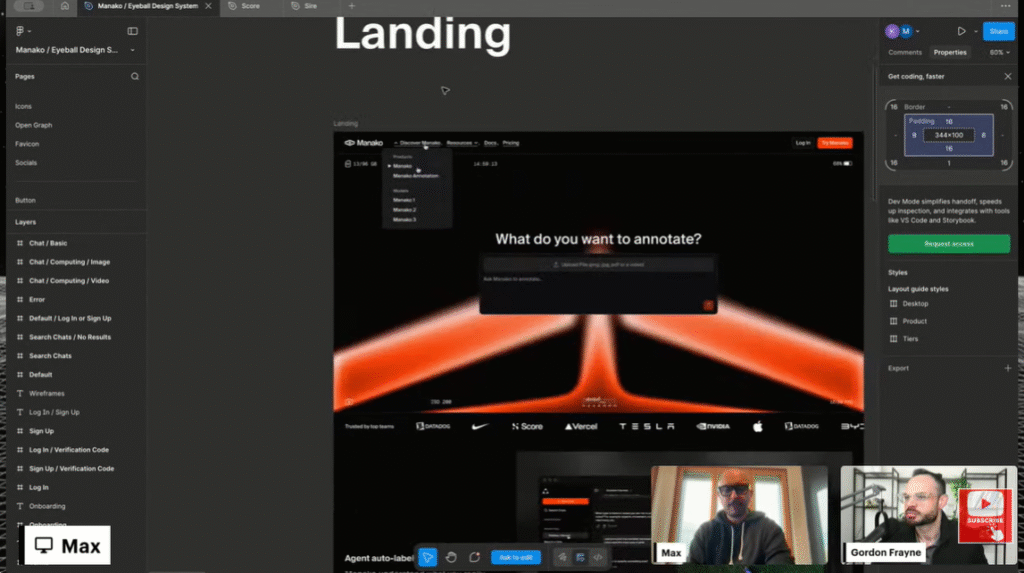
Sebti described Manako as a chat-driven, goal-oriented interface where users can upload images or video and specify what they want to achieve, in plain language.
Rather than receiving raw annotations, users interact with an agent that:
a. Frames the problem,
b. Selects or creates the right vision models,
c. Builds pipelines automatically, and
d. Outputs actionable results or integrations.
Frayne offered a concrete example. “You could upload a ten-minute football clip and ask how far a player ran during that segment,” he said. “That’s exactly it,” Sebti replied. “The system builds the tracker, runs the model, and delivers the output end-to-end.”
Manako is designed to appeal to developers first, but Sebti emphasized that its audience is broader. “Most of our end users are Web2,” he said. “They don’t care whether we’re paying AWS or a Bittensor subnet. They just want results.”
How Value Flows Back to the Subnet
Despite the focus on user experience, Score’s architecture remains tightly coupled to Bittensor. Manako would monetize access through a credit-based system. Revenue from enterprise and developer usage ultimately flows back to the subnet, which continues to function as a model factory.
“If Manako makes money, the subnet makes money,” Sebti said. “Manako is just a way to sell subnet output.”
Frayne noted that over time, this structure is intended to support value accrual to the subnet’s ‘$ALPHA’ token as adoption grows.
Sebti agreed, emphasizing that product quality, not emission management, is the primary responsibility of subnet builders.
“Build something meaningful,” he said. “Be transparent. The community will take care of the rest.”
Looking Ahead
Score plans to expand its task set, launch Manako publicly in early 2026, and target more strategic sectors such as manufacturing, loss prevention, and agriculture.
Sebti was candid about ambition. “Our goal is to build something that gives back to Bittensor at the same scale we’ve benefited from it,” he said.
For Frayne, the conversation highlighted a broader shift within decentralized AI. This is no longer just about proving that open systems can train models. It is about building products that operate in the real world, generate revenue, and close the loop between decentralized infrastructure and practical deployment.As Score scales, it may offer a blueprint for how decentralized AI moves from theory to impact.


Be the first to comment